Map of England showing where the Malinowski arms are recorded
The Malinowski arms were recorded in Warwick, c. 1620.
Warwickshire lay in the middle of England, and its landed families were spread evenly across it rather than gathered in one corner. A great many held a single manor each, and each of those holdings brought its own claim to arms.
This is where the arms were entered in the register. Families often moved to other parts of the country, so the same name can turn up in more than one region.
The body that granted and recorded arms in England in this period.
James VI and I
Sovereign of the period
James VI and I
1603–1625
Reigning in England when the Malinowski arms are first recorded.
How Arms Worked in England
English heraldry allowed arms to be shared by all legitimate descendants of the original owner. These symbols were treated as personal property that moved through the generations to all children. While the eldest son kept the original design, other family members could use the same shield without needing to change it or register their own unique versions.
Granting authority
The College of Arms in London has regulated the use of coats of arms throughout England and Wales since 1484.
How they got arms
Families typically obtained their coats of arms through a formal grant from the Crown or by proving their ancient right to them.
Where arms were recorded
All official coats of arms are recorded in the registers kept at the College of Arms, which date back to the fifteenth century.
The family's standing
Recorded among the armigerous families of Warwick.
Origin & History of the Malinowski Family in England
The surname Malinowski is traditionally of Polish origin, derived from the word "malina," which means raspberry. In its earliest form, the name likely served as a topographic identifier for a family living near a patch of raspberry bushes or as a descriptive nickname for a person with a ruddy complexion. While the name is deeply rooted in the Slavic linguistic tradition, the presence of individuals bearing this name in Warwick by 1620 suggests a fascinating period of early migration and cultural integration. During the seventeenth century, travelers and merchants from Central and Eastern Europe frequently moved across the continent for trade and religious reasons. The appearance of the Malinowski family in an English town like Warwick at this time indicates that they were part of a small but significant wave of continental settlers who brought their unique heritage into the local community. By settling in this historic region, these early family members helped bridge the gap between their Slavic origins and the evolving social landscape of seventeenth-century England.
Malinowski Meaning & Related Branches
Root word
Malina
Derived from the Slavic word for raspberry.
This name
MalinowskiA habitational name for someone originating from a place named after raspberries.
also spelled
Malyn
Malyne
Malyns
Documented Sources
Sir Bernard Burke, The General Armory of England, Scotland, Ireland and Wales, London: Harrison & Sons, 1884
Dziadulewicz, Stanisław. Herbarz rodzin tatarskich w Polsce. 1929
Rymut, Kazimierz. Nazwiska Polaków: Słownik historyczno-etymologiczny. 1999
Warwickshire County Record Office, Quarter Sessions Records, 1600–1650
Digital archive packCoat of arms PNG, gold border print PDF, vector SVG and the certificate of authenticity. Sent to your email in minutes.


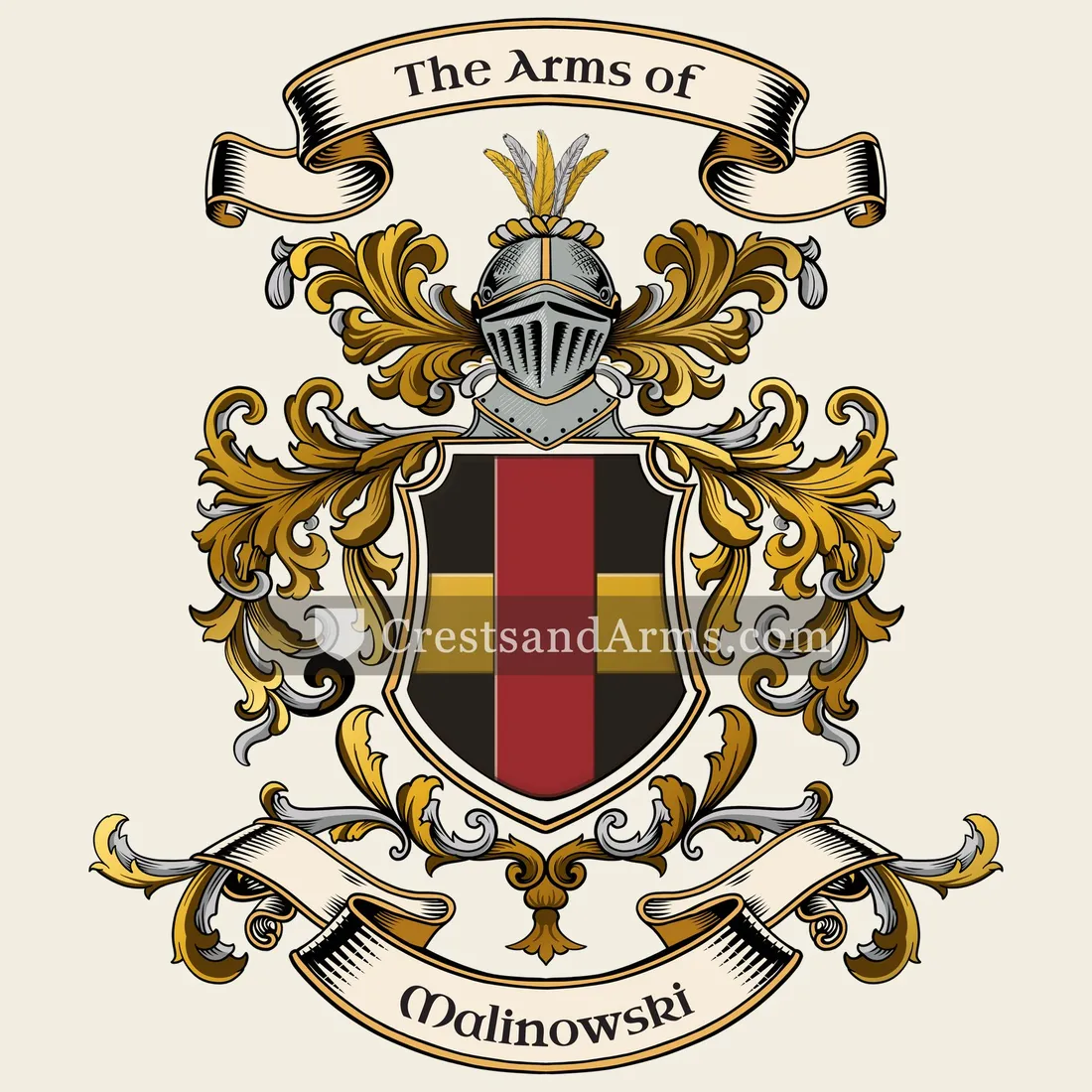
 fessThe military belt, and readiness to serve
 paleMilitary strength, and a fortified defence
 fessThe military belt, and readiness to serve
 paleMilitary strength, and a fortified defence