Map of England showing where the Malpass arms are recorded
The Malpass arms were recorded in Chester, c. 1620.
Cheshire was governed apart from the rest of England for much of its history, with its own courts and its own gentry. That separateness bred a strong local landed class, and landed families carried arms.
This is where the arms were entered in the register. Families often moved to other parts of the country, so the same name can turn up in more than one region.
The body that granted and recorded arms in England in this period.
James VI and I
Sovereign of the period
James VI and I
1603–1625
Reigning in England when the Malpass arms are first recorded.
How Arms Worked in England
English heraldry allowed arms to be shared by all legitimate descendants of the original owner. These symbols were treated as personal property that moved through the generations to all children. While the eldest son kept the original design, other family members could use the same shield without needing to change it or register their own unique versions.
Granting authority
The College of Arms in London has regulated the use of coats of arms throughout England and Wales since 1484.
How they got arms
Families typically obtained their coats of arms through a formal grant from the Crown or by proving their ancient right to them.
Where arms were recorded
All official coats of arms are recorded in the registers kept at the College of Arms, which date back to the fifteenth century.
The family's standing
Recorded among the armigerous families of Chester.
Origin & History of the Malpass Family in England
The surname Malpass originated as a locative name, meaning it was first used to identify people who lived in or came from the town of Malpas in Cheshire. The name itself is derived from the Old French words "mal" and "pas," which translate to "bad path" or "difficult passage." This likely referred to the challenging terrain of the local landscape during the medieval period. By the early 17th century, the family had firmly established roots in the city of Chester, which served as a major regional hub for trade and administration. Records from 1620 show that members of the Malpass family were active participants in the social and economic life of this historic walled city. Over time, the family name spread from these Cheshire origins to other parts of England, reflecting the movement of people across the country for work and family expansion.
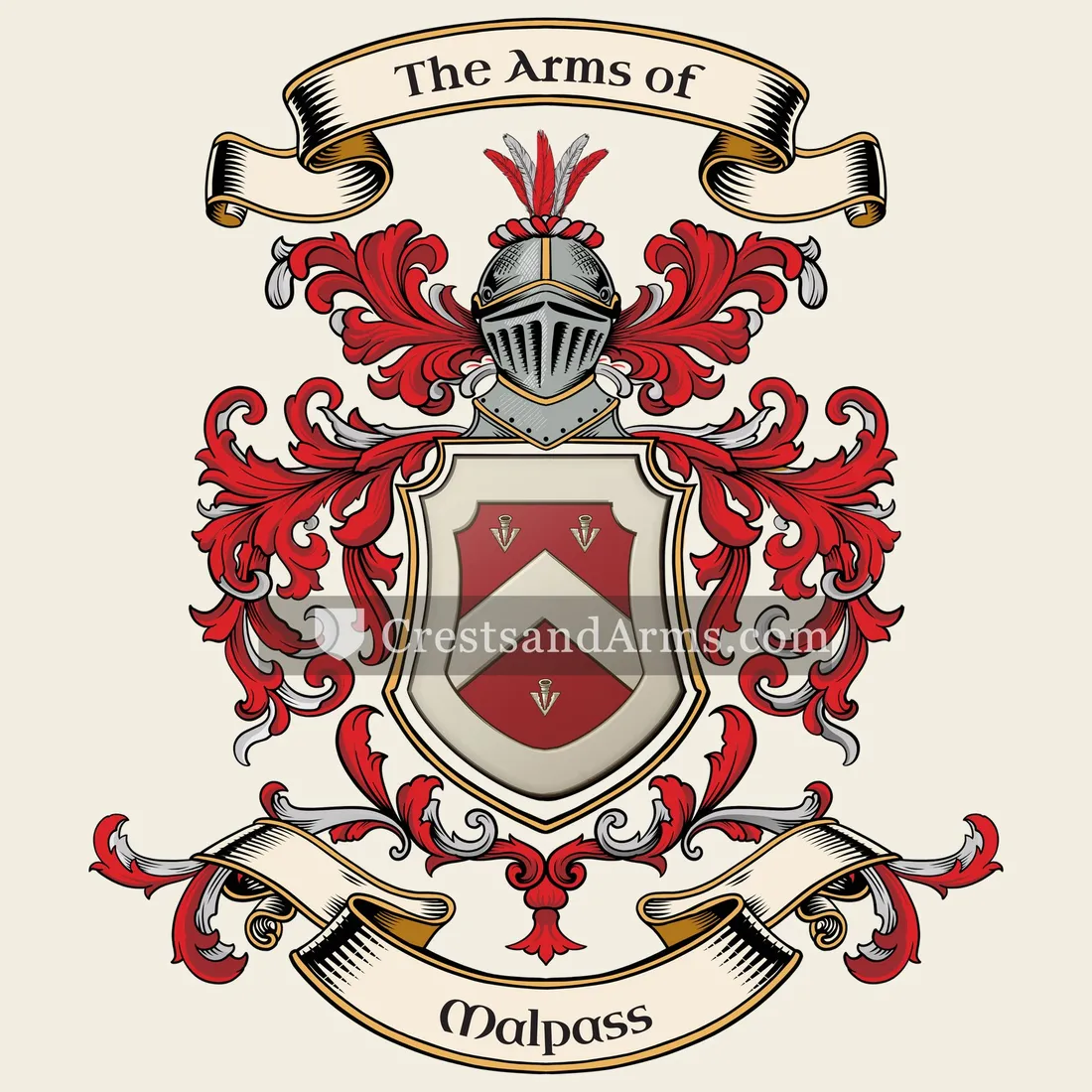
Meaning of the Malpass family crest colors & symbols
Symbols on this shield
chevronProtection, and faithful service completed
bordureA difference between branches of one family
arms pheon arrowheadReadiness for battle, and the broad arrow of the sovereign
Colours
Red (Gules)Means: Military strength
Silver (Argent)Means: Peace and sincerity
Historical info
Source
Sir Bernard Burke, The General Armory of England, Scotland, Ireland and Wales, London: Harrison & Sons, 1884
Blazon (the actual original written record)
“Gu. a chev. betw. three pheons, points down ar. a border of the last, charged with twelve roses of the first, a crescent for diff. Crest (confirmed to his descendant, JOHN MALPAS, Esq., of Rochestown, co. Dublin)—A demi lion ramp. gu. holding in the dexter paw a pheon point upwards ar”
DublinDundalk · Dublin, c. 1645
Digital archive packCoat of arms PNG, gold border print PDF, vector SVG and the certificate of authenticity. Sent to your email in minutes.
Map of Ireland showing where the Malpass arms are recorded
The Malpass arms were recorded in Dublin, c. 1645.
Dublin was the seat of government in Ireland and the place where grants were sought and recorded. Families with business at the castle or the courts settled nearby, and settling there put their arms on record.
This is where the arms were entered in the register. Families often moved to other parts of the country, so the same name can turn up in more than one region.
The body that granted and recorded arms in Ireland in this period.
Charles I of England
Sovereign of the period
Charles I of England
1625–1649
Reigning in England when the Malpass arms are first recorded.
How Arms Worked in Ireland
The Ulster King of Arms granted coats of arms to individuals who proved their social standing and good character. These symbols were typically inherited by all legitimate descendants of the original holder. If a family branch wanted a unique look, they could apply for a specific change to their design through the office to ensure their identity remained distinct.
Granting authority
The Ulster King of Arms acted as the official body that regulated and issued all coats of arms throughout Ireland.
How they got arms
Families obtained their arms through formal grants issued by the office after proving their eligibility and paying the required fees.
Where arms were recorded
All official grants were recorded in the registers held by the Ulster King of Arms starting from the year 1552.
The family's standing
Recorded among the armigerous families of Dublin.
Origin & History of the Malpass Family in Ireland
The Malpass family name first appears in the historical record of Dublin during the mid-seventeenth century, a period defined by significant political and social upheaval in Ireland. By 1645, members of the family were established within the city, likely participating in the urban life of a capital that was then a focal point for trade and administrative activity. While the name itself is of Anglo-Norman origin, its presence in Dublin suggests that these early settlers were part of the broader movement of families who integrated into the Irish landscape during the seventeenth century. These individuals often worked as merchants or tradespeople, contributing to the growing economy of the city as it recovered from the conflicts of the era. Over the following decades, the family became a part of the local fabric of Dublin, leaving behind records in parish registers and legal documents that trace their transition from newcomers to established residents of the city.
Malpass Meaning & Related Branches
Root word
mal pas
Old French for bad or difficult passage or path.
This name
MalpassA topographic name for someone who lived near a difficult or dangerous stretch of road.
also spelled
Malpasse
Documented Sources
Sir Bernard Burke, The General Armory of England, Scotland, Ireland and Wales, London: Harrison & Sons, 1884
Ekwall, Eilert. The Concise Oxford Dictionary of English Place-names. 1960
Reaney, P.H. A Dictionary of British Surnames. 1958
Cheshire Archives and Local Studies. Bishop's Transcripts for the Diocese of Chester. 1620
Digital archive packCoat of arms PNG, gold border print PDF, vector SVG and the certificate of authenticity. Sent to your email in minutes.


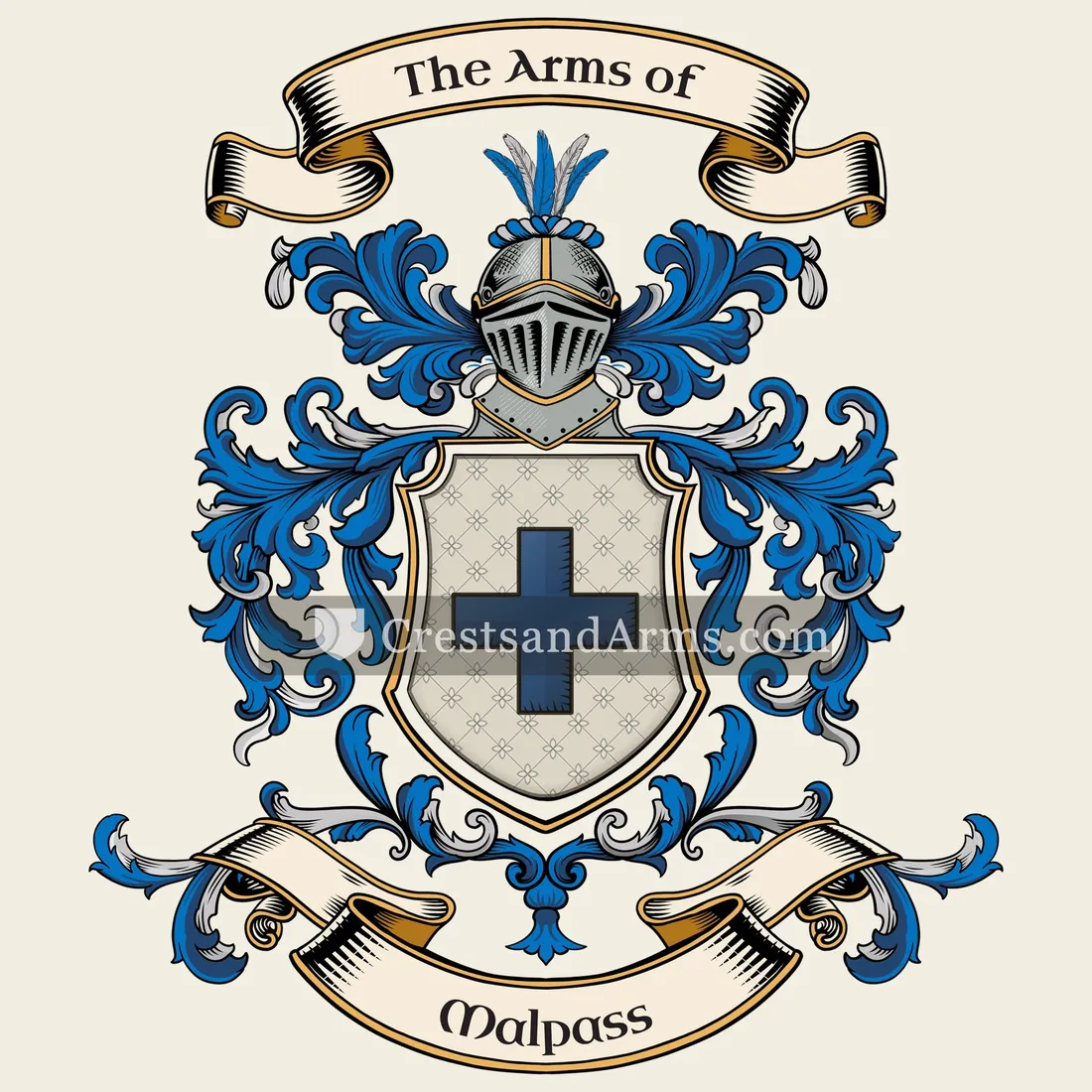
 cross symbolChristian faith and service
 cross symbolChristian faith and service


 chevronProtection, and faithful service completed
 bordureA difference between branches of one family
 arms pheon arrowheadReadiness for battle, and the broad arrow of the sovereign