Map of France showing where the Mami arms are recorded
The Mami arms were recorded in Ile-de-France, c. 1663.
Ile-de-France is the country around Paris, and proximity to the court mattered. Families who served the crown were rewarded with land near it, and land near the capital carried arms almost as a matter of course.
This is where the arms were entered in the register. Families often moved to other parts of the country, so the same name can turn up in more than one region.
The body that granted and recorded arms in France in this period.
Louis XIV of France
Sovereign of the period
Louis XIV of France
1643–1715
Reigning in France when the Mami arms are first recorded.
How Arms Worked in France
In France, a coat of arms was a mark of honor that passed down through the male line to all legitimate descendants. Families often used the same shield without changes to show their shared heritage. If a branch wanted to stand out, they could add a small mark to their shield to show their specific place in the family tree.
Granting authority
The Juge d'armes de France acted as the official authority that regulated and verified coats of arms across the country.
How they got arms
Families typically inherited their arms from ancestors, though they could also receive them through royal grants or by proving their noble status.
Where arms were recorded
Coats of arms were officially recorded in the Armorial Général de France, which began its main collection in the year 1696.
The family's standing
Recorded among the armigerous families of Ile-de-France.
Origin & History of the Mami Family in France
The family name Mami has roots that trace back to the heart of the French kingdom during the seventeenth century. Official records confirm that members of the family were established in the Île-de-France region by 1663. During this period, the area surrounding Paris was the center of political and social life under the reign of King Louis XIV. Families living in this region were often connected to the local agricultural economy or the growing administrative needs of the royal capital. The name likely evolved as a way to distinguish specific households within these rural or semi-urban communities. As the family grew, they became part of the long history of the French peasantry and middle class who helped shape the landscape of the Paris basin. Their presence in the region during the mid-1600s places them in the middle of a transformative era for French society and local record-keeping.
Meaning of the Mami family crest colors & symbols
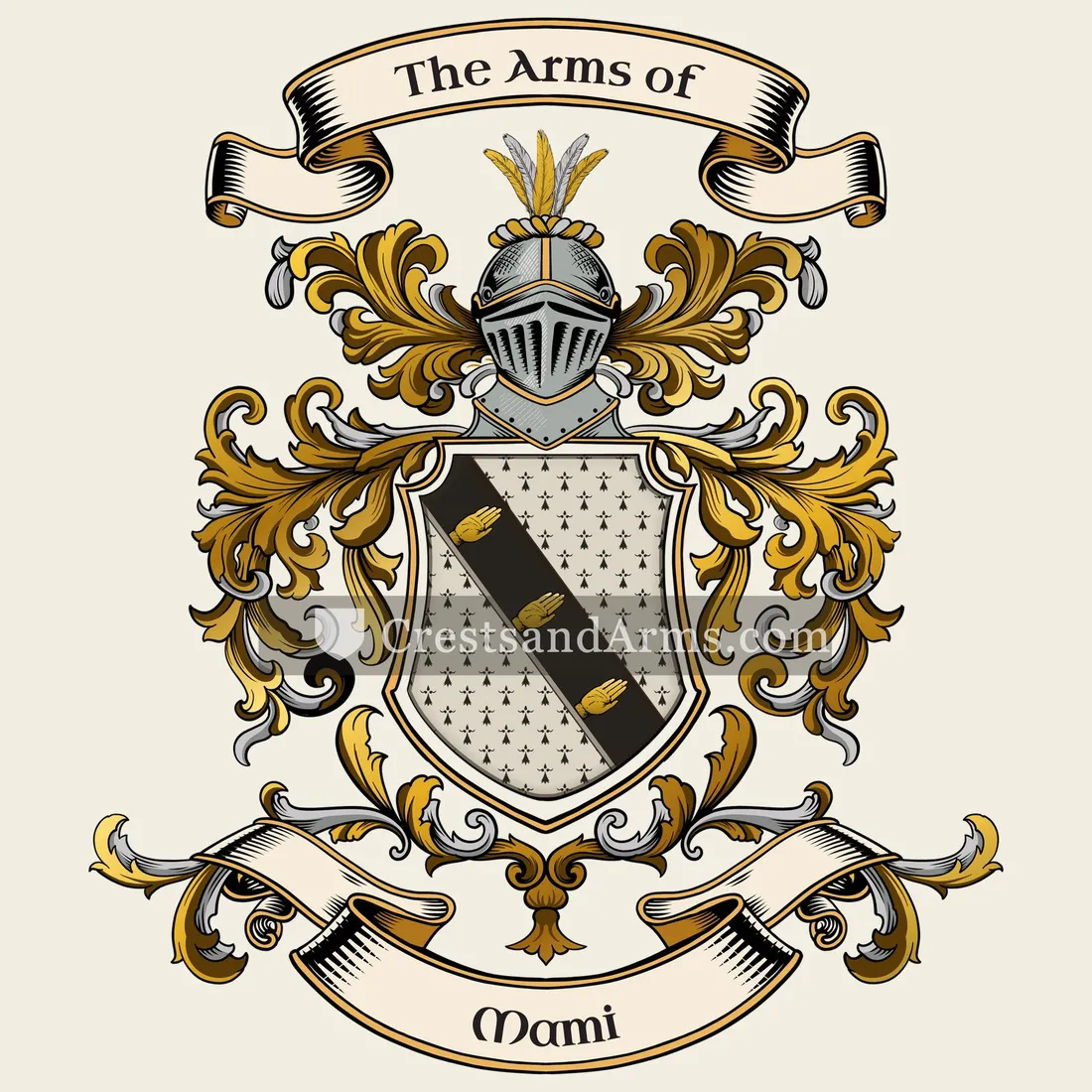
Symbols on this shield
bendDefence, and the scarf of a commander
handFaith, sincerity and justice
Colours
ErmineMeans: Dignity
Black (Sable)Means: Constancy
Gold (Or)Means: Generosity
Historical info
Source
Sir Bernard Burke, The General Armory of England, Scotland, Ireland and Wales, London: Harrison & Sons, 1884
Blazon (the actual original written record)
“Erm. on a bend sa. three dexter hands or”
BuckinghamBuckingham, c. 1620
Digital archive packCoat of arms PNG, gold border print PDF, vector SVG and the certificate of authenticity. Sent to your email in minutes.
Map of England showing where the Mami arms are recorded
The Mami arms were recorded in Buckingham, c. 1620.
Buckinghamshire was quiet farming country on the road out of London. Court officials and lawyers bought manors there within easy reach of the capital, and a manor was the usual reason to take arms.
This is where the arms were entered in the register. Families often moved to other parts of the country, so the same name can turn up in more than one region.
The body that granted and recorded arms in England in this period.
James VI and I
Sovereign of the period
James VI and I
1603–1625
Reigning in France when the Mami arms are first recorded.
How Arms Worked in England
English heraldry allowed arms to be shared by all legitimate descendants of the original owner. These symbols were treated as personal property that moved through the generations to all children. While the eldest son kept the original design, other family members could use the same shield without needing to change it or register their own unique versions.
Granting authority
The College of Arms in London has regulated the use of coats of arms throughout England and Wales since 1484.
How they got arms
Families typically obtained their coats of arms through a formal grant from the Crown or by proving their ancient right to them.
Where arms were recorded
All official coats of arms are recorded in the registers kept at the College of Arms, which date back to the fifteenth century.
The family's standing
Recorded among the armigerous families of Buckingham.
Origin & History of the Mami Family in England
The history of the Mami family in England finds its earliest documented roots in the town of Buckingham during the early seventeenth century. By 1620, members of the family were established residents of this market town, which served as a significant hub for trade and local governance in the region. During this era, families like the Mamis often integrated into the local economy through skilled crafts or agricultural management, contributing to the steady growth of Buckinghamshire. Their presence in official records from this period suggests they were part of the settled population that helped define the social fabric of the town. As the family navigated the challenges of the Stuart period, they remained connected to the local parish systems, which were the primary way people recorded their lives and legacies in the seventeenth century. This early foothold in Buckingham provides a clear starting point for understanding how the family established its place within the English landscape.
Meaning of the Mami family crest colors & symbols
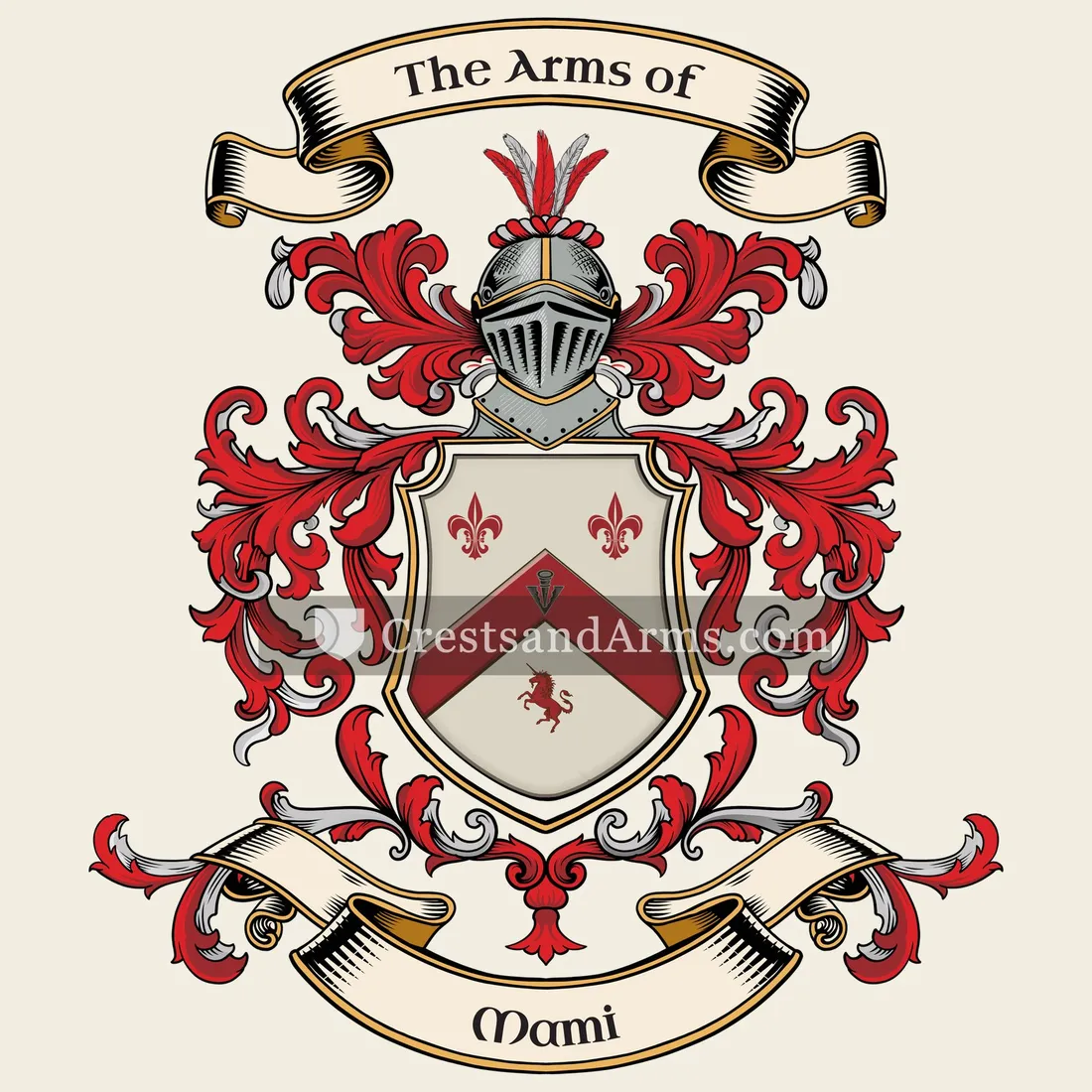
Symbols on this shield
chevronProtection, and faithful service completed
fleur de lisPurity, light, and the sixth son
unicornPurity, and extreme courage in defence of honour
arms pheon arrowheadReadiness for battle, and the broad arrow of the sovereign
Colours
Silver (Argent)Means: Peace and sincerity
Red (Gules)Means: Military strength
Black (Sable)Means: Constancy
Historical info
Source
Sir Bernard Burke, The General Armory of England, Scotland, Ireland and Wales, London: Harrison & Sons, 1884
Blazon (the actual original written record)
“Ar. on a chev. voided gu. betw. two fleurs-de-lis in chief and a unicorn's head couped in base a pheon sa”
EdinburghEdinburgh, c. 1685
Digital archive packCoat of arms PNG, gold border print PDF, vector SVG and the certificate of authenticity. Sent to your email in minutes.
Map of Scotland showing where the Mami arms are recorded
The Mami arms were recorded in Edinburgh, c. 1685.
Edinburgh was the seat of Scotland's government, its courts and its heralds. Families with business there settled nearby, and being close to where arms were recorded is exactly why so many of them appear.
This is where the arms were entered in the register. Families often moved to other parts of the country, so the same name can turn up in more than one region.
The body that granted and recorded arms in Scotland in this period.
Charles II of England
Sovereign of the period
Charles II of England
1660–1685
Reigning in France when the Mami arms are first recorded.
How Arms Worked in Scotland
Scottish heraldry is unique because it treats a coat of arms as a piece of personal property protected by law. Only one person can own a specific design at any given time. When a family grows, the head keeps the original shield while other relatives must apply for their own distinct version with slight changes to prove their specific identity.
Granting authority
The Court of the Lord Lyon acts as the official body that regulates and controls all heraldic matters throughout Scotland.
How they got arms
Individuals obtain a legal right to their arms through a formal petition process that confirms their identity and family connection.
Where arms were recorded
All valid coats of arms are officially entered into the Public Register of All Arms and Bearings starting from 1672.
The family's standing
Recorded among the armigerous families of Edinburgh.
Origin & History of the Mami Family in Scotland
The history of the Mami family in Scotland begins with documented records of individuals residing in Edinburgh during the year 1685. During this period, the city was a bustling center of trade and intellectual growth, often attracting merchants and skilled workers from across Europe. The presence of the Mami name in these early civic records suggests that the family was likely part of a small group of continental arrivals who integrated into the local urban economy. Because Edinburgh was a primary hub for legal and commercial activity, these early family members were likely involved in the city’s developing guilds or maritime commerce. While the name remains rare in Scottish historical registers, its appearance in the late seventeenth century highlights the diverse migration patterns that shaped the capital city long before the modern era.
Mami Meaning & Related Branches
Root word
Mamertus
Derived from the Roman god of war Mars.
This name
MamiA locative or patronymic surname originating from the saintly name Mamertus, often associated with the French region of Provence.
also spelled
Mayn
Man
Maine
Mayne
Mane
Documented Sources
J. B. Rietstap, Armorial Général, Gouda: G. B. van Goor Zonen, 1884–87
Archives nationales de France, Minutier central des notaires de Paris
Boudet, Jacques, Les noms de famille en France, 1977
Dauzat, Albert, Dictionnaire étymologique des noms de famille et prénoms de France, 1951
Digital archive packCoat of arms PNG, gold border print PDF, vector SVG and the certificate of authenticity. Sent to your email in minutes.


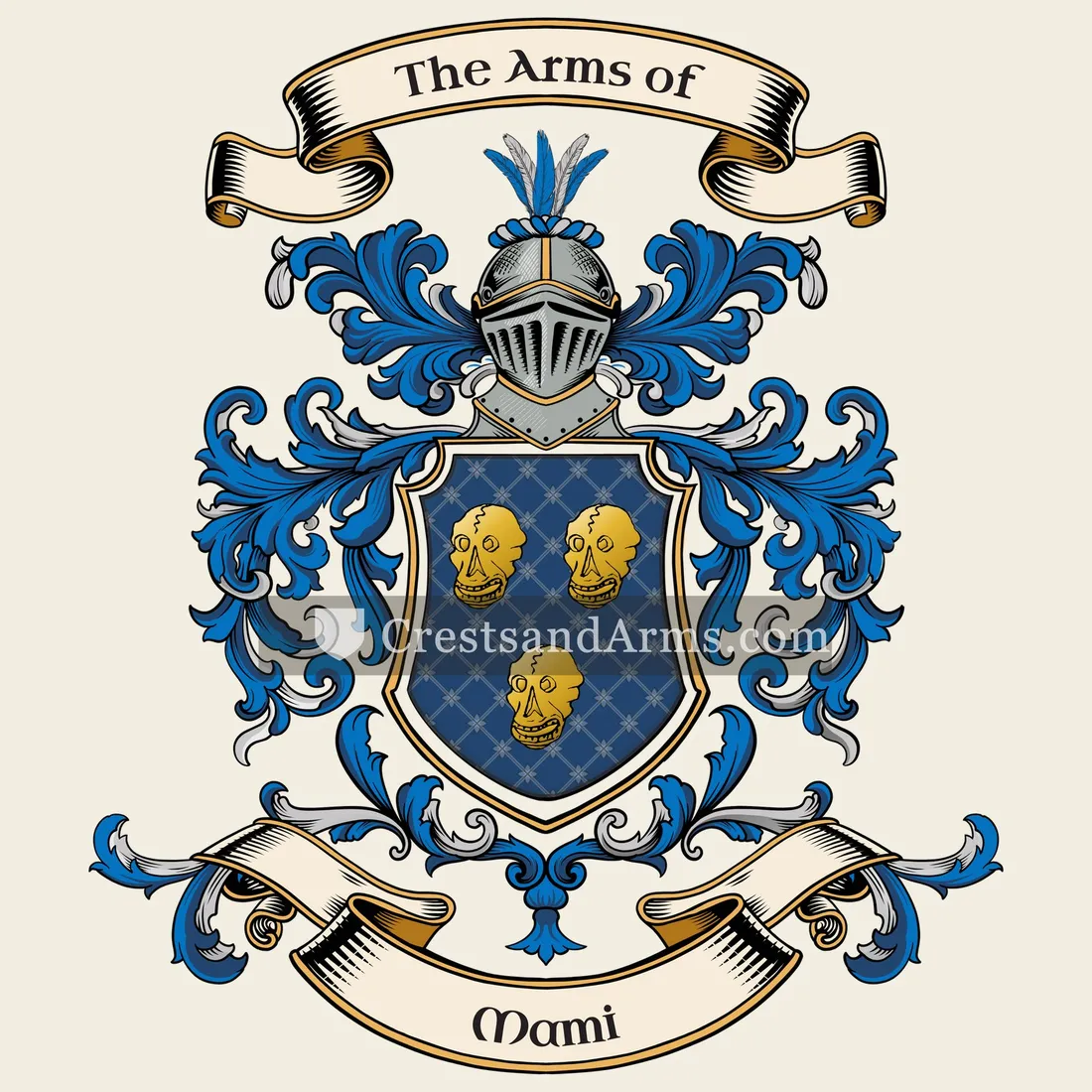
 skullMortality remembered, and courage in the face of death
 skullMortality remembered, and courage in the face of death


 bendDefence, and the scarf of a commander
 handFaith, sincerity and justice


 chevronProtection, and faithful service completed
 fleur de lisPurity, light, and the sixth son
 unicornPurity, and extreme courage in defence of honour
 arms pheon arrowheadReadiness for battle, and the broad arrow of the sovereign