Map of France showing where the Mannon arms are recorded
The Mannon arms were recorded in Paris, c. 1663.
This is where the arms were entered in the register. Families often moved to other parts of the country, so the same name can turn up in more than one region.
The body that granted and recorded arms in France in this period.
Louis XIV of France
Sovereign of the period
Louis XIV of France
1643–1715
Reigning in France when the Mannon arms are first recorded.
How Arms Worked in France
In France, a coat of arms was a mark of honor that passed down through the male line to all legitimate descendants. Families often used the same shield without changes to show their shared heritage. If a branch wanted to stand out, they could add a small mark to their shield to show their specific place in the family tree.
Granting authority
The Juge d'armes de France acted as the official authority that regulated and verified coats of arms across the country.
How they got arms
Families typically inherited their arms from ancestors, though they could also receive them through royal grants or by proving their noble status.
Where arms were recorded
Coats of arms were officially recorded in the Armorial Général de France, which began its main collection in the year 1696.
The family's standing
Recorded among the armigerous families of France.
Origin & History of the Mannon Family in France
The family name Mannon has roots that trace back to the vibrant streets of seventeenth-century Paris. By 1663, records confirm that members of the family were established residents within the city, a time when Paris was undergoing significant architectural and social expansion under the reign of King Louis XIV. The name likely evolved from regional naming traditions common in northern France, where surnames were often adapted from personal nicknames or specific geographic markers. As the family navigated life in the capital, they became part of the growing urban middle class that supported the city’s bustling trades and administrative functions. Their presence in Paris during this era suggests that the family was well-integrated into the social fabric of the time, contributing to the daily life and steady development of one of Europe’s most influential cities.
Mannon Meaning & Related Branches
Root word
Emmanuel
Hebrew for God is with us.
This name
MannonA diminutive form derived from the biblical name meaning God is with us.
also spelled
Mainon
Maynond
Mainond
Maynonn
Documented Sources
J. B. Rietstap, Armorial Général, Gouda: G. B. van Goor Zonen, 1884–87
Archives nationales de France, Minutier central des notaires de Paris
Boudon, Françoise, Système de la composition urbaine à Paris, 1977
Foisil, Madeleine, La vie quotidienne au temps de Louis XIV, 1980
Digital archive packCoat of arms PNG, gold border print PDF, vector SVG and the certificate of authenticity. Sent to your email in minutes.


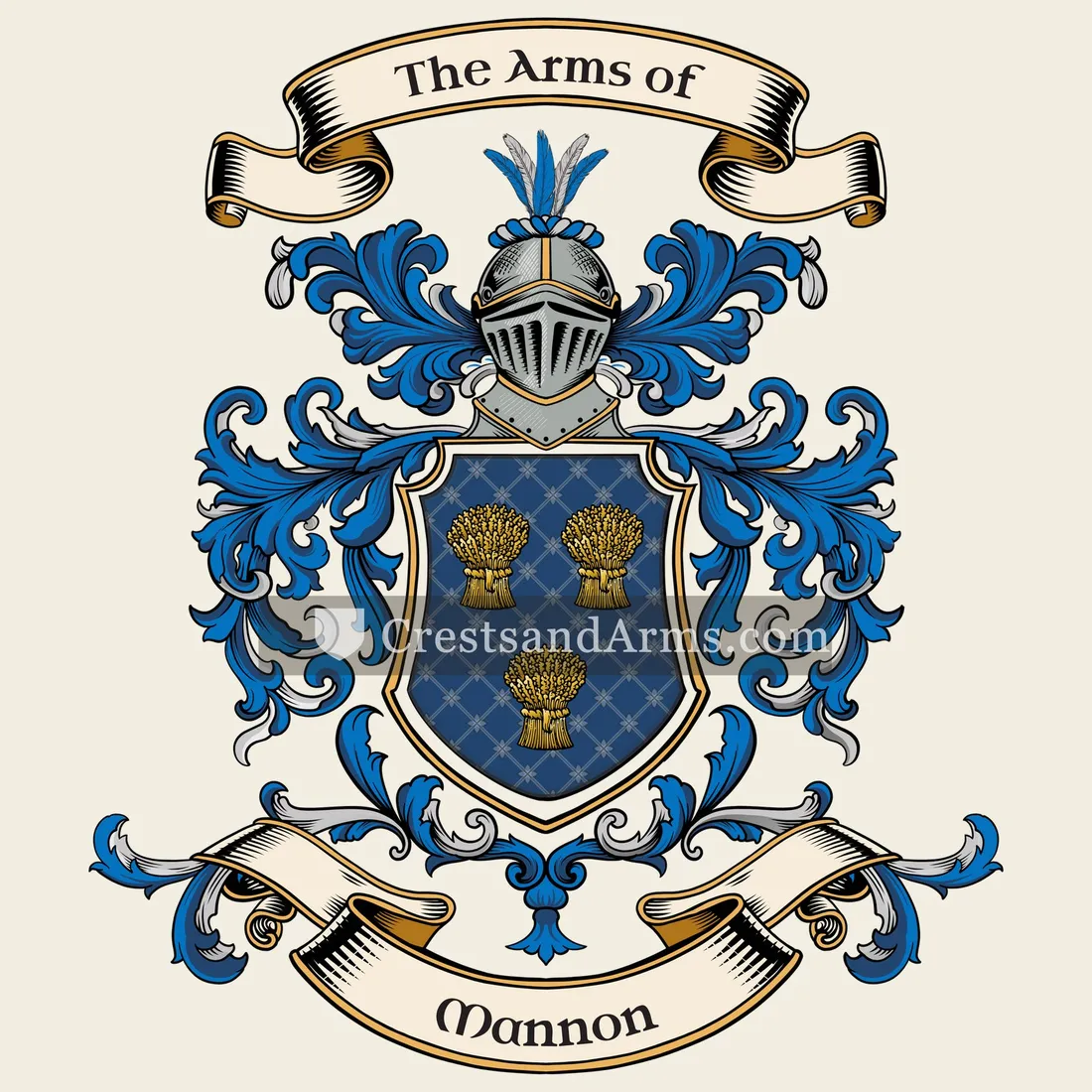
 wheatsheafPlenty, and the harvest of one's own labour
 wheatsheafPlenty, and the harvest of one's own labour