Map of France showing where the Marchand arms are recorded
The Marchand arms were recorded in France, c. 1663.
Arms such as these were typically recorded in Bretagne.
More families held coats of arms in Bretagne than anywhere else in France. The land was divided into many small estates rather than a few large ones, so far more households counted as gentry, and each needed a shield of its own to be told apart.
This is where the arms were entered in the register. Families often moved to other parts of the country, so the same name can turn up in more than one region.
The body that granted and recorded arms in France in this period.
Louis XIV of France
Sovereign of the period
Louis XIV of France
1643–1715
Reigning in France when the Marchand arms are first recorded.
How Arms Worked in France
In France, a coat of arms was a mark of honor that passed down through the male line to all legitimate descendants. Families often used the same shield without changes to show their shared heritage. If a branch wanted to stand out, they could add a small mark to their shield to show their specific place in the family tree.
Granting authority
The Juge d'armes de France acted as the official authority that regulated and verified coats of arms across the country.
How they got arms
Families typically inherited their arms from ancestors, though they could also receive them through royal grants or by proving their noble status.
Where arms were recorded
Coats of arms were officially recorded in the Armorial Général de France, which began its main collection in the year 1696.
The family's standing
Recorded among the armigerous families of France.
Origin & History of the Marchand Family in France
The surname Marchand is a classic occupational name that originated in medieval France, serving as a direct descriptor for those who worked as merchants or traders. During the Middle Ages, as local markets and trade routes expanded across the French countryside, individuals who bought and sold goods were often identified by their profession, eventually turning the title into a permanent family name. By the time the name appeared in the historical records of Bretagne in 1663, the Marchand family was already well-established within the social and economic fabric of the region. Families bearing this name were often central to the growth of towns, as their work required them to interact with diverse groups of people and manage the flow of essential supplies. This professional heritage suggests that early members of the family were likely literate, well-connected, and deeply involved in the local commerce that defined life in seventeenth-century France.
Coat of Arms & Family Crest Details
Symbols on this shield
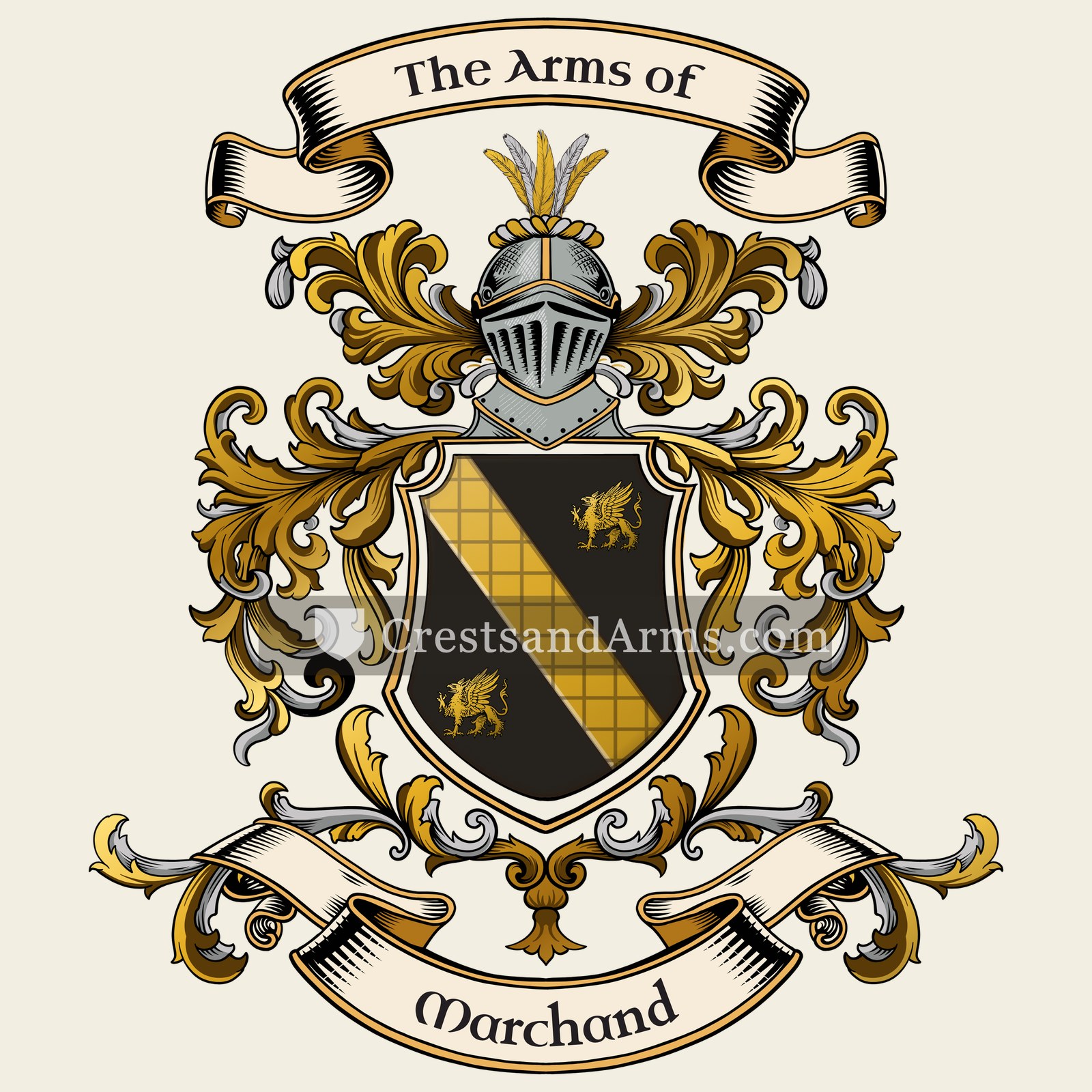
bendDefence, and the scarf of a commander
Colours
Black (Sable)Means: Constancy
Gold (Or)Means: Generosity
Historical info
Source
J. B. Rietstap, Armorial Général, Gouda: G. B. van Goor Zonen, 1884–87
Blazon (the actual original written record)
“De sa. à la bande d'or.”
SwitzerlandAubonne, c. 1745
Digital archive packCoat of arms PNG, gold border print PDF, vector SVG and the certificate of authenticity. Sent to your email in minutes.
Map of Switzerland showing where the Marchand arms are recorded
The Marchand arms were recorded in Aubonne, c. 1745.
This is where the arms were entered in the register. Families often moved to other parts of the country, so the same name can turn up in more than one region.
The body that granted and recorded arms in Switzerland in this period.
How Arms Worked in Switzerland
In Switzerland, coats of arms were not restricted to the nobility and were often adopted by common citizens and families. These symbols were passed down through generations to show family identity. When branches of a family grew, they often changed small details of the design to distinguish their own line from the original group.
Granting authority
Cantonal and civic authorities managed the use of coats of arms within their specific regions and local jurisdictions.
How they got arms
Families typically assumed their own coats of arms based on local custom rather than receiving them from a central monarch.
Where arms were recorded
Arms were recorded in various cantonal and civic registers starting from the fourteenth century throughout the Swiss region.
The family's standing
Recorded among the armigerous families of Switzerland.
Origin & History of the Marchand Family in Switzerland
The surname Marchand is deeply rooted in the French-speaking regions of Switzerland, where it historically identified individuals who worked as merchants or traders. By the mid-18th century, the family established a notable presence in the town of Aubonne, located in the canton of Vaud. Records from 1745 confirm that members of the Marchand family were active participants in the local community during this period. At that time, Aubonne was a center for regional commerce and agriculture, providing a stable environment for families to settle and grow. The name reflects the importance of trade in Swiss society, as families often adopted surnames based on their primary occupation to distinguish themselves within growing towns. Over generations, the Marchands became integrated into the social and economic fabric of the Vaud region, contributing to the development of their local parishes and the broader Swiss landscape.
Coat of Arms & Family Crest Details
Symbols on this shield
bendDefence, and the scarf of a commander
griffinValour and vigilance, guarding great treasure
Colours
Black (Sable)Means: Constancy
Gold (Or)Means: Generosity
Historical info
Source
Sir Bernard Burke, The General Armory of England, Scotland, Ireland and Wales, London: Harrison & Sons, 1884
Blazon (the actual original written record)
“Sa. a bend couped betw. two griffins segreant or”
BuckinghamBuckingham, c. 1582
Digital archive packCoat of arms PNG, gold border print PDF, vector SVG and the certificate of authenticity. Sent to your email in minutes.
Map of England showing where the Marchand arms are recorded
The Marchand arms were recorded in Buckingham, c. 1582.
Buckinghamshire was quiet farming country on the road out of London. Court officials and lawyers bought manors there within easy reach of the capital, and a manor was the usual reason to take arms.
This is where the arms were entered in the register. Families often moved to other parts of the country, so the same name can turn up in more than one region.
The body that granted and recorded arms in England in this period.
Elizabeth I of England
Sovereign of the period
Elizabeth I of England
1558–1603
Reigning in France when the Marchand arms are first recorded.
How Arms Worked in England
English heraldry allowed arms to be shared by all legitimate descendants of the original owner. These symbols were treated as personal property that moved through the generations to all children. While the eldest son kept the original design, other family members could use the same shield without needing to change it or register their own unique versions.
Granting authority
The College of Arms in London has regulated the use of coats of arms throughout England and Wales since 1484.
How they got arms
Families typically obtained their coats of arms through a formal grant from the Crown or by proving their ancient right to them.
Where arms were recorded
All official coats of arms are recorded in the registers kept at the College of Arms, which date back to the fifteenth century.
The family's standing
Recorded among the armigerous families of Buckingham.
Origin & History of the Marchand Family in England
The surname Marchand carries a history deeply rooted in the practical world of medieval trade and commerce. Derived from the Old French word for a merchant, the name was originally an occupational title given to those who traveled to buy and sell goods. While the name has strong continental origins, members of the family were firmly established in the English town of Buckingham by 1582. During this period, families with this name were often integrated into the local economy as tradespeople or skilled workers who helped sustain the growing market towns of the era. Their presence in Buckingham suggests that the family had successfully transitioned from their roots as itinerant traders to becoming settled members of the English community. By documenting their lives in parish registers and local legal records, these early individuals helped weave the name into the social fabric of rural England long before the industrial age transformed the country.
Related Branches & Arms
Root word
mercari
Latin verb meaning to trade or deal in goods.
This name
MarchandAn occupational surname for a merchant or a trader of goods.
also spelled
Marchant
Marshand
Marshon
Merchant
Marchaunt
Related arms
Baillysame arms
Agdesimilar arms
Clementisimilar arms
Marchantvariant spelling
Documented Sources
J. B. Rietstap, Armorial Général, Gouda: G. B. van Goor Zonen, 1884–87
Dauzat, Albert. Dictionnaire étymologique des noms de famille et prénoms de France. 1951
Morlet, Marie-Thérèse. Dictionnaire étymologique des noms de famille. 1991
Digital archive packCoat of arms PNG, gold border print PDF, vector SVG and the certificate of authenticity. Sent to your email in minutes.


 chevronProtection, and faithful service completed
 chevronProtection, and faithful service completed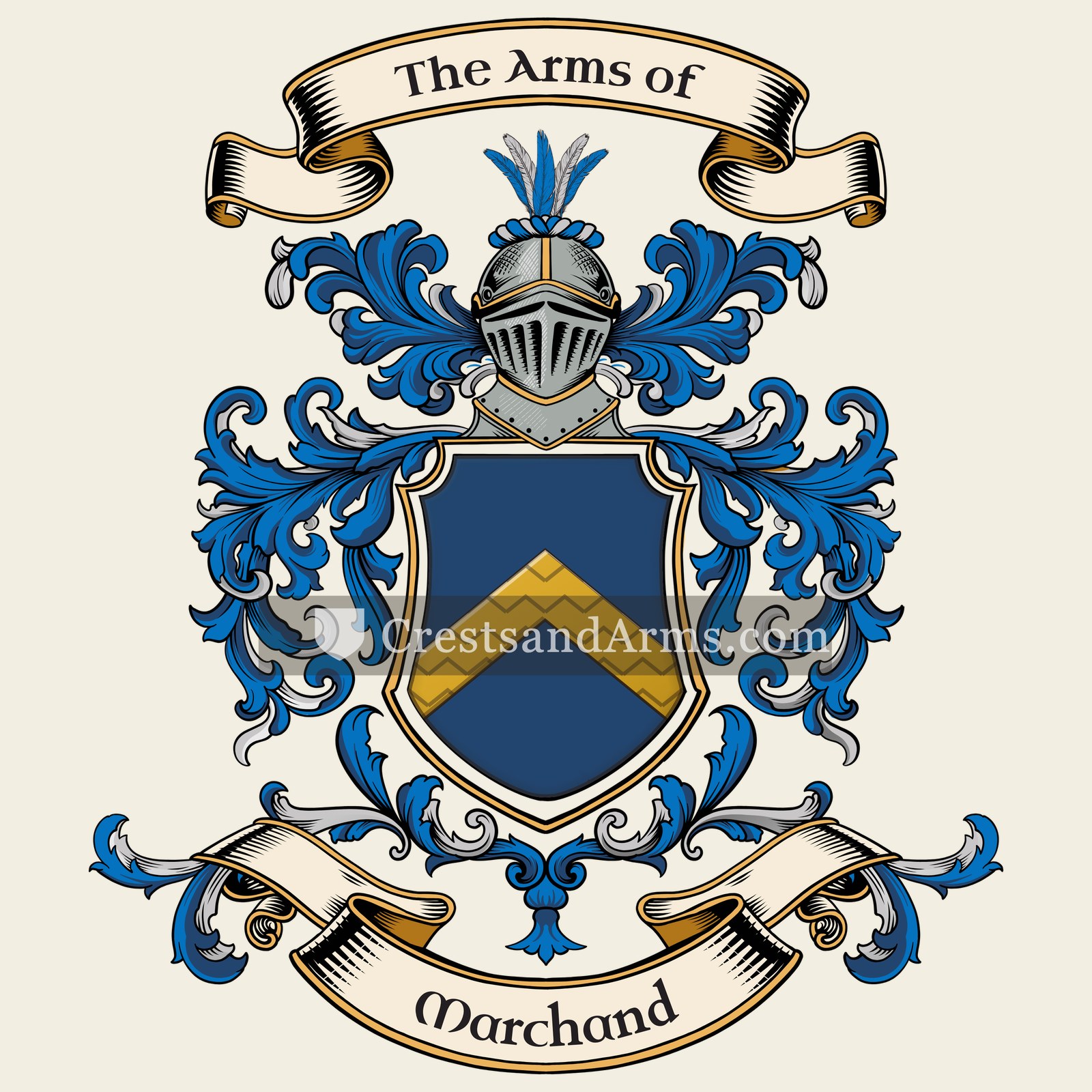


 bendDefence, and the scarf of a commander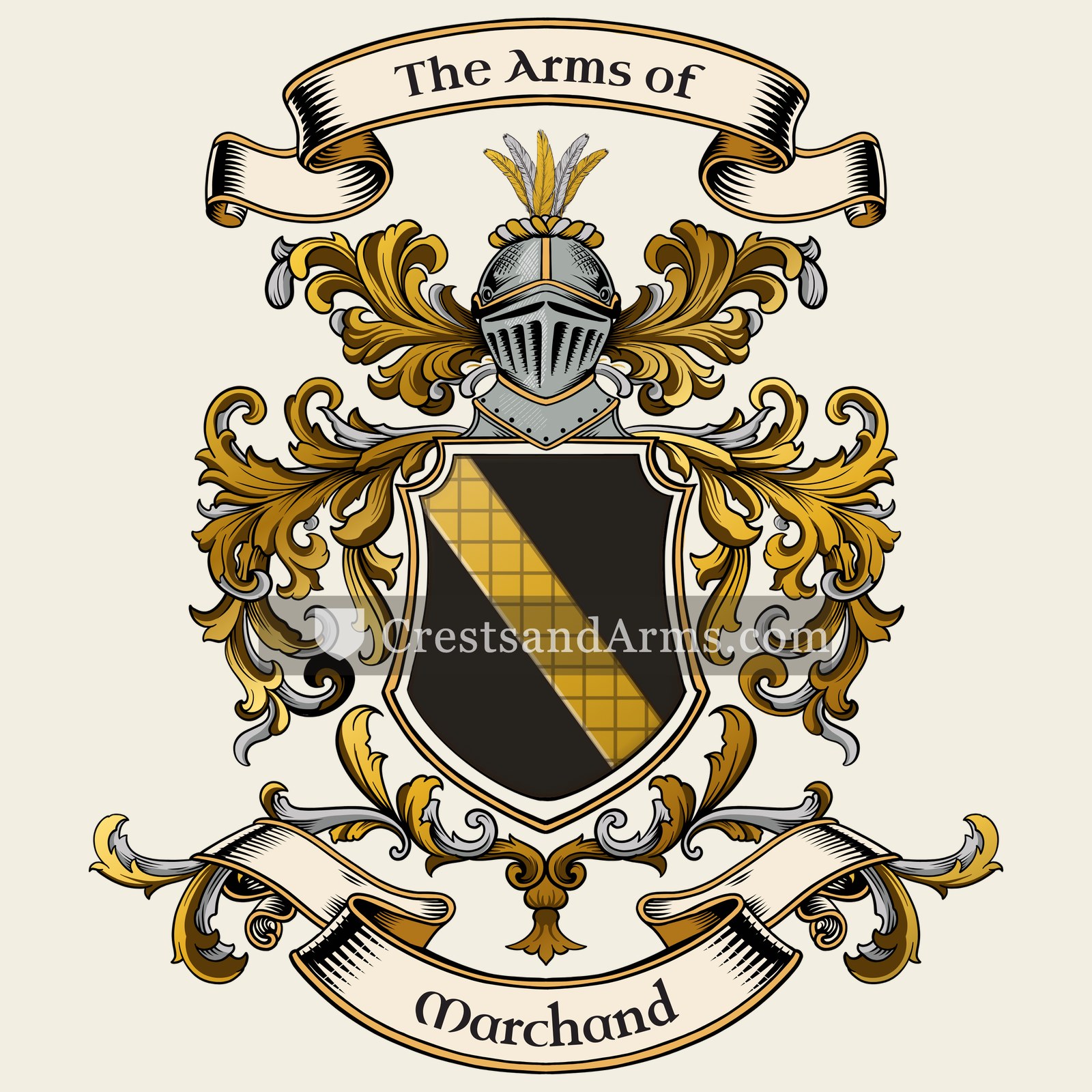

 griffinValour and vigilance, guarding great treasure