Map of Belgium showing where the Marche arms are recorded
The Marche arms were recorded in Flandre, c. 1663.
Flandre grew rich on cloth, and its towns were among the busiest in Europe. Merchant families bought land with their profits and took arms to go with it, so trade put as many names in the registers here as land did.
This is where the arms were entered in the register. Families often moved to other parts of the country, so the same name can turn up in more than one region.
The body that granted and recorded arms in Belgium in this period.
Philip IV of Spain
Sovereign of the period
Philip IV of Spain
1621–1665
Reigning in Belgium when the Marche arms are first recorded.
How Arms Worked in Belgium
In Belgium, a coat of arms is considered personal property that is passed down through the male line to legitimate descendants. Families often use the same shield design across generations to show their shared heritage. If a branch of the family wants to change the design, they must apply for an official update to their specific version of the arms.
Granting authority
The Conseil héraldique is the official body that regulates and approves all coats of arms in Belgium.
How they got arms
Families obtain their coats of arms through formal royal grants or by confirming their historical right to use existing designs.
Where arms were recorded
All approved coats of arms are officially recorded in the public registers of the Conseil héraldique since 1844.
The family's standing
Recorded among the armigerous families of Flandre.
Origin & History of the Marche Family in Belgium
The family name Marche has deep roots in the historical region of Flanders, where records confirm the presence of family members as early as 1663. During the seventeenth century, this area was a bustling center of trade and agriculture, which likely influenced the daily lives and social standing of the family. The name itself is often linked to the geography of the Low Countries, as it is derived from the French word for a borderland or a marketplace. Families living in these regions were frequently involved in the local economy or served as guardians of the territorial boundaries that defined the complex political landscape of the time. By settling in Flanders, the early Marche family became part of a resilient population that navigated the shifting borders and cultural exchanges between the French-speaking and Dutch-speaking worlds. Their presence in the region during the mid-1600s suggests they were well-integrated into the local community, contributing to the rich social fabric of the Flemish countryside.
Meaning of the Marche family crest colors & symbols
Symbols on this shield
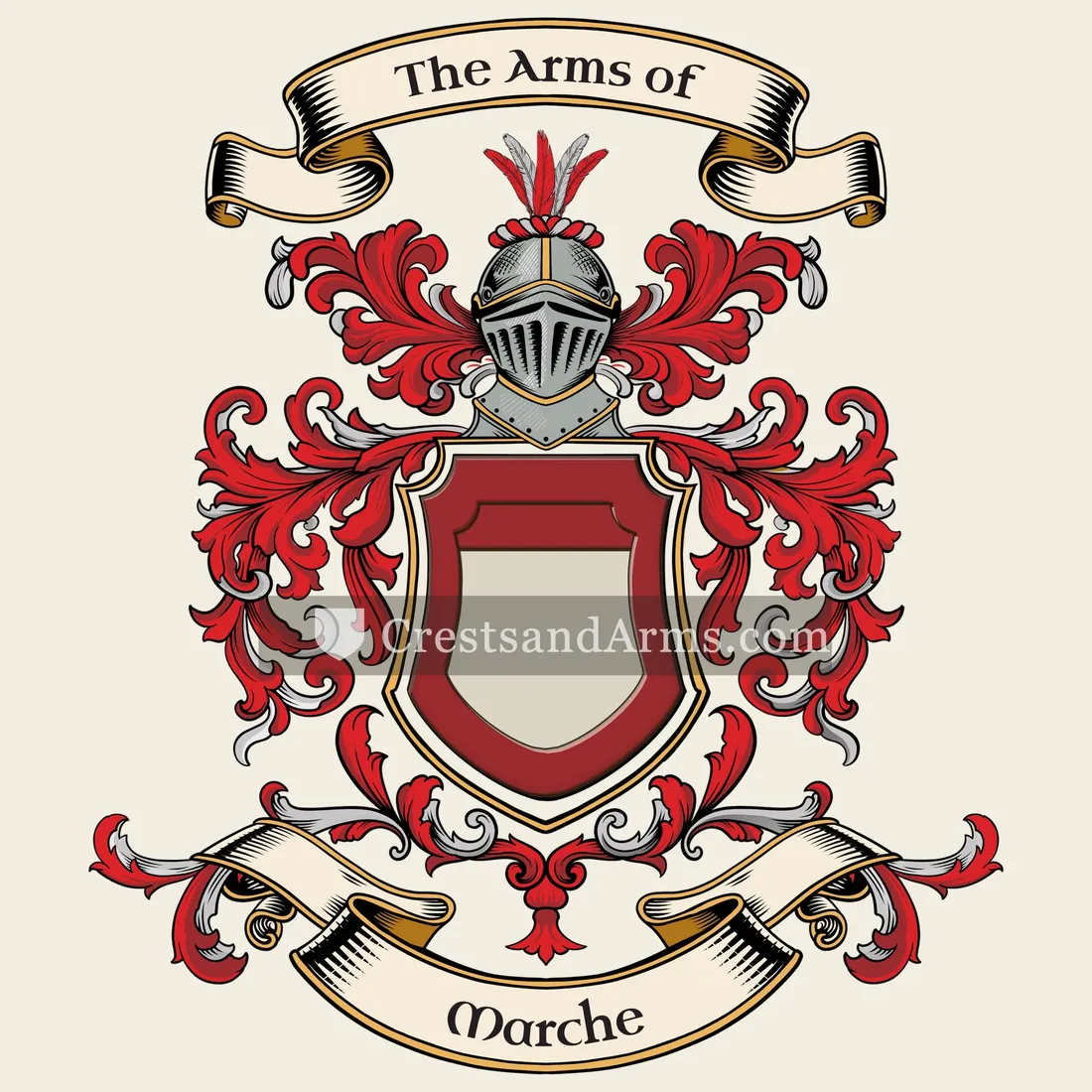
chiefAuthority, wisdom and dominion
Colours
Silver (Argent)Means: Peace and sincerity
Red (Gules)Means: Military strength
Historical info
Source
J. B. Rietstap, Armorial Général, Gouda: G. B. van Goor Zonen, 1884–87
Blazon (the actual original written record)
“D'arg. à la bord. de gu.; au chef du même.”
BerryBerry, c. 1663
Digital archive packCoat of arms PNG, gold border print PDF, vector SVG and the certificate of authenticity. Sent to your email in minutes.
Map of France showing where the Marche arms are recorded
The Marche arms were recorded in Berry, c. 1663.
Berry was central French farming country, quiet and long-settled. Its estates were modest and stayed in the same hands for centuries, and steady landholding of that kind is exactly what puts a name into the heraldic records.
This is where the arms were entered in the register. Families often moved to other parts of the country, so the same name can turn up in more than one region.
The body that granted and recorded arms in France in this period.
Louis XIV of France
Sovereign of the period
Louis XIV of France
1643–1715
Reigning in Belgium when the Marche arms are first recorded.
How Arms Worked in France
In France, a coat of arms was a mark of honor that passed down through the male line to all legitimate descendants. Families often used the same shield without changes to show their shared heritage. If a branch wanted to stand out, they could add a small mark to their shield to show their specific place in the family tree.
Granting authority
The Juge d'armes de France acted as the official authority that regulated and verified coats of arms across the country.
How they got arms
Families typically inherited their arms from ancestors, though they could also receive them through royal grants or by proving their noble status.
Where arms were recorded
Coats of arms were officially recorded in the Armorial Général de France, which began its main collection in the year 1696.
The family's standing
Recorded among the armigerous families of Berry.
Origin & History of the Marche Family in France
The family name Marche finds its roots in the historical province of Berry, a region in central France known for its deep agricultural traditions and rural landscape. Records confirm that members of the family were established in this area by 1663, living during a time when the French monarchy was centralizing power under King Louis XIV. In the French language, the word "marche" refers to a borderland or a frontier, suggesting that the earliest ancestors may have lived near the edges of a territory or served as guardians of a boundary. Life in the 17th-century Berry region was defined by the rhythms of the seasons and the feudal ties that connected families to the local land. As the family grew, they became part of the social fabric of the French countryside, contributing to the local economy and the development of the provincial culture that defined that era of French history.
Meaning of the Marche family crest colors & symbols
Symbols on this shield
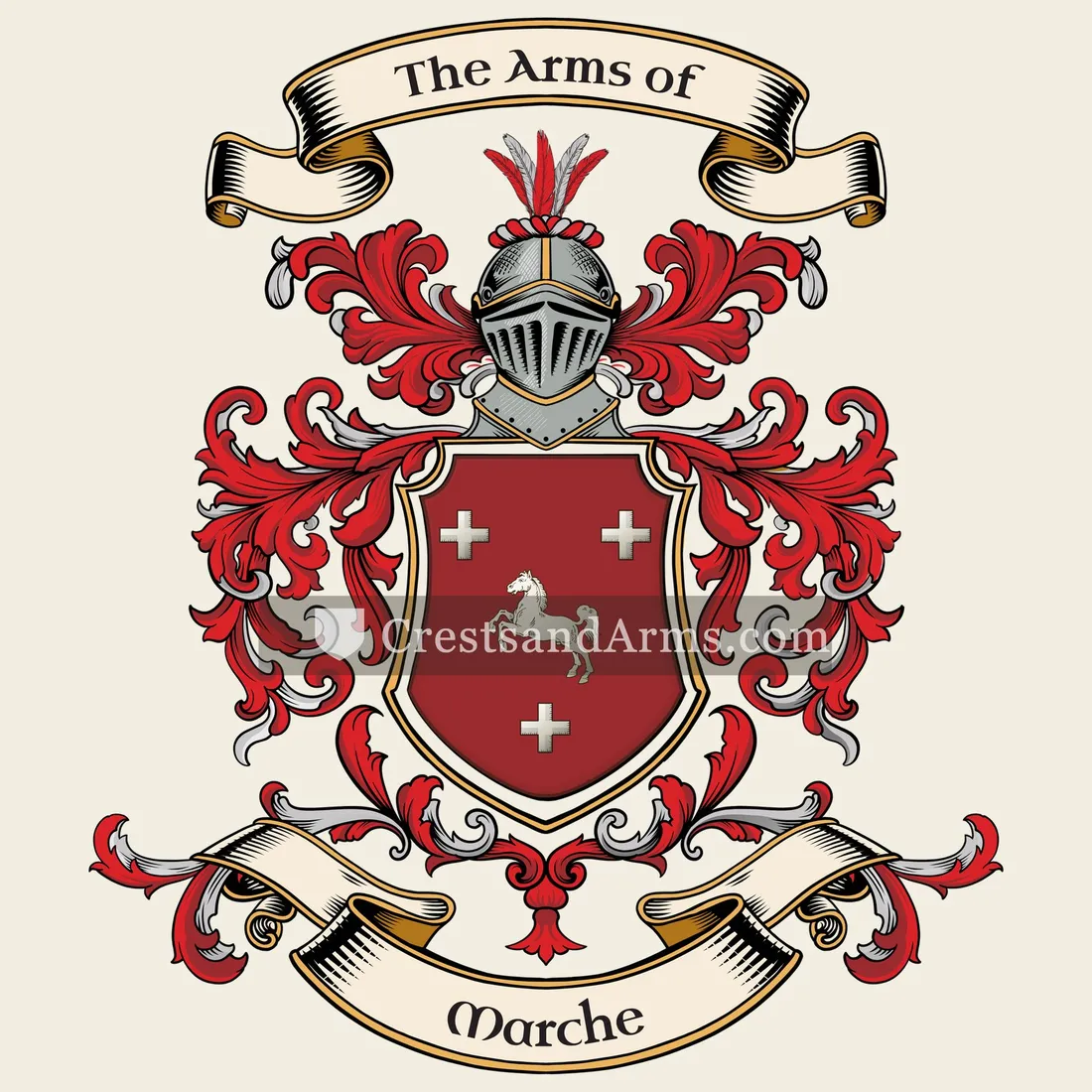
cross symbolChristian faith and service
horseReadiness to serve king and country
Colours
Red (Gules)Means: Military strength
Silver (Argent)Means: Peace and sincerity
Historical info
Source
Sir Bernard Burke, The General Armory of England, Scotland, Ireland and Wales, London: Harrison & Sons, 1884
Blazon (the actual original written record)
“Gu. a horse's head couped betw. three crosses crosslet fitchée ar”
EnglandLondon, c. 1585
Digital archive packCoat of arms PNG, gold border print PDF, vector SVG and the certificate of authenticity. Sent to your email in minutes.
Map of England showing where the Marche arms are recorded
The Marche arms were recorded in London, c. 1585.
This is where the arms were entered in the register. Families often moved to other parts of the country, so the same name can turn up in more than one region.
The body that granted and recorded arms in England in this period.
Elizabeth I of England
Sovereign of the period
Elizabeth I of England
1558–1603
Reigning in Belgium when the Marche arms are first recorded.
How Arms Worked in England
English heraldry allowed arms to be shared by all legitimate descendants of the original owner. These symbols were treated as personal property that moved through the generations to all children. While the eldest son kept the original design, other family members could use the same shield without needing to change it or register their own unique versions.
Granting authority
The College of Arms in London has regulated the use of coats of arms throughout England and Wales since 1484.
How they got arms
Families typically obtained their coats of arms through a formal grant from the Crown or by proving their ancient right to them.
Where arms were recorded
All official coats of arms are recorded in the registers kept at the College of Arms, which date back to the fifteenth century.
The family's standing
Recorded among the armigerous families of England.
Origin & History of the Marche Family in England
The family name Marche has roots that stretch back into the bustling streets of sixteenth-century London. By 1585, records confirm that individuals bearing this name were already established within the city, living during a time of rapid urban growth and social change. The name itself likely originated as a topographical term, referring to people who lived near a boundary or a borderland, known in Middle English as a "march." As these early family members navigated life in the capital, they were part of a society transitioning from the medieval era into the early modern period. Their presence in London suggests they were likely involved in the vibrant trade and craft guilds that defined the city’s economy at the time. Over the following decades, the family name became woven into the fabric of English life, reflecting the movement and development of people who helped shape the local communities of the Elizabethan age.
Marche Meaning & Related Branches
Root word
marca
A boundary, border, or frontier region.
This name
MarcheRefers to someone who lived near a border or a marked boundary line.
also spelled
Marchee
Marches
March
Marsh
Marshe
Related arms
Marshsimilar arms
Marchvariant spelling
Marshevariant spelling
Documented Sources
J. B. Rietstap, Armorial Général, Gouda: G. B. van Goor Zonen, 1884–87
State Archives in Belgium (Rijksarchief in België), Parochieregisters (Registers van de parochies)
State Archives in Belgium (Rijksarchief in België), Notariële archieven (Archives notariales)
Debrabandere, Frans, Woordenboek van de familienamen in België en Noord-Frankrijk, 2003
Leys, O., De familienamen in de Nederlanden, 1987
Digital archive packCoat of arms PNG, gold border print PDF, vector SVG and the certificate of authenticity. Sent to your email in minutes.


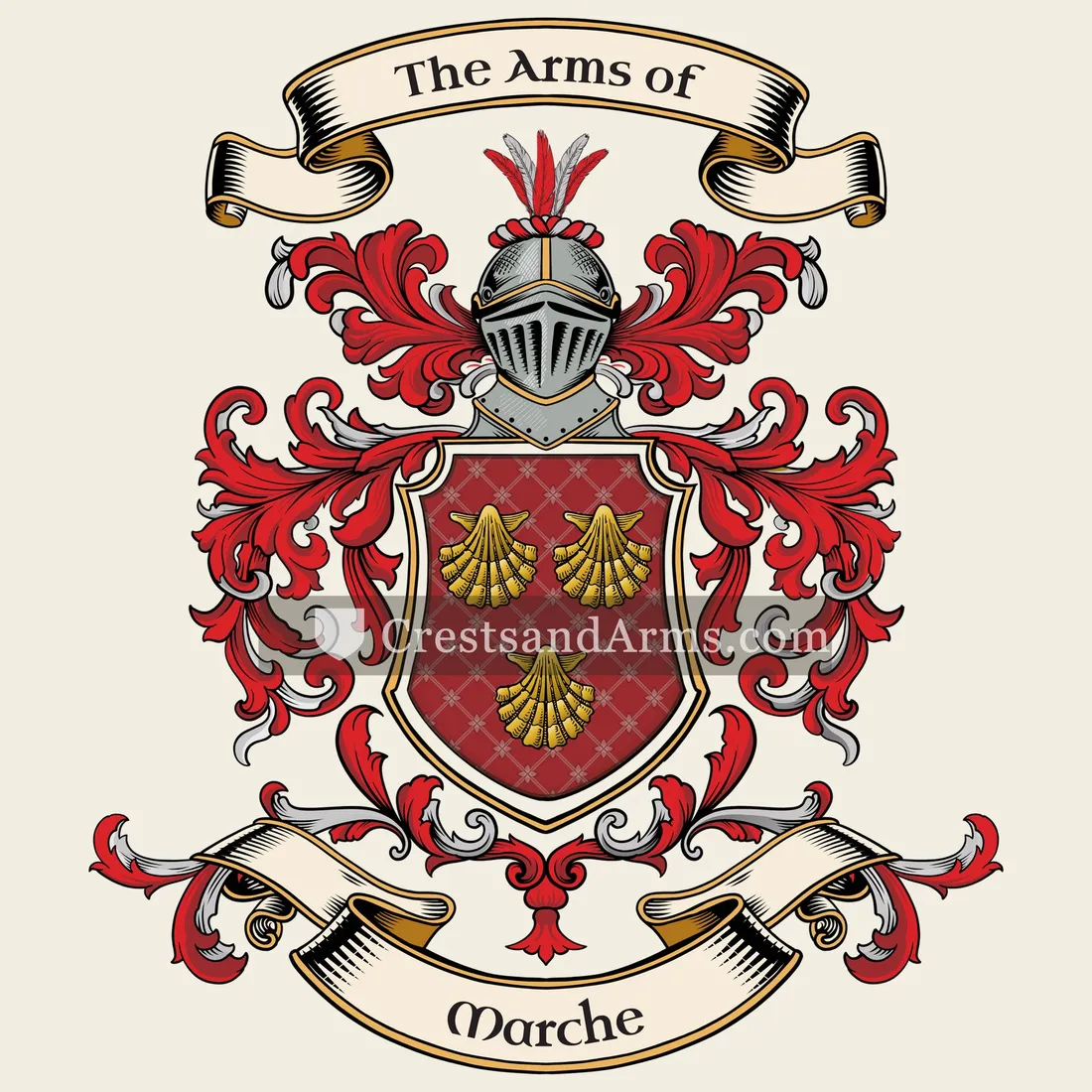
 escallopThe pilgrim's shell, and a long journey made
 escallopThe pilgrim's shell, and a long journey made


 chiefAuthority, wisdom and dominion


 cross symbolChristian faith and service
 horseReadiness to serve king and country