Map of France showing where the Marchildon arms are recorded
The Marchildon arms were recorded in Lorraine, c. 1663.
Lorraine sat on the border between France and the German lands, and border country bred soldiers. Families here held small estates and served in arms, and a fighting man was exactly the sort who carried a shield of his own.
This is where the arms were entered in the register. Families often moved to other parts of the country, so the same name can turn up in more than one region.
The body that granted and recorded arms in France in this period.
Louis XIV of France
Sovereign of the period
Louis XIV of France
1643–1715
Reigning in France when the Marchildon arms are first recorded.
How Arms Worked in France
In France, a coat of arms was a mark of honor that passed down through the male line to all legitimate descendants. Families often used the same shield without changes to show their shared heritage. If a branch wanted to stand out, they could add a small mark to their shield to show their specific place in the family tree.
Granting authority
The Juge d'armes de France acted as the official authority that regulated and verified coats of arms across the country.
How they got arms
Families typically inherited their arms from ancestors, though they could also receive them through royal grants or by proving their noble status.
Where arms were recorded
Coats of arms were officially recorded in the Armorial Général de France, which began its main collection in the year 1696.
The family's standing
Recorded among the armigerous families of Lorraine.
Origin & History of the Marchildon Family in France
The Marchildon family name has deep roots in the Lorraine region of France, where members of the family were established by the mid-seventeenth century. In 1663, a man named Jean Marchildon left this ancestral home to seek a new life in New France, which is modern-day Quebec. He traveled across the Atlantic Ocean to settle in a rugged landscape that required immense physical labor and resilience to survive. By moving to a new continent, he became the progenitor of the family line in North America. The name itself likely evolved from local nicknames or descriptions used in the Lorraine countryside, reflecting the common naming customs of that era. These early pioneers played a vital role in the development of colonial settlements, helping to build the foundations of a community that would grow and spread across the continent over the following centuries.
Marchildon Meaning & Related Branches
Root word
Marchand
A merchant or trader who buys and sells goods.
This name
MarchildonA diminutive or patronymic form referring to the descendant of a merchant.
also spelled
Marchal
Corny
Marchall
Marshal de Corny
Documented Sources
J. B. Rietstap, Armorial Général, Gouda: G. B. van Goor Zonen, 1884–87
Jetté, René, Dictionnaire généalogique des familles du Québec, 1983
Tanguay, Cyprien, Dictionnaire généalogique des familles canadiennes depuis la fondation de la colonie jusqu'à nos jours, 1871
Bibliothèque et Archives nationales du Québec, Fonds du Conseil souverain
Digital archive packCoat of arms PNG, gold border print PDF, vector SVG and the certificate of authenticity. Sent to your email in minutes.


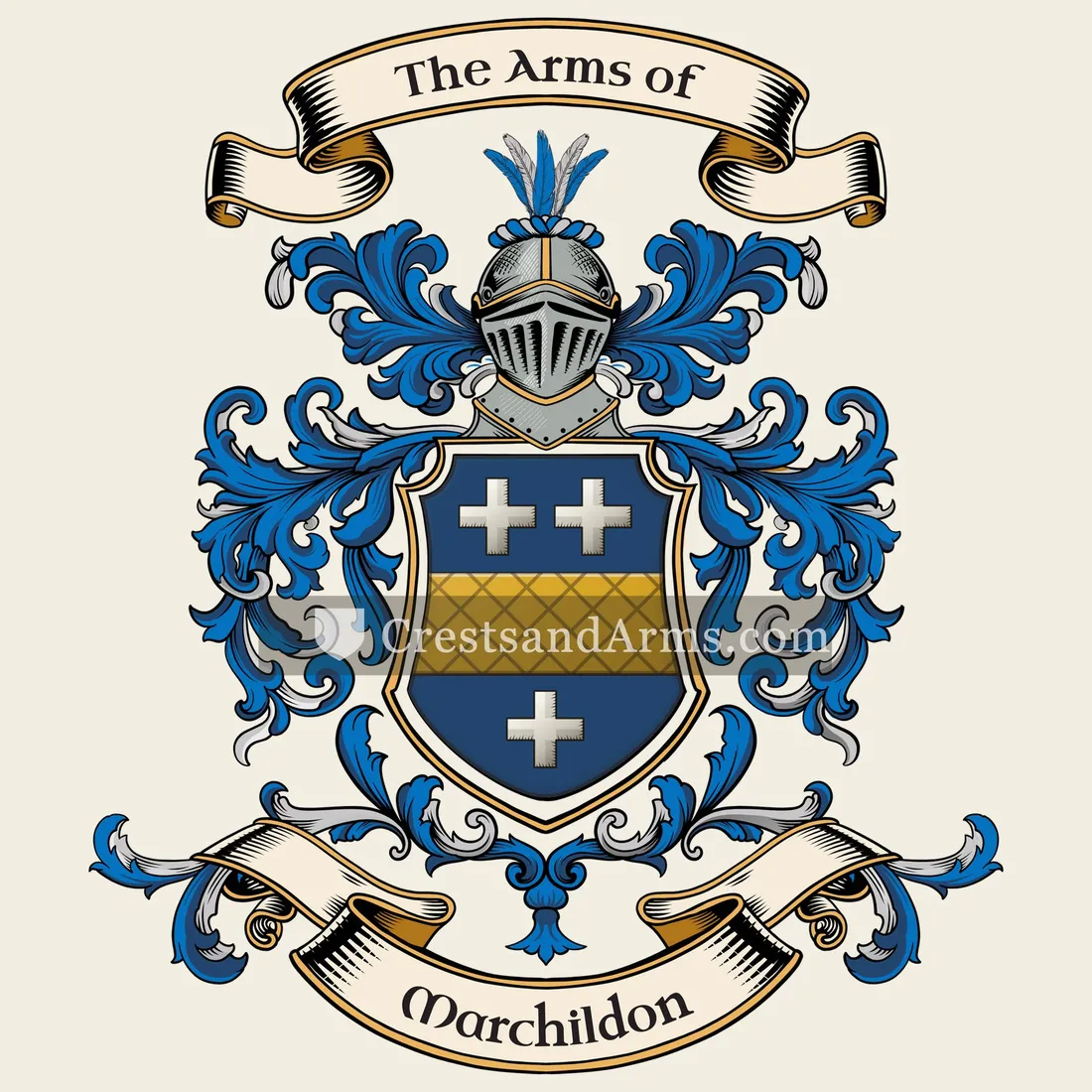
 fessThe military belt, and readiness to serve
 cross symbolChristian faith and service
 fessThe military belt, and readiness to serve
 cross symbolChristian faith and service