Map of England showing where the Markham arms are recorded
The Markham arms were recorded in England, c. 1620.
Arms such as these were typically recorded in York.
Yorkshire is the largest of the English counties, and it held more gentry families than any other. Land there was split among a great many households rather than a few, so a great many of them carried arms.
This is where the arms were entered in the register. Families often moved to other parts of the country, so the same name can turn up in more than one region.
The body that granted and recorded arms in England in this period.
James VI and I
Sovereign of the period
James VI and I
1603–1625
Reigning in England when the Markham arms are first recorded.
How Arms Worked in England
English heraldry allowed arms to be shared by all legitimate descendants of the original owner. These symbols were treated as personal property that moved through the generations to all children. While the eldest son kept the original design, other family members could use the same shield without needing to change it or register their own unique versions.
Granting authority
The College of Arms in London has regulated the use of coats of arms throughout England and Wales since 1484.
How they got arms
Families typically obtained their coats of arms through a formal grant from the Crown or by proving their ancient right to them.
Where arms were recorded
All official coats of arms are recorded in the registers kept at the College of Arms, which date back to the fifteenth century.
The family's standing
Recorded among the armigerous families of England.
Origin & History of the Markham Family in England
The Markham name is a classic example of a locational surname, which means it originated from a specific place rather than a trade or a nickname. The family took its name from the village of Markham in Nottinghamshire, which was recorded in the Domesday Book of 1086 as "Marcham." Over the centuries, members of the family moved away from their ancestral home to seek new opportunities in larger urban centers. By 1620, records confirm that the Markham family had established a notable presence in the city of York. During this period, York served as a vital hub for trade and administration in Northern England, making it a logical destination for families looking to expand their influence. The transition from a rural village identity to an urban presence in a major city like York highlights how the family adapted to the changing social and economic landscape of early modern England.
Meaning of the Markham family crest colors & symbols
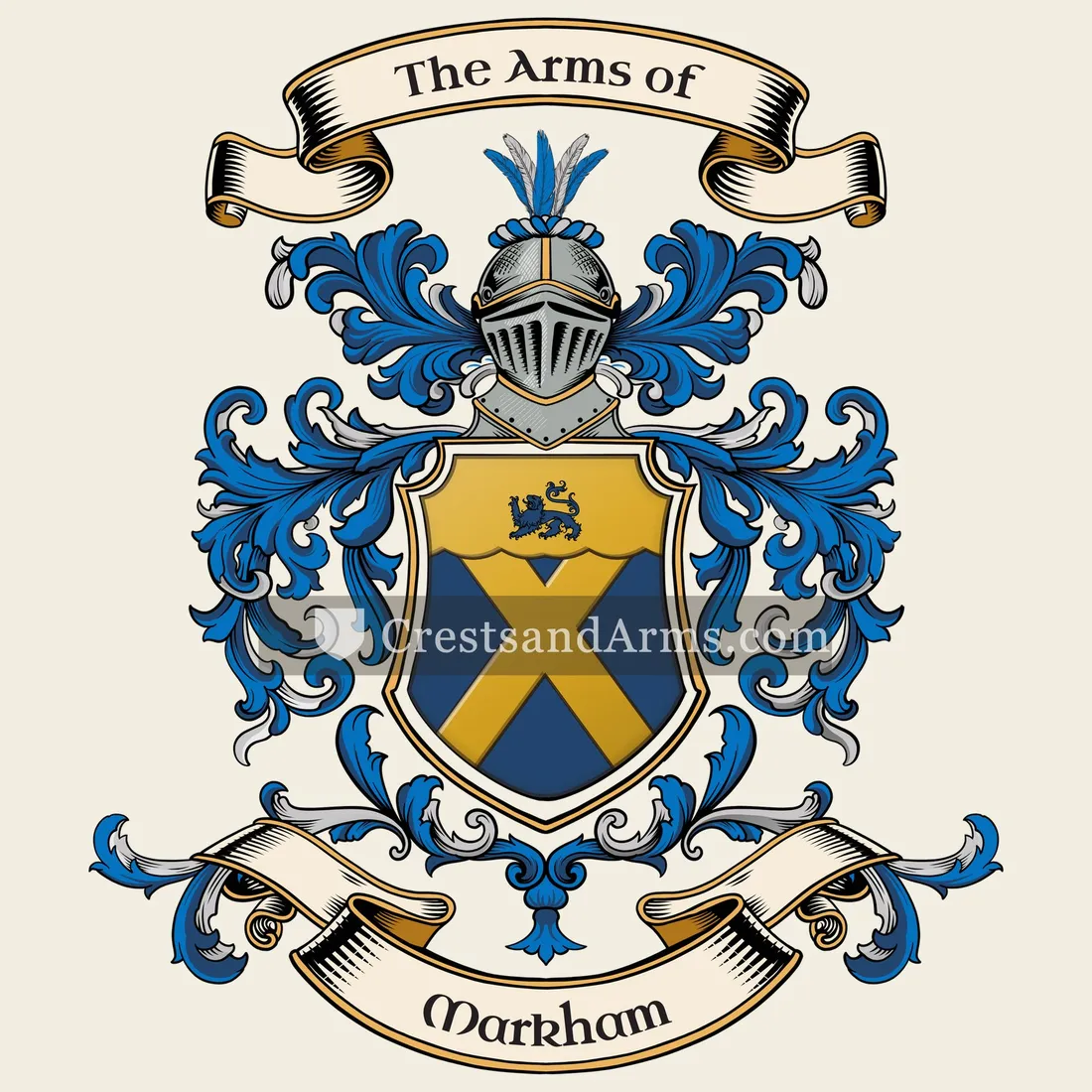
Symbols on this shield
saltireResolution, and St Andrew's cross
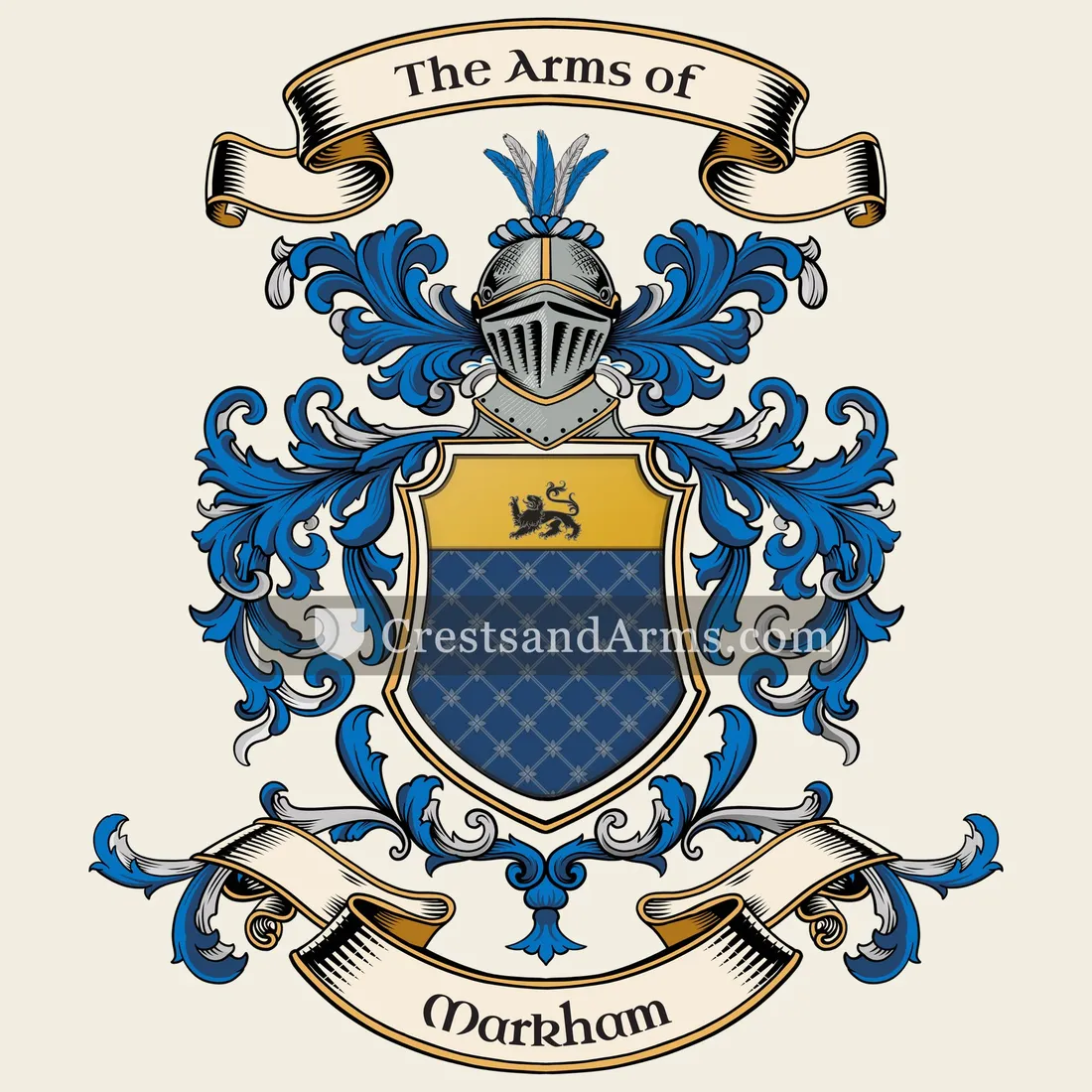
chiefAuthority, wisdom and dominion
lionCourage, strength and royalty
Colours
Blue (Azure)Means: Loyalty and truth
Gold (Or)Means: Generosity
Historical info
Source
Sir Bernard Burke, The General Armory of England, Scotland, Ireland and Wales, London: Harrison & Sons, 1884
Blazon (the actual original written record)
“Az. a saltire engr. or, on a chief of the last a lion ramp. issuant of the first”
DublinDublin, c. 1644
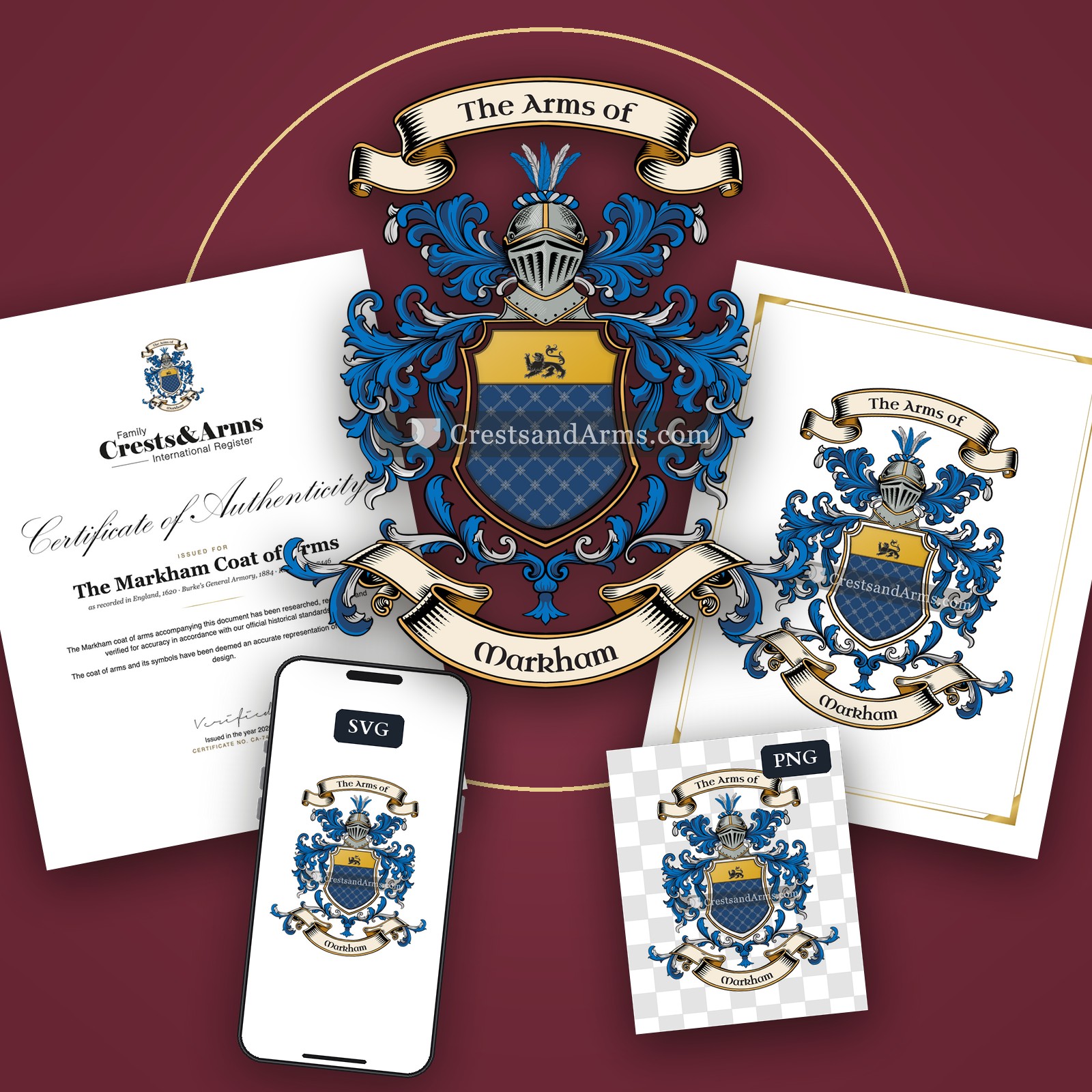
Digital archive packCoat of arms PNG, gold border print PDF, vector SVG and the certificate of authenticity. Sent to your email in minutes.
Map of Ireland showing where the Markham arms are recorded
The Markham arms were recorded in Dublin, c. 1644.
Dublin was the seat of government in Ireland and the place where grants were sought and recorded. Families with business at the castle or the courts settled nearby, and settling there put their arms on record.
This is where the arms were entered in the register. Families often moved to other parts of the country, so the same name can turn up in more than one region.
The body that granted and recorded arms in Ireland in this period.
Charles I of England
Sovereign of the period
Charles I of England
1625–1649
Reigning in England when the Markham arms are first recorded.
How Arms Worked in Ireland
The Ulster King of Arms granted coats of arms to individuals who proved their social standing and good character. These symbols were typically inherited by all legitimate descendants of the original holder. If a family branch wanted a unique look, they could apply for a specific change to their design through the office to ensure their identity remained distinct.
Granting authority
The Ulster King of Arms acted as the official body that regulated and issued all coats of arms throughout Ireland.
How they got arms
Families obtained their arms through formal grants issued by the office after proving their eligibility and paying the required fees.
Where arms were recorded
All official grants were recorded in the registers held by the Ulster King of Arms starting from the year 1552.
The family's standing
Recorded among the armigerous families of Dublin.
Origin & History of the Markham Family in Ireland
The Markham name in Ireland is deeply connected to the shifting political landscape of the seventeenth century. While the name has roots in England, records confirm that members of the family were established in Dublin by 1644. During this period, Dublin served as a central hub for administrators, soldiers, and merchants arriving from across the Irish Sea. Families like the Markhams often settled in the city to participate in the growing trade networks or to serve in the government offices located near Dublin Castle. As the century progressed, these early settlers became part of the urban fabric of the capital. They lived through a time of significant social change, witnessing the transition of power that defined Irish history during the mid-1600s. By embedding themselves in the local economy and community, the early Markhams helped establish a lasting presence for the name in the region.
Markham Meaning & Related Branches
Root word
mearc-ham
Boundary or border settlement
This name
MarkhamDerived from Old English words referring to a homestead located near a boundary or frontier.
also spelled
Markeham
Markam
Markehamme
Documented Sources
Sir Bernard Burke, The General Armory of England, Scotland, Ireland and Wales, London: Harrison & Sons, 1884
Ekwall, Eilert. The Concise Oxford Dictionary of English Place-names. 1960
Reaney, P.H. A Dictionary of British Surnames. 1958
Borthwick Institute for Archives, University of York. Archbishop of York’s Diocesan Records
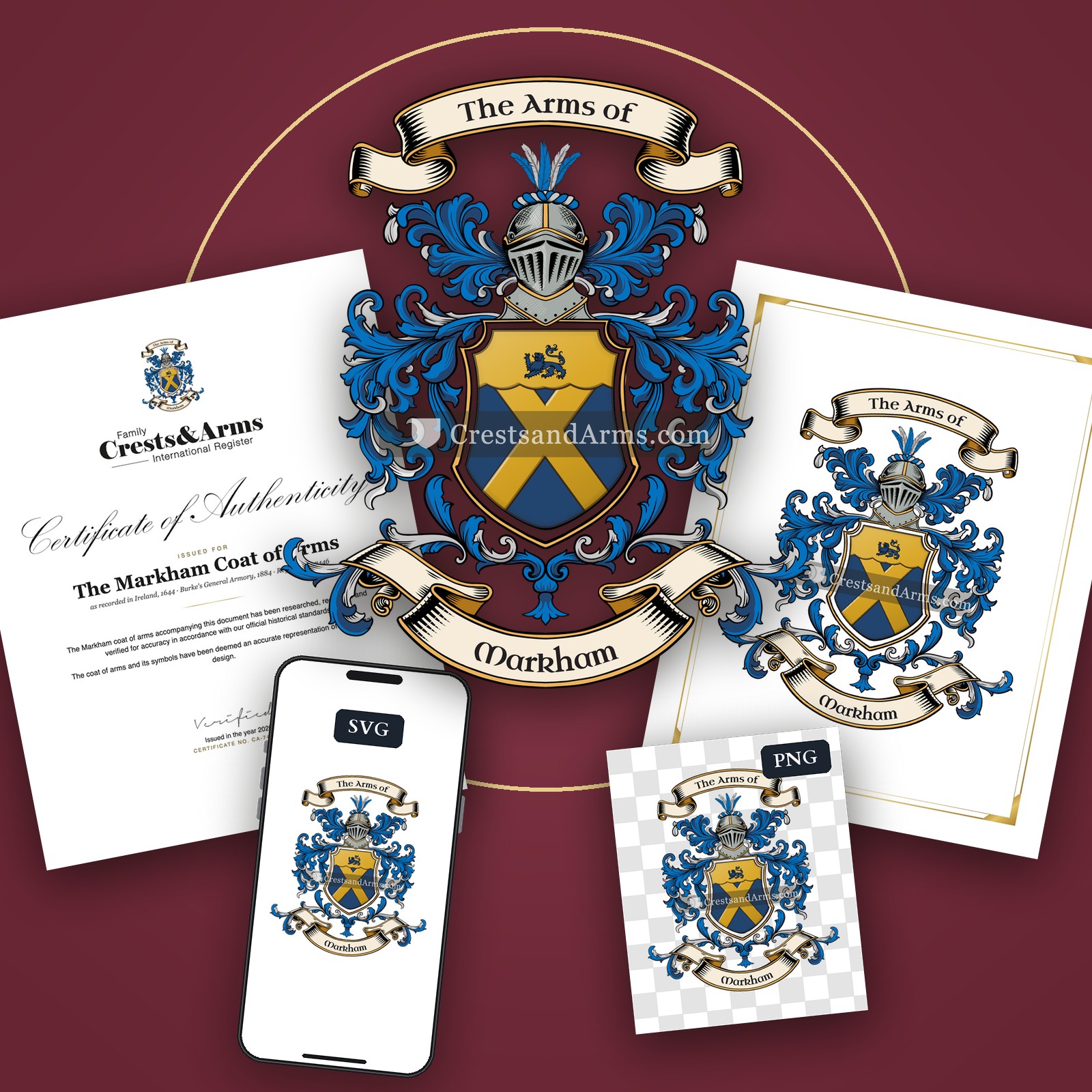
Digital archive packCoat of arms PNG, gold border print PDF, vector SVG and the certificate of authenticity. Sent to your email in minutes.


 chiefAuthority, wisdom and dominion
 lionCourage, strength and royalty
 chiefAuthority, wisdom and dominion
 lionCourage, strength and royalty


 saltireResolution, and St Andrew's cross