Map of Netherlands showing where the Markus arms are recorded
The Markus arms were recorded in Leyde, c. 1815.
This is where the arms were entered in the register. Families often moved to other parts of the country, so the same name can turn up in more than one region.
Region
Leyde
Town
Leyde
First recorded
1815
Granting Authority for the Markus Arms
Hoge Raad van Adel
Photograph made by me · CC BY-SA 3.0
The body that granted and recorded arms in Netherlands in this period.
William I of the Netherlands
Sovereign of the period
William I of the Netherlands
1815–1840
Reigning in Netherlands when the Markus arms are first recorded.
How Arms Worked in Netherlands
In the Netherlands, coats of arms were often used by noble families and those who held specific public offices. These arms were passed down through the generations to legitimate descendants. Younger branches of a family usually kept the original design without needing to add special marks. This system ensured that the family identity remained clear and consistent over many years.
Granting authority
The Hoge Raad van Adel is the official body that regulates and manages noble titles and coats of arms in the Netherlands.
How they got arms
Families typically obtained their coats of arms through official royal grants or by proving their long-standing historical use of the symbols.
Where arms were recorded
Coats of arms are officially recorded in the registers held by the Hoge Raad van Adel, which began its work in 1814.
The family's standing
Recorded among the armigerous families of Netherlands.
Origin & History of the Markus Family in Netherlands
The name Markus finds its roots in the ancient Latin name Marcus, which was derived from the Roman god Mars. Over many centuries, this name spread across Europe and evolved into a common surname as people began using their father’s given name to identify their own family line. By the early 19th century, members of the Markus family were well-established in the Dutch city of Leiden. This period was a time of significant transition for the Netherlands, as the country had recently emerged from French occupation to become a new kingdom. Living in Leiden during 1815, the family would have been part of a historic urban center known for its prestigious university and its role as a hub for trade and craftsmanship. These early ancestors likely navigated the social and economic shifts of the post-Napoleonic era while contributing to the local community in this vibrant academic city.
Markus Meaning & Related Branches
Root word
Marcus
Derived from the Roman god of war Mars.
This name
MarkusA Dutch surname originating from the Latin name meaning dedicated to Mars.
also spelled
Markus
Marcuz
Documented Sources
J. B. Rietstap, Armorial Général, Gouda: G. B. van Goor Zonen, 1884–87
Erfgoed Leiden en Omstreken, Bevolkingsregister Leiden 1815
Nationaal Archief, Burgerlijke Stand van de Gemeente Leiden
Meertens, P.J., De betekenis van Nederlandse familienamen, 1963
Van der Schaar, J., Woordenboek van voornamen, 1964
Digital archive packCoat of arms PNG, gold border print PDF, vector SVG and the certificate of authenticity. Sent to your email in minutes.


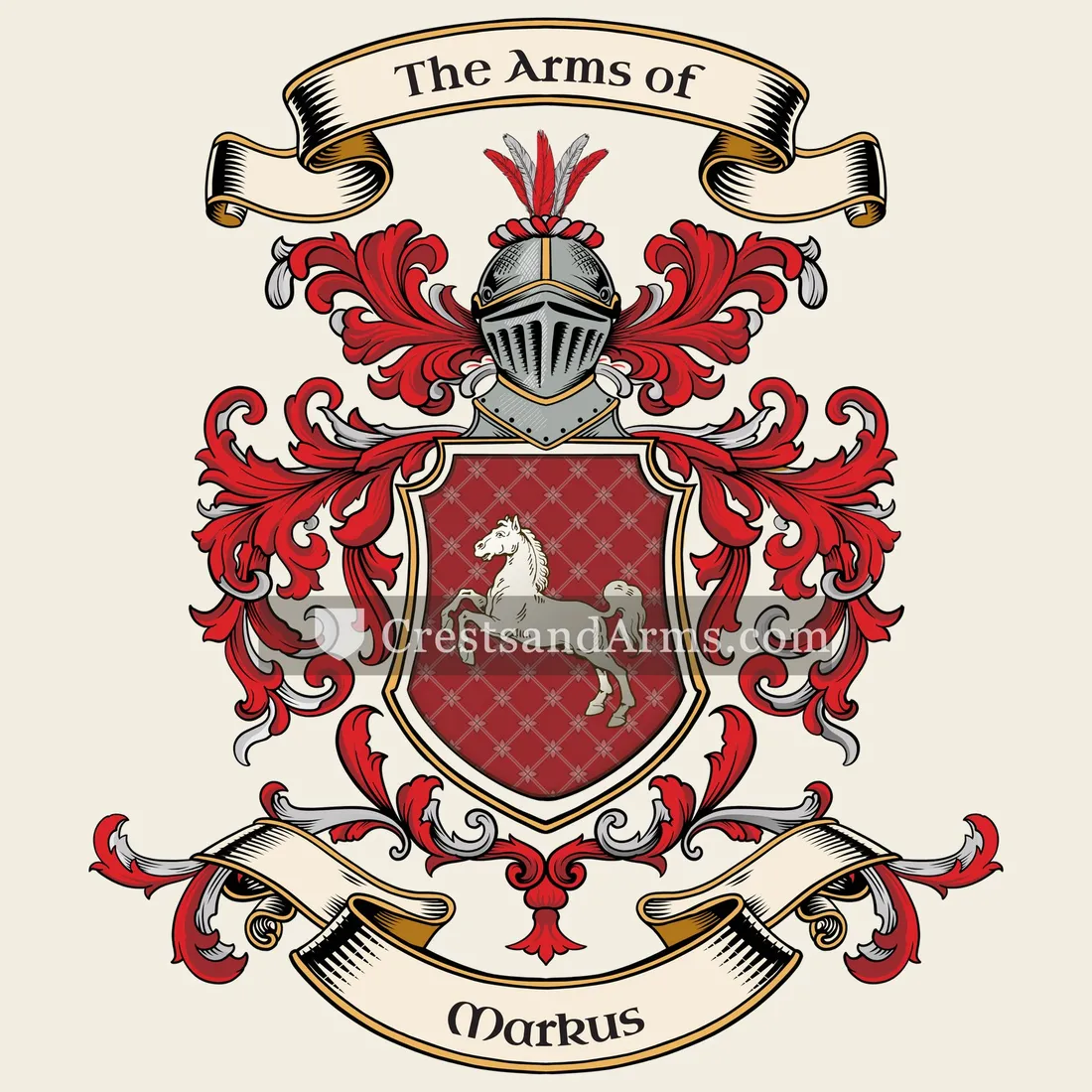
 horseReadiness to serve king and country
 horseReadiness to serve king and country