Map of Italy showing where the Maron arms are recorded
The Maron arms were recorded in Venice, c. 1775.
Venice ran on trade, and its great families were merchants before they were anything else. The city kept a formal list of its noble houses, and a name on that list carried arms as a matter of record.
This is where the arms were entered in the register. Families often moved to other parts of the country, so the same name can turn up in more than one region.
The body that granted and recorded arms in Italy in this period.
Alvise Giovanni Mocenigo
Sovereign of the period
Alvise Giovanni Mocenigo
1763–1778
Reigning in Italy when the Maron arms are first recorded.
How Arms Worked in Italy
In the Italian states, coats of arms were often used by noble families to show their status and history. These symbols were passed down through the generations to all legitimate male descendants. Younger branches of a family usually kept the original design but sometimes added small changes to distinguish their specific line from the main branch.
Granting authority
Various local rulers and city governments controlled the use of coats of arms across the different Italian states.
How they got arms
Families often assumed their own arms or received them as official grants from local lords, popes, or city councils.
Where arms were recorded
Arms were recorded in local city archives or private family books rather than in one single national register.
The family's standing
Recorded among the armigerous families of Venice.
Origin & History of the Maron Family in Italy
The family name Maron carries a rich history rooted in the vibrant culture of Northern Italy. By 1775, records confirm that members of the Maron family were well-established residents of Venice, a city that served as a major crossroads for trade and intellectual exchange during the eighteenth century. The name itself is often linked to regional linguistic roots, potentially deriving from the Italian word for chestnut or serving as a variation of traditional given names common to the Veneto region. As inhabitants of Venice, the family likely participated in the unique social and economic life of the Venetian Republic, which was famous for its maritime influence and artistic contributions. Their presence in such a prominent city suggests they were part of the active urban population that helped shape the local community during the final decades of the republic.
Maron Meaning & Related Branches
Root word
Maro
Latin name derived from the Roman cognomen meaning famous or renowned.
This name
MaronA patronymic or locative surname indicating descent from an ancestor named Maro or originating from a chestnut-producing region.
also spelled
Maronot
Maronos
Marono de la Tour
Documented Sources
J. B. Rietstap, Armorial Général, Gouda: G. B. van Goor Zonen, 1884–87
Archivio di Stato di Venezia, Anagrafe dei cittadini veneziani, 1770-1780
Cessi, Roberto, Storia della Repubblica di Venezia, 1944
Lane, Frederic C., Venice, a Maritime Republic, 1973
Digital archive packCoat of arms PNG, gold border print PDF, vector SVG and the certificate of authenticity. Sent to your email in minutes.


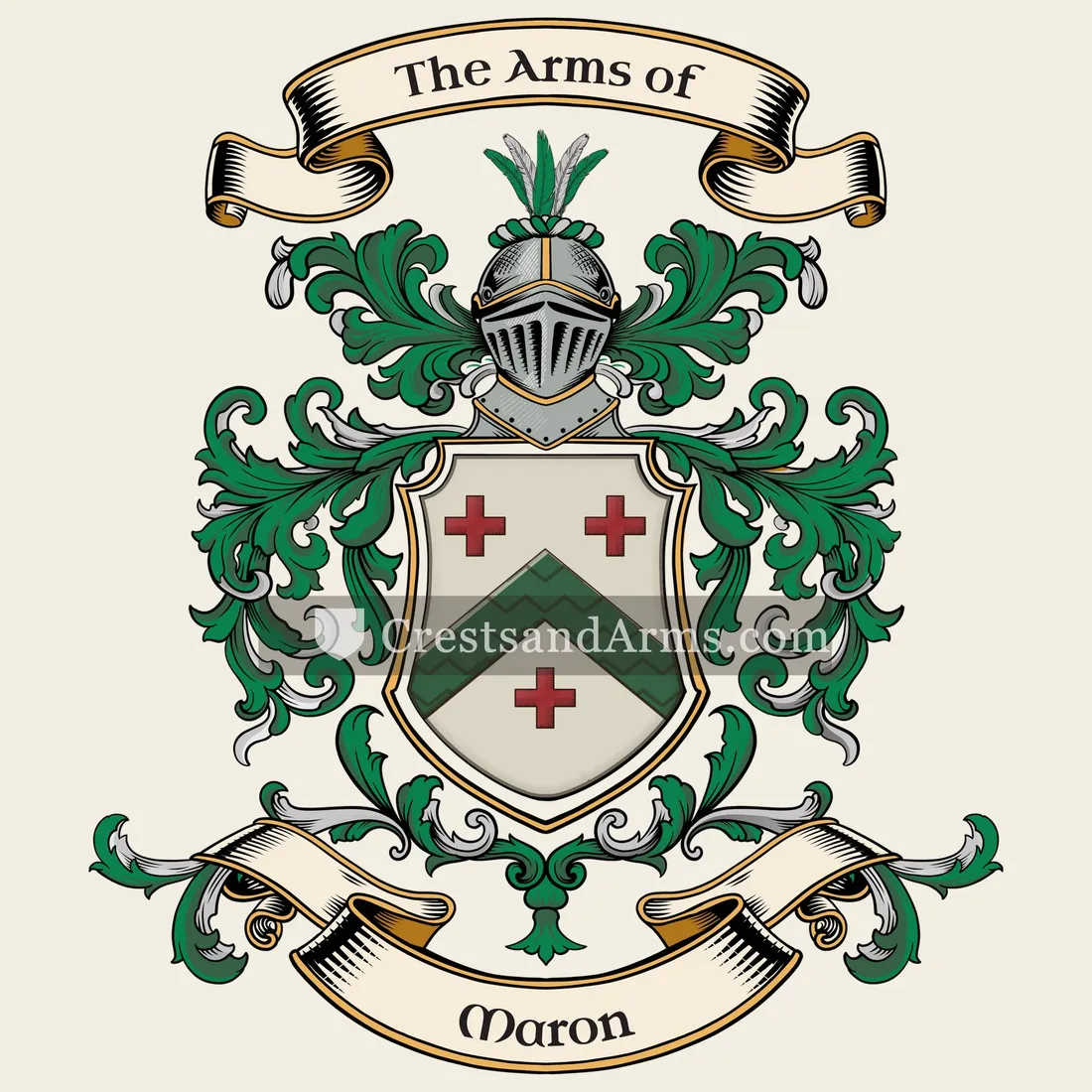
 chevronProtection, and faithful service completed
 cross symbolChristian faith and service
 chevronProtection, and faithful service completed
 cross symbolChristian faith and service