Map of Belgium showing where the Marriage arms are recorded
The Marriage arms were recorded in Flandre, c. 1663.
Flandre grew rich on cloth, and its towns were among the busiest in Europe. Merchant families bought land with their profits and took arms to go with it, so trade put as many names in the registers here as land did.
This is where the arms were entered in the register. Families often moved to other parts of the country, so the same name can turn up in more than one region.
The body that granted and recorded arms in Belgium in this period.
Philip IV of Spain
Sovereign of the period
Philip IV of Spain
1621–1665
Reigning in Belgium when the Marriage arms are first recorded.
How Arms Worked in Belgium
In Belgium, a coat of arms is considered personal property that is passed down through the male line to legitimate descendants. Families often use the same shield design across generations to show their shared heritage. If a branch of the family wants to change the design, they must apply for an official update to their specific version of the arms.
Granting authority
The Conseil héraldique is the official body that regulates and approves all coats of arms in Belgium.
How they got arms
Families obtain their coats of arms through formal royal grants or by confirming their historical right to use existing designs.
Where arms were recorded
All approved coats of arms are officially recorded in the public registers of the Conseil héraldique since 1844.
The family's standing
Recorded among the armigerous families of Flandre.
Origin & History of the Marriage Family in Belgium
The family name Marriage has deep roots that trace back to the region of Flanders during the mid-seventeenth century. Historical records confirm that members of the family were established in this area by 1663, living in a landscape defined by trade, religious shifts, and cross-border movement. The name itself likely originated as a descriptive term or a nickname, which was a common practice for identifying individuals in small communities before the widespread use of formal surnames. As the family moved across borders, often driven by the search for economic opportunity or religious freedom, the name became a permanent marker of their heritage. Over time, the family transitioned from their Flemish origins to become well-known figures in various industries, particularly in England, where they gained a reputation for their contributions to milling and agriculture. This history reflects the broader patterns of migration that shaped many families in Northern Europe during the early modern period.
Marriage Meaning & Related Branches
Root word
Maritus
Latin term meaning husband or a married person.
This name
MarriageAn occupational or descriptive surname referring to a married man or a wedding official.
also spelled
Mariadge
Mariagge
Marriage
Documented Sources
J. B. Rietstap, Armorial Général, Gouda: G. B. van Goor Zonen, 1884–87
Marriage, Henry, The Marriage Family: A History of the Family in England, 1902
Essex Record Office, Marriage Family Papers, D/F 24
The National Archives, Records of the Huguenot Society of Great Britain and Ireland, Series HS/Q
Digital archive packCoat of arms PNG, gold border print PDF, vector SVG and the certificate of authenticity. Sent to your email in minutes.


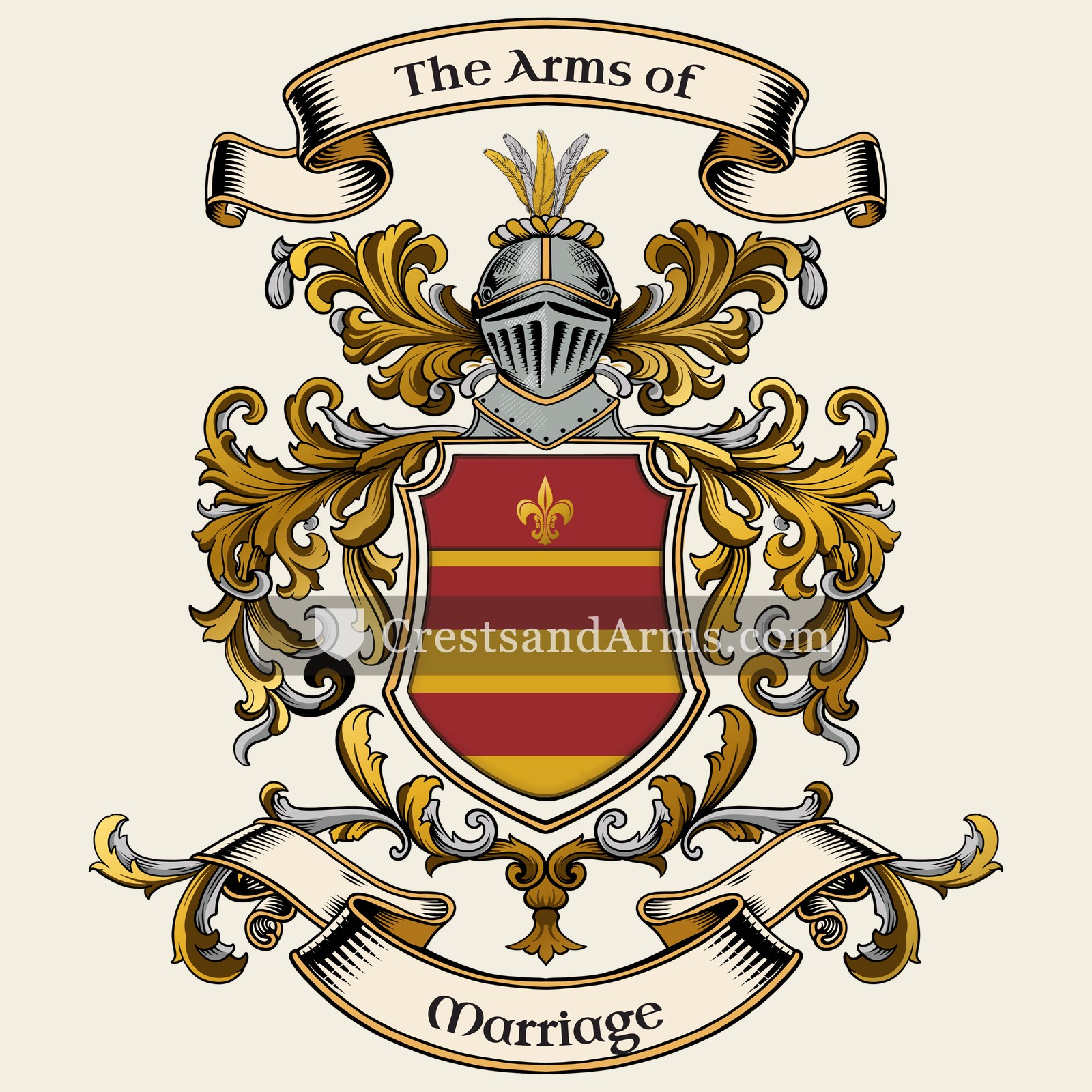
 fessThe military belt, and readiness to serve
 chiefAuthority, wisdom and dominion
 fleur de lisPurity, light, and the sixth son
 fessThe military belt, and readiness to serve
 chiefAuthority, wisdom and dominion
 fleur de lisPurity, light, and the sixth son