Map of Spain showing where the Martello arms are recorded
The Martello arms were recorded in Catalonia, c. 1722.
Catalonia lived by sea trade, and its merchant houses were as powerful as its landowners. Both sorts of family took arms, and Barcelona kept records of the houses entitled to bear them.
This is where the arms were entered in the register. Families often moved to other parts of the country, so the same name can turn up in more than one region.
The body that granted and recorded arms in Spain in this period.
Philip V of Spain
Sovereign of the period
Philip V of Spain
1714–1724
Reigning in Spain when the Martello arms are first recorded.
How Arms Worked in Spain
In Spain, a coat of arms was considered a form of property that belonged to the entire family line. These arms were passed down from a father to all his children equally. Younger branches of the family usually kept the original design without needing to add any special marks to distinguish their specific line.
Granting authority
The Cronista Rey de Armas was the official body that regulated and granted coats of arms throughout Spain.
How they got arms
Families often obtained their arms through royal grants or by proving their noble status to the official heraldic authority.
Where arms were recorded
Coats of arms were officially recorded in the registers of the Cronista Rey de Armas starting in 1496.
The family's standing
Recorded among the armigerous families of Catalonia.
Origin & History of the Martello Family in Spain
The Martello family name has deep roots in the northeastern region of Spain, particularly within Catalonia. By the early 18th century, records confirm that members of the family were well-established in this area. The name itself is derived from the word for a hammer, which suggests that the earliest ancestors likely worked as skilled blacksmiths or metalworkers. During this period, Catalonia was a hub of trade and craftsmanship, and families often adopted surnames that reflected their specific trade or their role in the local community. As these individuals moved through the towns and villages of the region, they helped shape the local economy through their manual labor and technical expertise. This connection to metalwork provided the family with a stable foundation, allowing them to integrate into the social and professional life of 18th-century Spanish society.
Meaning of the Martello family crest colors & symbols
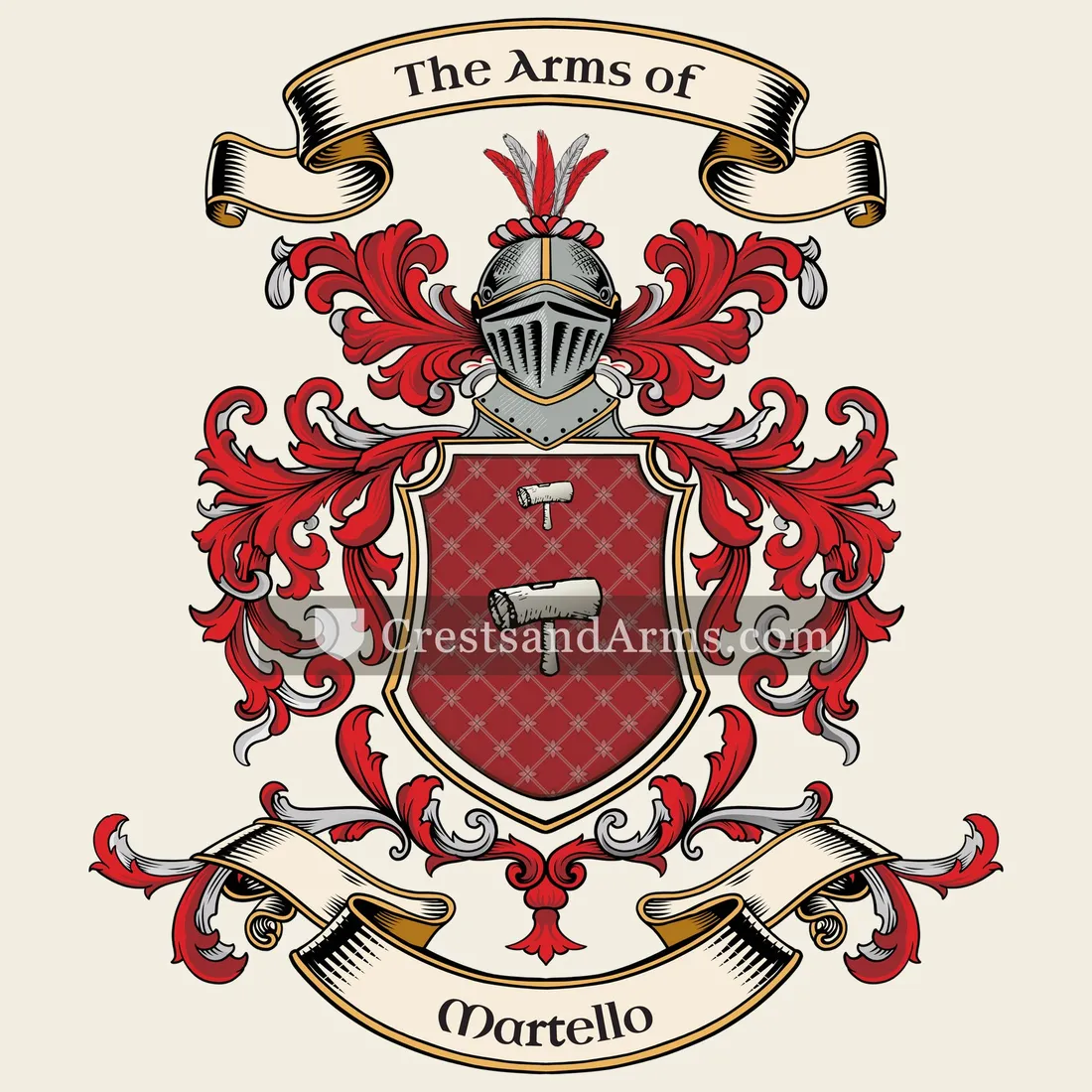
Symbols on this shield
hammerHonest labour, and the smith's craft
Colours
Gold (Or)Means: Generosity
Red (Gules)Means: Military strength
Historical info
Source
Sir Bernard Burke, The General Armory of England, Scotland, Ireland and Wales, London: Harrison & Sons, 1884
Blazon (the actual original written record)
“Or, three mallets gu.; another, Ar. a cross engr. betw. four martlets sa.; another, Or, three Danish axes gu”
Englandc. 1620
Digital archive packCoat of arms PNG, gold border print PDF, vector SVG and the certificate of authenticity. Sent to your email in minutes.
Map of England showing where the Martello arms are recorded
The Martello arms were recorded in England, c. 1620.
Arms such as these were typically recorded in York.
Yorkshire is the largest of the English counties, and it held more gentry families than any other. Land there was split among a great many households rather than a few, so a great many of them carried arms.
This is where the arms were entered in the register. Families often moved to other parts of the country, so the same name can turn up in more than one region.
The body that granted and recorded arms in England in this period.
James VI and I
Sovereign of the period
James VI and I
1603–1625
Reigning in Spain when the Martello arms are first recorded.
How Arms Worked in England
English heraldry allowed arms to be shared by all legitimate descendants of the original owner. These symbols were treated as personal property that moved through the generations to all children. While the eldest son kept the original design, other family members could use the same shield without needing to change it or register their own unique versions.
Granting authority
The College of Arms in London has regulated the use of coats of arms throughout England and Wales since 1484.
How they got arms
Families typically obtained their coats of arms through a formal grant from the Crown or by proving their ancient right to them.
Where arms were recorded
All official coats of arms are recorded in the registers kept at the College of Arms, which date back to the fifteenth century.
The family's standing
Recorded among the armigerous families of England.
Origin & History of the Martello Family in England
The surname Martello carries a rich history that suggests a connection to the trade and craftsmanship of medieval Europe. While the name is often associated with Mediterranean roots, its presence in England became firmly established by the early seventeenth century. Records confirm that members of the family were living in the historic city of York by 1620. During this period, York was a bustling center for commerce and industry, making it an ideal location for families involved in metalworking or construction. The name itself is derived from the word for a hammer, which implies that the earliest ancestors likely worked as blacksmiths or stonemasons. These professionals were essential to the growth of English towns, as they provided the tools and structural support needed for urban development. By settling in a major hub like York, the Martello family integrated themselves into the local economy and contributed to the skilled labor force that defined the era.
Martello Meaning & Related Branches
Root word
Martellus
A small hammer or tool used for striking.
This name
MartelloDerived from a nickname for a blacksmith or a person with a forceful personality.
also spelled
Martel
Martill
Documented Sources
J. B. Rietstap, Armorial Général, Gouda: G. B. van Goor Zonen, 1884–87
Arxiu de la Corona d'Aragó, Registre de l'Audiència de Catalunya
Arxiu Històric de Protocols de Barcelona, Llibres de Mestres i Aprenents
Alcover, Antoni Maria, Diccionari català-valencià-balear, 1930
Moll, Francesc de Borja, Els llinatges catalans, 1959
Digital archive packCoat of arms PNG, gold border print PDF, vector SVG and the certificate of authenticity. Sent to your email in minutes.


 hammerHonest labour, and the smith's craft
 hammerHonest labour, and the smith's craft