A record of documented arms, meaning and origin, researched for the Martini family lines. Documented in 3 countries.
Reg. 4580 · Belgian, M–O
Meaning of the Martini family crest colors & symbols
Symbols on this shield
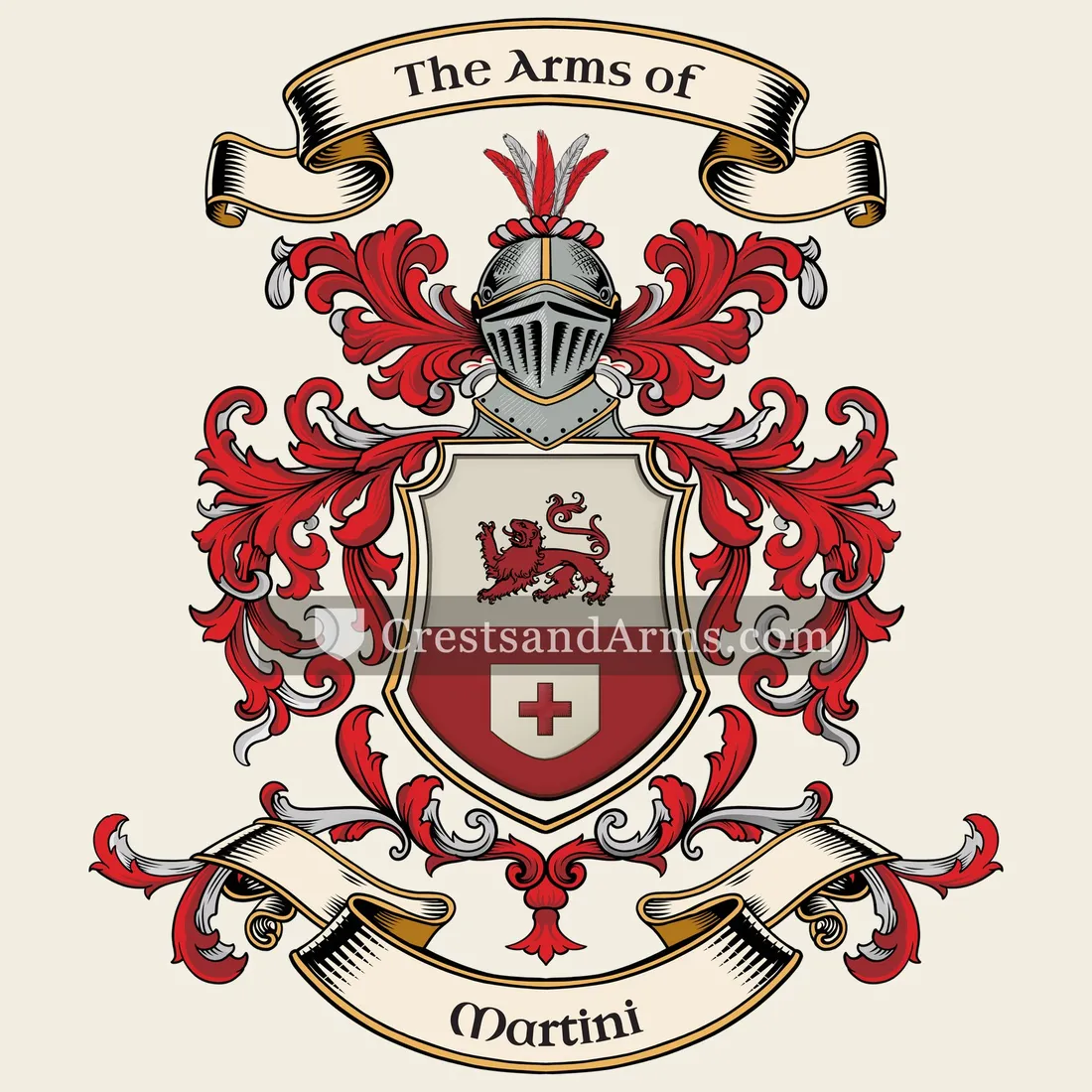
cross symbolChristian faith and service
lionCourage, strength and royalty
Colours
Silver (Argent)Means: Peace and sincerity
Red (Gules)Means: Military strength
Historical info
Source
J. B. Rietstap, Armorial Général, Gouda: G. B. van Goor Zonen, 1884–87
Blazon (the actual original written record)
“Coupé: au 1 d'arg. au lion de gu.; au 2 de gu. à un écusson d'arg. en abîme, ch. d'une croix ancrée de gu. C.: un lion iss. d'or, arm. et lamp. de gu., accosté de deux chicots au nat., posés en chev. renv. S.: deux panthères reg., au nat.”
BelgiumAnvers, c. 1737
Digital archive packCoat of arms PNG, gold border print PDF, vector SVG and the certificate of authenticity. Sent to your email in minutes.
Map of Belgium showing where the Martini arms are recorded
The Martini arms were recorded in Anvers, c. 1737.
This is where the arms were entered in the register. Families often moved to other parts of the country, so the same name can turn up in more than one region.
The body that granted and recorded arms in Belgium in this period.
Charles VI, Holy Roman Emperor
Sovereign of the period
Charles VI, Holy Roman Emperor
1711–1740
Reigning in Belgium when the Martini arms are first recorded.
How Arms Worked in Belgium
In Belgium, a coat of arms is considered personal property that is passed down through the male line to legitimate descendants. Families often use the same shield design across generations to show their shared heritage. If a branch of the family wants to change the design, they must apply for an official update to their specific version of the arms.
Granting authority
The Conseil héraldique is the official body that regulates and approves all coats of arms in Belgium.
How they got arms
Families obtain their coats of arms through formal royal grants or by confirming their historical right to use existing designs.
Where arms were recorded
All approved coats of arms are officially recorded in the public registers of the Conseil héraldique since 1844.
The family's standing
Recorded among the armigerous families of Belgium.
Origin & History of the Martini Family in Belgium
The history of the Martini family in Belgium is deeply connected to the vibrant urban life of Antwerp during the eighteenth century. By 1737, records confirm that members of the family were already established residents of the city, which was a major hub for international trade and culture at the time. The name itself is a variation of the Latin name Martinus, which was widely popular across Europe due to the influence of Saint Martin of Tours. As the family settled into the social fabric of Antwerp, they likely participated in the city’s bustling merchant guilds or local administrative circles. During this period, Antwerp served as a gateway for goods and ideas moving between the North Sea and the rest of the continent. The Martini family would have navigated this environment as part of the growing middle class, contributing to the economic stability of the region while maintaining their distinct family identity. Their presence in the city archives highlights how families of that era often moved through major trade centers to build new lives and professional reputations.
Meaning of the Martini family crest colors & symbols
Symbols on this shield
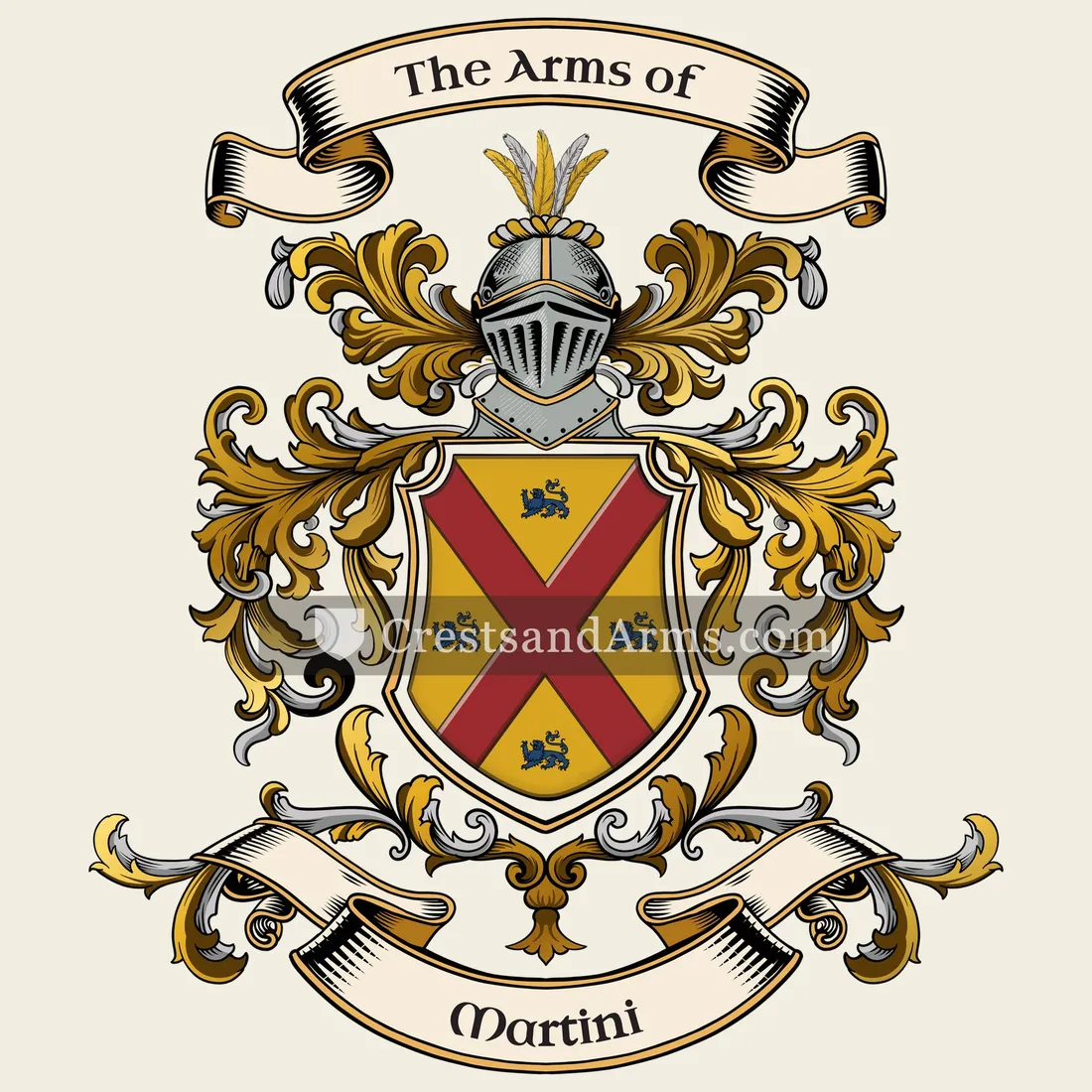
saltireResolution, and St Andrew's cross
lionCourage, strength and royalty
Colours
Gold (Or)Means: Generosity
Red (Gules)Means: Military strength
Blue (Azure)Means: Loyalty and truth
Historical info
Source
J. B. Rietstap, Armorial Général, Gouda: G. B. van Goor Zonen, 1884–87
Blazon (the actual original written record)
“D'or au saut. de gu., acc. aux 1 et 4 d'une tête de lion d'azur et aux 2 et 3 d'une tête de léopard d'azur. C.: un sautoir de gu. L. d'or, d'azur et de gu.”
Germanyc. 1765
Digital archive packCoat of arms PNG, gold border print PDF, vector SVG and the certificate of authenticity. Sent to your email in minutes.
Map of Germany showing where the Martini arms are recorded
The Martini arms were recorded in Germany, c. 1765.
Arms such as these were typically recorded in Bavaria.
Bavaria was a country of old landed families and walled market towns. Estates passed down the same line for centuries, and both the landowners and the leading townsmen kept arms, which is why so many Bavarian names sit in the registers.
This is where the arms were entered in the register. Families often moved to other parts of the country, so the same name can turn up in more than one region.
The body that granted and recorded arms in Germany in this period.
Francis I, Holy Roman Emperor
Sovereign of the period
Francis I, Holy Roman Emperor
1745–1765
Reigning in Belgium when the Martini arms are first recorded.
How Arms Worked in Germany
In the Holy Roman Empire, coats of arms were often granted to individuals by the Emperor or his representatives. These arms were then passed down through the generations to all legitimate descendants of the original holder. Younger branches of a family usually kept the same shield design without needing to change it, as the arms belonged to the entire lineage.
Granting authority
The Holy Roman Emperor held the sole power to grant new coats of arms throughout his vast imperial territories.
How they got arms
Families typically obtained their coats of arms through a formal imperial grant or by proving their noble status to the authorities.
Where arms were recorded
These grants were officially recorded in the Imperial Chancery registers, which began keeping formal records of such honors during the Middle Ages.
The family's standing
Recorded among the armigerous families of Germany.
Origin & History of the Martini Family in Germany
The surname Martini is a Latinized form of the name Martin, which traces its roots back to the Roman god of war, Mars. In the German-speaking regions, particularly in Bavaria, the name became popular due to the widespread influence of Saint Martin of Tours. By the time records confirm the presence of the family in Bavaria in 1765, the name had already evolved from a simple personal name into a hereditary surname used to identify specific family lineages. During this era, families with this name were often integrated into the local agricultural or artisan communities of southern Germany. The transition to a fixed surname allowed these families to maintain a distinct identity as they moved through the social and economic shifts of the eighteenth century. Because the name was tied to a saint, it carried a sense of religious tradition that helped the family establish deep roots within their local Bavarian parishes.
Meaning of the Martini family crest colors & symbols
Symbols on this shield
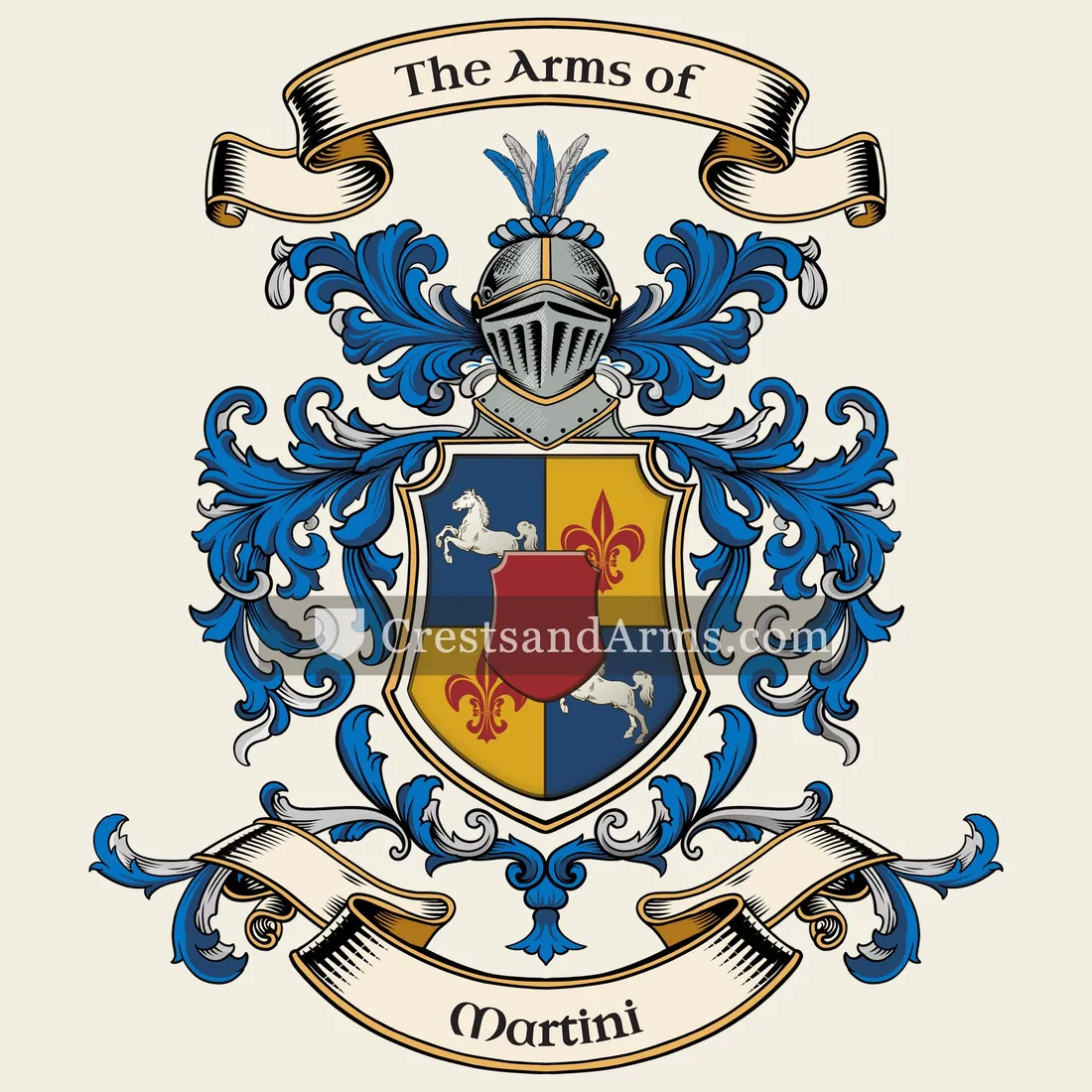
horseReadiness to serve king and country
fleur de lisPurity, light, and the sixth son
Colours
Blue (Azure)Means: Loyalty and truth
Gold (Or)Means: Generosity
Red (Gules)Means: Military strength
Silver (Argent)Means: Peace and sincerity
Historical info
Source
J. B. Rietstap, Armorial Général, Gouda: G. B. van Goor Zonen, 1884–87
Blazon (the actual original written record)
“Ec.: aux 1 et 4 d'azur à un cheval cabré d'arg., la queue levée; aux 2 et 3 d'or à une fleur-de-lis de gu. Sur le tout de gu. à un 5 d'arg. Trois cq. cour. C.: 1° un ange iss. de profil et cont. de carn., supp. de sa main dextre une fleur-de-lis de gu.; 2° un 5 d'arg. entre un vol de sa., les plumes ext. d'arg.; 3° le cheval du 1, iss. L. d'arg. et d'azur. S.: deux lévriers reg. d'arg., coll. de gu.”
TyrolTyrol, c. 1772
Digital archive packCoat of arms PNG, gold border print PDF, vector SVG and the certificate of authenticity. Sent to your email in minutes.
Map of Austria showing where the Martini arms are recorded
The Martini arms were recorded in Tyrol, c. 1772.
Tyrol was mountain country in western Austria, where the valleys were held by families who had been there a very long time. Old tenure counted for more than money, and old families carried arms.
This is where the arms were entered in the register. Families often moved to other parts of the country, so the same name can turn up in more than one region.
Region
Tyrol
First recorded
1772
Granting Authority for the Martini Arms
Imperial and Royal chancery
Sodacan · CC BY-SA 3.0
The body that granted and recorded arms in Austria in this period.
Joseph II, Holy Roman Emperor
Sovereign of the period
Joseph II, Holy Roman Emperor
1765–1790
Reigning in Belgium when the Martini arms are first recorded.
How Arms Worked in Austria
Austrian coats of arms were often linked directly to noble titles granted by the Emperor. These symbols belonged to the entire family line rather than just one individual. When a family grew, new branches kept the original design without needing to change it. This system allowed all members of a noble house to share the same identity across many generations.
Granting authority
The Imperial and Royal chancery managed all heraldic matters and controlled the official granting of arms throughout the Austrian lands.
How they got arms
Families typically received their arms through a formal imperial decree that often accompanied the elevation of a person to noble status.
Where arms were recorded
Official records of these grants were kept in the Imperial Register of Nobility which began its formal documentation process in 1453.
The family's standing
Recorded among the armigerous families of Tyrol.
Origin & History of the Martini Family in Austria
The name Martini has deep roots in the Alpine regions of Europe, particularly within the historical territory of Tyrol. By the year 1772, members of the Martini family were already well-established figures in this mountainous landscape, which was then a vital part of the Habsburg Empire. The name itself is a patronymic, derived from the Latin name Martinus, which honors Saint Martin of Tours. In the context of 18th-century Tyrol, families with this name were often integrated into the local social fabric as landowners, craftsmen, or regional administrators. Living in such a rugged environment required the family to adapt to the unique cultural blend of Germanic and Italian influences that defined the region. Their presence in official records from this era suggests that they were active participants in the economic and civic life of the Austrian provinces during a time of significant imperial reform.
Martini Meaning & Related Branches
Root word
Martinus
Derived from Mars, the Roman god of war.
This name
MartiniA patronymic surname indicating descent from someone named Martin, meaning dedicated to Mars.
also spelled
Martiny
Martinee
Related arms
Adamisimilar arms
Aissema d'Alszheimsimilar arms
Glimenheimsimilar arms
Martinyvariant spelling
Documented Sources
J. B. Rietstap, Armorial Général, Gouda: G. B. van Goor Zonen, 1884–87
Stadsarchief Antwerpen, Doopregisters van de Sint-Jacobskerk, 1737
Stadsarchief Antwerpen, Poortersboeken van de stad Antwerpen, 1737
Verstraelen, J., De Antwerpse bevolking in de 18e eeuw, 1974
Digital archive packCoat of arms PNG, gold border print PDF, vector SVG and the certificate of authenticity. Sent to your email in minutes.


 cross symbolChristian faith and service
 lionCourage, strength and royalty
 cross symbolChristian faith and service
 lionCourage, strength and royalty


 saltireResolution, and St Andrew's cross


 horseReadiness to serve king and country
 fleur de lisPurity, light, and the sixth son