Map of Switzerland showing where the Marty arms are recorded
The Marty arms were recorded in Switzerland, c. 1705.
Arms such as these were typically recorded in Bern.
Bern was the largest of the Swiss cantons and ran itself, with its own council and its own courts. Its governing families held office for generations, and office of that kind carried a shield with it.
This is where the arms were entered in the register. Families often moved to other parts of the country, so the same name can turn up in more than one region.
The body that granted and recorded arms in Switzerland in this period.
How Arms Worked in Switzerland
In Switzerland, coats of arms were not restricted to the nobility and were often adopted by common citizens and families. These symbols were passed down through generations to show family identity. When branches of a family grew, they often changed small details of the design to distinguish their own line from the original group.
Granting authority
Cantonal and civic authorities managed the use of coats of arms within their specific regions and local jurisdictions.
How they got arms
Families typically assumed their own coats of arms based on local custom rather than receiving them from a central monarch.
Where arms were recorded
Arms were recorded in various cantonal and civic registers starting from the fourteenth century throughout the Swiss region.
The family's standing
Recorded among the armigerous families of Switzerland.
Origin & History of the Marty Family in Switzerland
The surname Marty has deep roots in the alpine regions of Switzerland, where it functioned as a patronymic name derived from the given name Martin. By the early 18th century, the family had established a notable presence in the city of Bern, which served as a major political and cultural hub during that era. Families like the Martys often lived as citizens within the city walls or as farmers in the surrounding cantons, contributing to the local economy through trade and agriculture. Because the name is linked to the Latin name Martinus, which means dedicated to Mars, it reflects a long history of naming traditions common in central Europe. By 1705, records indicate that members of the Marty family were integrated into the social fabric of the region, participating in the civic life and religious communities that defined Swiss society at the time.
Marty Meaning & Related Branches
Root word
Martinus
Derived from Mars, the Roman god of war.
This name
MartyA patronymic surname indicating a descendant of someone named Martin, meaning dedicated to Mars.
also spelled
Marty
Documented Sources
J. B. Rietstap, Armorial Général, Gouda: G. B. van Goor Zonen, 1884–87
Familiennamenbuch der Schweiz (Swiss Family Name Book), 1989
Müller, Josef, Die schweizerischen Familiennamen, 1927
Staatsarchiv des Kantons Bern, Burgerrodel (Citizenship Registers)
Staatsarchiv des Kantons Bern, Kirchenbücher (Church Records)
Digital archive packCoat of arms PNG, gold border print PDF, vector SVG and the certificate of authenticity. Sent to your email in minutes.


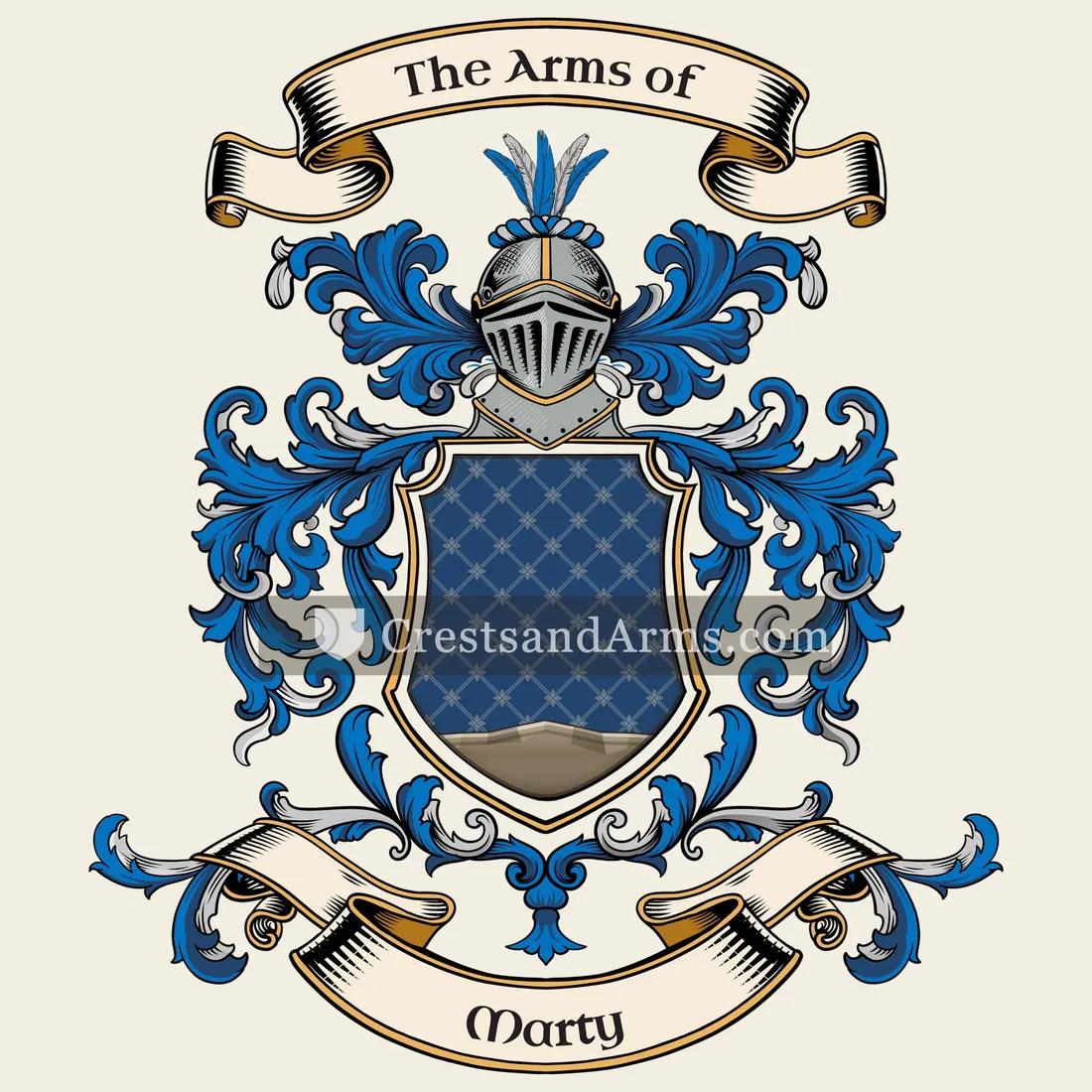
 mountThe ground held, and steadfastness upon it
 mountThe ground held, and steadfastness upon it