Map of France showing where the Maruca arms are recorded
The Maruca arms were recorded in Languedoc, c. 1663.
Languedoc stretched across the south of France, a country of small towns, vineyards and old local families. Its gentry were numerous rather than grand, and a great many of them held arms even where their estates were modest.
This is where the arms were entered in the register. Families often moved to other parts of the country, so the same name can turn up in more than one region.
The body that granted and recorded arms in France in this period.
Louis XIV of France
Sovereign of the period
Louis XIV of France
1643–1715
Reigning in France when the Maruca arms are first recorded.
How Arms Worked in France
In France, a coat of arms was a mark of honor that passed down through the male line to all legitimate descendants. Families often used the same shield without changes to show their shared heritage. If a branch wanted to stand out, they could add a small mark to their shield to show their specific place in the family tree.
Granting authority
The Juge d'armes de France acted as the official authority that regulated and verified coats of arms across the country.
How they got arms
Families typically inherited their arms from ancestors, though they could also receive them through royal grants or by proving their noble status.
Where arms were recorded
Coats of arms were officially recorded in the Armorial Général de France, which began its main collection in the year 1696.
The family's standing
Recorded among the armigerous families of Languedoc.
Origin & History of the Maruca Family in France
The Maruca family name finds its historical roots in the sun-drenched region of Languedoc, where records confirm their presence as early as 1663. During this period, the Languedoc area was a hub of agricultural activity and religious transition, deeply influenced by the cultural shifts of southern France. Families living in this region often identified closely with the local Occitan language and traditions, which shaped the way their names were recorded in parish registers and legal documents. As the Maruca family established themselves in these rural communities, they likely participated in the local viticulture and trade networks that defined the economy of the seventeenth century. Their early history reflects the broader experience of families living in the French provinces, where life was centered around the rhythms of the land and the local parish church. By maintaining a documented presence in Languedoc, the family became part of the enduring social fabric of a region known for its distinct heritage and long-standing traditions.
Meaning of the Maruca family crest colors & symbols
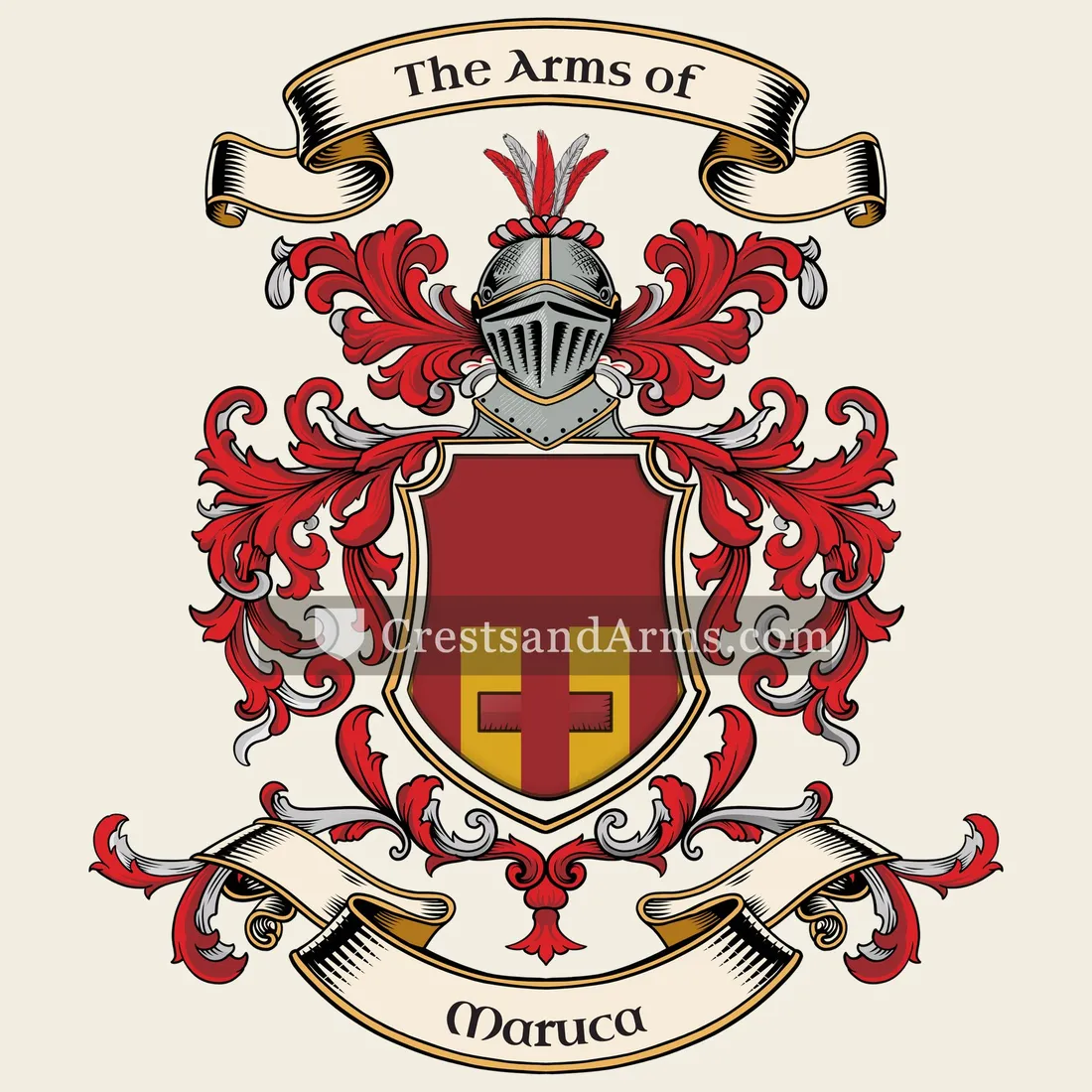
Symbols on this shield
cross symbolChristian faith and service
paleMilitary strength, and a fortified defence
Colours
Red (Gules)Means: Military strength
Gold (Or)Means: Generosity
Historical info
Source
J. B. Rietstap, Armorial Général, Gouda: G. B. van Goor Zonen, 1884–87
Blazon (the actual original written record)
“Coupé: au 1 parti: a. de gu. à un sac fermé et lié de sa.; b. d'or à une croix patriarcale de trois traverses de gu., posée en barre; au 2 d'or à trois pals de gu. Cq. cour. C.: un chien braque iss. de sa., coll. d'un ruban flottant d'or, tenant entre ses pattes une étoile du même. L. d'or et de sa.”
Germanyc. 1813
Digital archive packCoat of arms PNG, gold border print PDF, vector SVG and the certificate of authenticity. Sent to your email in minutes.
Map of Germany showing where the Maruca arms are recorded
The Maruca arms were recorded in Germany, c. 1813.
Arms such as these were typically recorded in Bavaria.
Bavaria was a country of old landed families and walled market towns. Estates passed down the same line for centuries, and both the landowners and the leading townsmen kept arms, which is why so many Bavarian names sit in the registers.
This is where the arms were entered in the register. Families often moved to other parts of the country, so the same name can turn up in more than one region.
The body that granted and recorded arms in Germany in this period.
Frederick William III of Prussia
Sovereign of the period
Frederick William III of Prussia
1797–1840
Reigning in France when the Maruca arms are first recorded.
How Arms Worked in Germany
Prussian heraldry was strictly tied to social rank and noble status rather than being a free choice for every citizen. These symbols were treated as permanent family property that moved through the generations to all legitimate heirs. If a family branch wanted to change their design to stand out, they had to apply for official permission to alter their specific version of the shield.
Granting authority
The Prussian Heroldsamt acted as the central state office that managed and strictly controlled all noble titles and coats of arms.
How they got arms
Families usually obtained their arms through formal royal grants or by proving their long-standing noble status to the state authorities.
Where arms were recorded
All official coats of arms were kept in the rolls of the Prussian Heroldsamt, which functioned from 1706 until 1918.
The family's standing
Recorded among the armigerous families of Germany.
Origin & History of the Maruca Family in Germany
The surname Maruca carries a distinct history that traces back to the southern regions of Germany, specifically within the state of Bavaria. By the early nineteenth century, records confirm that families bearing this name were well-established in the Bavarian landscape during a period of significant political and social transition. The name likely evolved as a localized variation of regional naming customs, reflecting the movement of people across the borders of the Holy Roman Empire and the later German Confederation. During the year 1813, these families were living through the turbulent era of the Napoleonic Wars, which reshaped the administration of local census and parish records. As these families navigated the changing laws of the Bavarian Kingdom, they helped anchor the name within the local culture, leaving behind a legacy that bridges the gap between traditional rural life and the modernization of the German state.
Maruca Meaning & Related Branches
Root word
Marcus
Derived from the Roman god Mars, meaning dedicated to Mars.
This name
MarucaA diminutive or variant form indicating a descendant or follower of Marcus.
also spelled
Marck
Marqua
Marka
Documented Sources
J. B. Rietstap, Armorial Général, Gouda: G. B. van Goor Zonen, 1884–87
Archives départementales de l'Hérault, Registres paroissiaux et d'état civil, 1663
Le Roy Ladurie, Emmanuel, Les Paysans de Languedoc, 1966
Digital archive packCoat of arms PNG, gold border print PDF, vector SVG and the certificate of authenticity. Sent to your email in minutes.


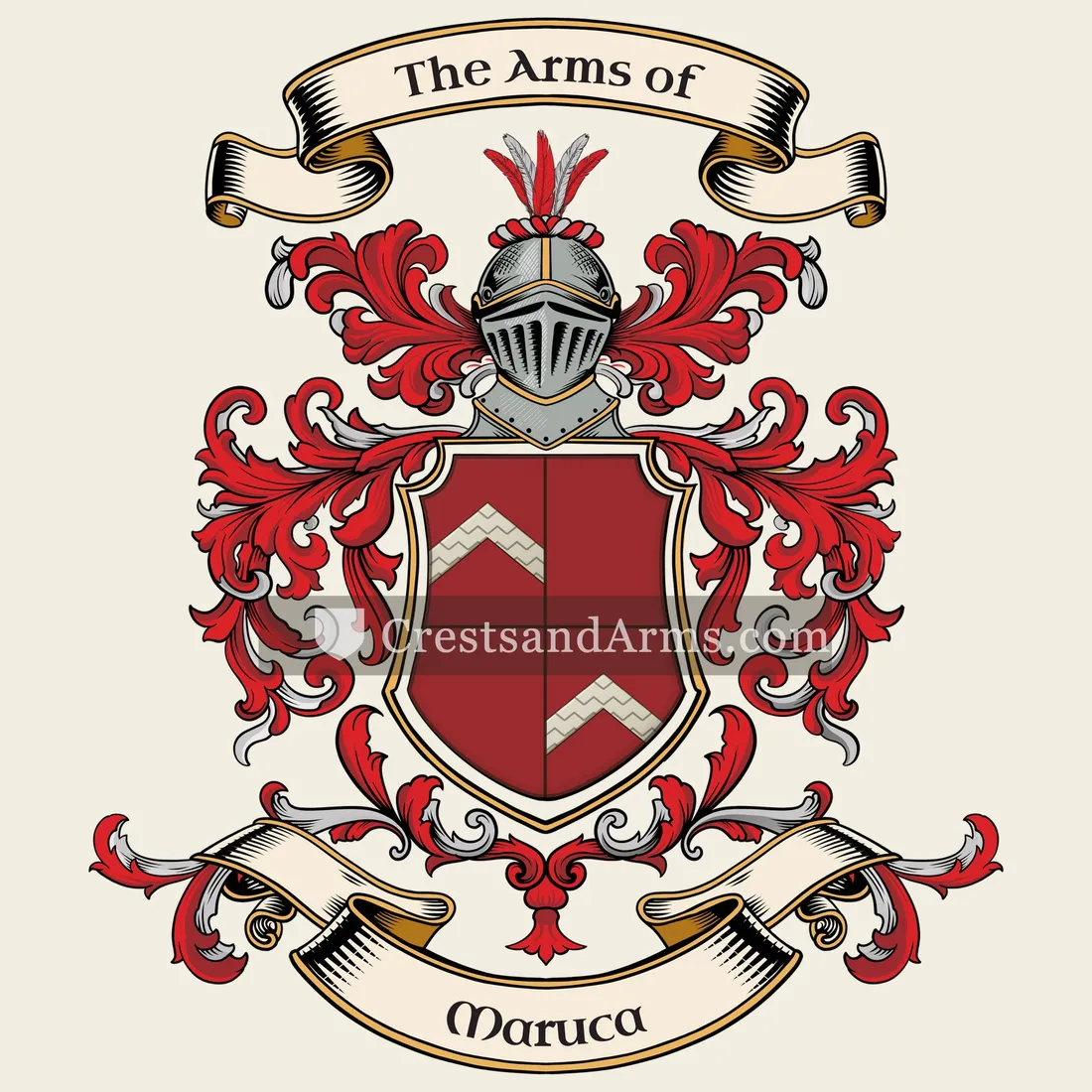


 cross symbolChristian faith and service
 paleMilitary strength, and a fortified defence