Map of France showing where the Masi arms are recorded
The Masi arms were recorded in France, c. 1663.
Arms such as these were typically recorded in Bretagne.
More families held coats of arms in Bretagne than anywhere else in France. The land was divided into many small estates rather than a few large ones, so far more households counted as gentry, and each needed a shield of its own to be told apart.
This is where the arms were entered in the register. Families often moved to other parts of the country, so the same name can turn up in more than one region.
The body that granted and recorded arms in France in this period.
Louis XIV of France
Sovereign of the period
Louis XIV of France
1643–1715
Reigning in France when the Masi arms are first recorded.
How Arms Worked in France
In France, a coat of arms was a mark of honor that passed down through the male line to all legitimate descendants. Families often used the same shield without changes to show their shared heritage. If a branch wanted to stand out, they could add a small mark to their shield to show their specific place in the family tree.
Granting authority
The Juge d'armes de France acted as the official authority that regulated and verified coats of arms across the country.
How they got arms
Families typically inherited their arms from ancestors, though they could also receive them through royal grants or by proving their noble status.
Where arms were recorded
Coats of arms were officially recorded in the Armorial Général de France, which began its main collection in the year 1696.
The family's standing
Recorded among the armigerous families of France.
Origin & History of the Masi Family in France
The history of the Masi family in France is deeply rooted in the cultural landscape of the seventeenth century, particularly within the region of Bretagne. By the year 1663, records confirm that members of the family were already established in this coastal province, which was known for its distinct traditions and strong local identity. The name likely evolved from regional naming patterns that focused on personal characteristics or ancestral origins common to the area. Life in Bretagne during this period was defined by agricultural work and maritime trade, and families like the Masis were part of the social fabric that supported the local parishes and rural communities. As they settled into the region, they contributed to the steady growth of the local population and the preservation of the unique customs that defined life in western France. Their presence in the historical record during the mid-1600s highlights a period of stability and integration for the family as they navigated the challenges and opportunities of life in the French countryside.
Coat of Arms & Family Crest Details
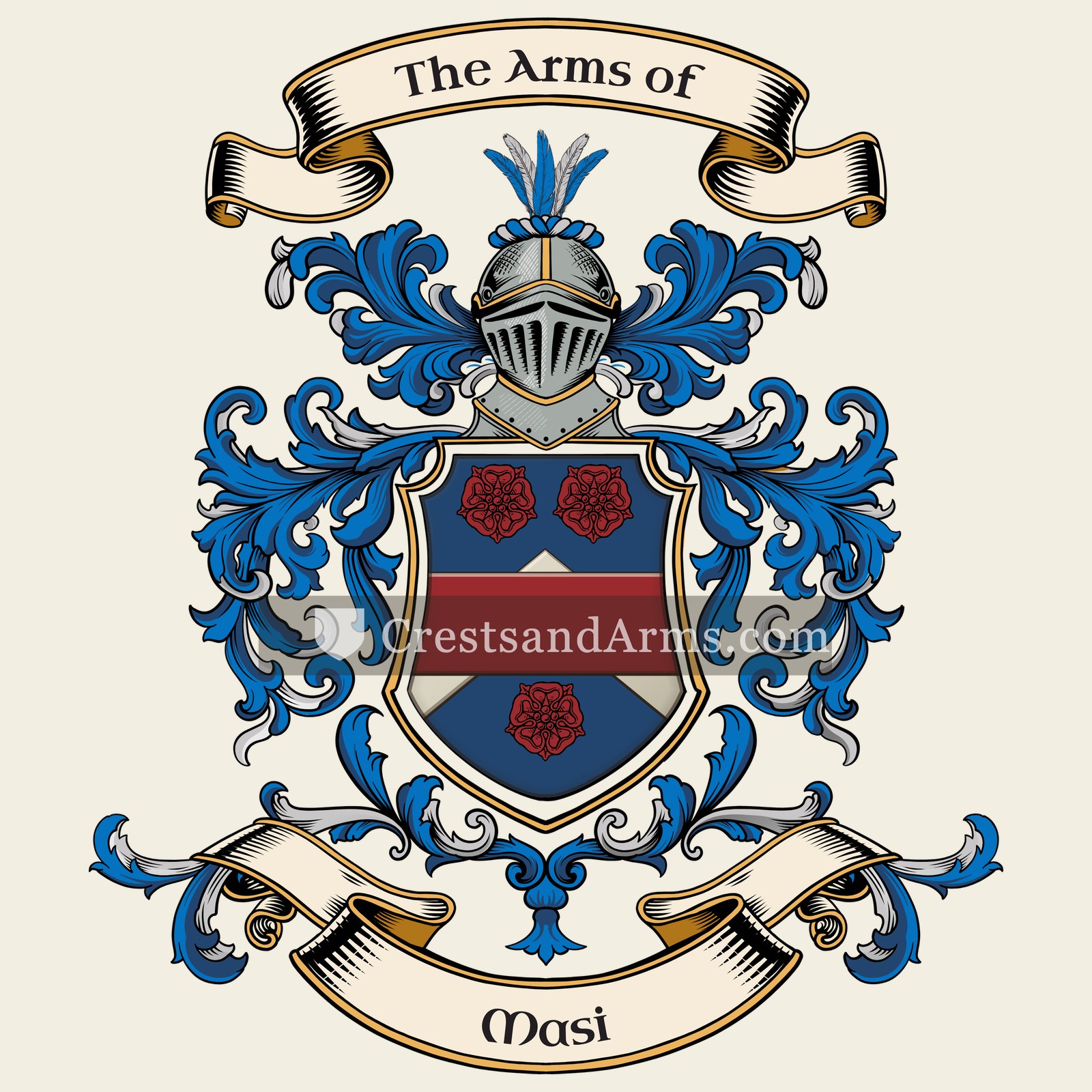
Symbols on this shield
chevronProtection, and faithful service completed
fessThe military belt, and readiness to serve
roseThe seventh son, and beauty with grace
Colours
Blue (Azure)Means: Loyalty and truth
Silver (Argent)Means: Peace and sincerity
Red (Gules)Means: Military strength
Historical info
Source
J. B. Rietstap, Armorial Général, Gouda: G. B. van Goor Zonen, 1884–87
Blazon (the actual original written record)
“D'azur au chev. d'arg., acc. de trois roses de gu.; à la fasce du dernier, br. sur le tout.”
ItalyFlorence, c. 1775
Digital archive packCoat of arms PNG, gold border print PDF, vector SVG and the certificate of authenticity. Sent to your email in minutes.
Map of Italy showing where the Masi arms are recorded
The Masi arms were recorded in Florence, c. 1775.
This is where the arms were entered in the register. Families often moved to other parts of the country, so the same name can turn up in more than one region.
The body that granted and recorded arms in Italy in this period.
Alvise Giovanni Mocenigo
Sovereign of the period
Alvise Giovanni Mocenigo
1763–1778
Reigning in France when the Masi arms are first recorded.
How Arms Worked in Italy
In the Italian states, coats of arms were often used by noble families to show their status and history. These symbols were passed down through the generations to all legitimate male descendants. Younger branches of a family usually kept the original design but sometimes added small changes to distinguish their specific line from the main branch.
Granting authority
Various local rulers and city governments controlled the use of coats of arms across the different Italian states.
How they got arms
Families often assumed their own arms or received them as official grants from local lords, popes, or city councils.
Where arms were recorded
Arms were recorded in local city archives or private family books rather than in one single national register.
The family's standing
Recorded among the armigerous families of Italy.
Origin & History of the Masi Family in Italy
The surname Masi holds deep roots in the Italian peninsula, particularly within the cultural heart of Tuscany. While the name appears in various regions, its presence in Florence by 1775 highlights a family deeply embedded in the urban life of one of history’s most significant cities. During this era, families like the Masi were often part of the rising merchant and artisan classes that defined the social fabric of Florence. The name itself is thought to be a shortened form of the name Tommaso, which was a common practice in Italy to create affectionate or practical nicknames for ancestors. As these individuals lived and worked in the city, they participated in the local economy and civic traditions that allowed the Masi name to persist through generations. By the late 18th century, the family was well-established, contributing to the steady growth of the Florentine population during a time of great social change.
Related Branches & Arms
Root word
Thomas
Aramaic for twin
This name
MasiA patronymic surname derived from a diminutive form of the name Thomas.
also spelled
Massi
Masy
Mazi
Documented Sources
J. B. Rietstap, Armorial Général, Gouda: G. B. van Goor Zonen, 1884–87
Archives départementales d'Ille-et-Vilaine, Série B (Cours et juridictions)
Archives départementales du Finistère, Série E (Familles et seigneuries)
Gautier, Hervé. Histoire de la Bretagne. 1993
Le Moyne de La Borderie, Arthur. Histoire de Bretagne. 1896
Digital archive packCoat of arms PNG, gold border print PDF, vector SVG and the certificate of authenticity. Sent to your email in minutes.


 paleMilitary strength, and a fortified defence
 paleMilitary strength, and a fortified defence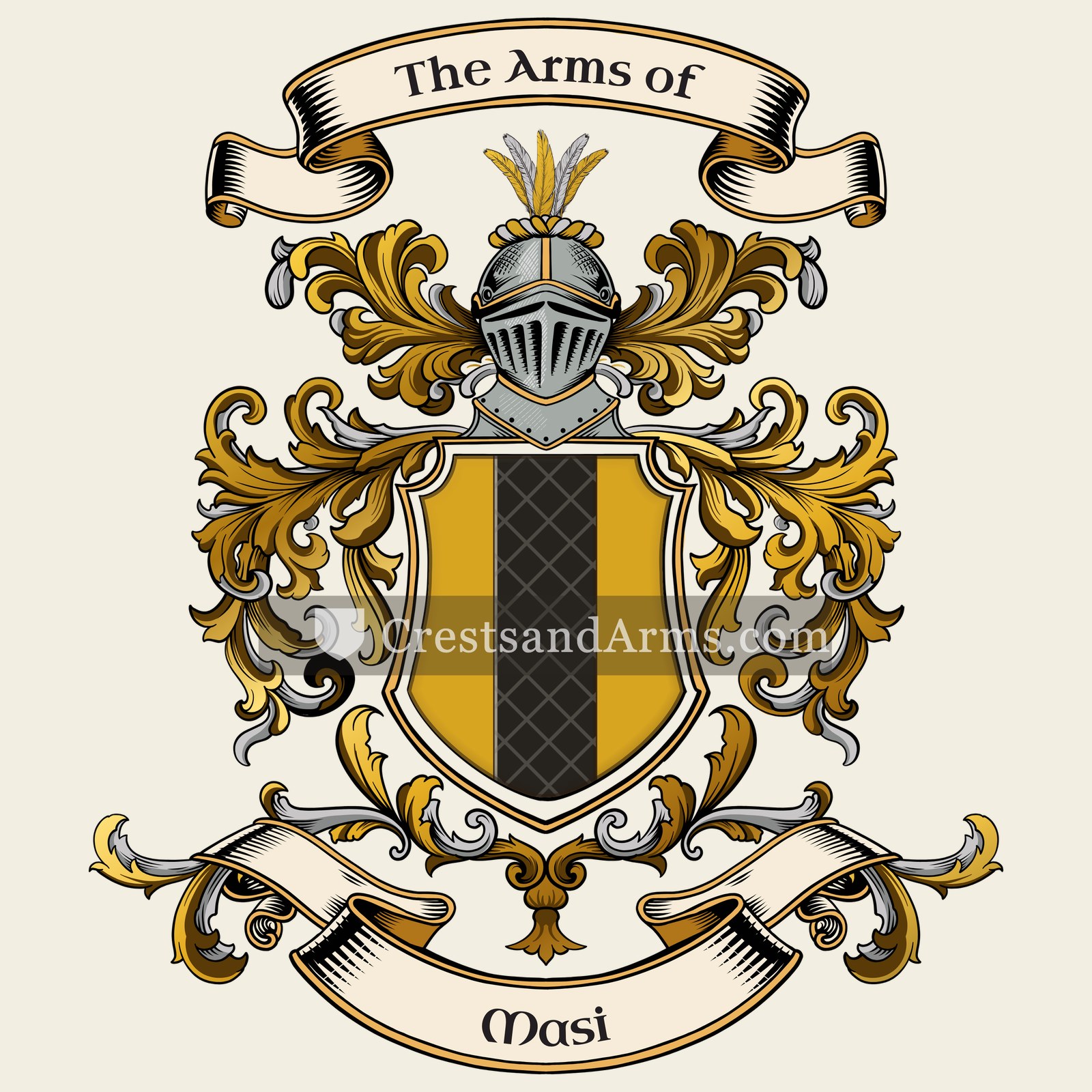


 chevronProtection, and faithful service completed
 fessThe military belt, and readiness to serve
 roseThe seventh son, and beauty with grace