Map of Poland showing where the Maslow arms are recorded
The Maslow arms were recorded in Livonia, c. 1772.
Livonia was Baltic country held by a small number of landed families who kept their estates for centuries. Land there passed down whole rather than being divided, and long unbroken tenure is what fills a register.
This is where the arms were entered in the register. Families often moved to other parts of the country, so the same name can turn up in more than one region.
Region
Livonia
First recorded
1772
Granting Authority for the Maslow Arms
Ennoblement by the Sejm
Author: Olek Remesz · CC BY-SA 3.0
The body that granted and recorded arms in Poland in this period.
Stanisław August Poniatowski
Sovereign of the period
Stanisław August Poniatowski
1764–1795
Reigning in Poland when the Maslow arms are first recorded.
How Arms Worked in Poland
Polish noble families shared a single coat of arms across many different surnames, creating large clans rather than individual designs. These symbols were held collectively by all members of the clan regardless of their specific family name. When a new family joined the nobility, they were adopted into an existing clan and began using that group's established shield.
Granting authority
The Sejm, which was the Polish parliament, held the power to grant noble status and the right to bear arms.
How they got arms
Families typically received their coat of arms through a formal act of ennoblement granted by the Sejm for distinguished service.
Where arms were recorded
These grants were officially recorded in the Crown Metrica, which served as the central archive for state documents starting in the sixteenth century.
The family's standing
Recorded among the armigerous families of Livonia.
Origin & History of the Maslow Family in Poland
The surname Maslow is deeply rooted in the history of the Baltic region, particularly within the territory of Livonia. By 1772, members of the family were well-established in this area, which was a crossroads for diverse cultures and shifting political borders between the Russian Empire and the Baltic provinces. The name itself is thought to be derived from Slavic linguistic origins, often associated with the root word for "oil" or "butter," which suggests that early ancestors may have been involved in agriculture or trade. As the family lived in Livonia, they likely navigated a complex society where German, Latvian, and Russian influences shaped daily life. Over time, the family name became a marker of their presence in these northern lands, reflecting a history tied to the rural development and the evolving social structures of the eighteenth century.
Related Branches & Arms
Root word
Masło
A Polish word referring to butter or a buttery substance.
This name
MaslowA topographic or occupational surname likely denoting a butter maker or merchant.
also spelled
Maslowe
Documented Sources
J. B. Rietstap, Armorial Général, Gouda: G. B. van Goor Zonen, 1884–87
Kasekamp, Andres. A History of the Baltic States. 2010
Plakans, Andrejs. The Latvians: A Short History. 1995
Latvian State Historical Archives (Latvijas Valsts vēstures arhīvs), Fond 235 (Livonian Land Registry Records)
Digital archive packCoat of arms PNG, gold border print PDF, vector SVG and the certificate of authenticity. Sent to your email in minutes.


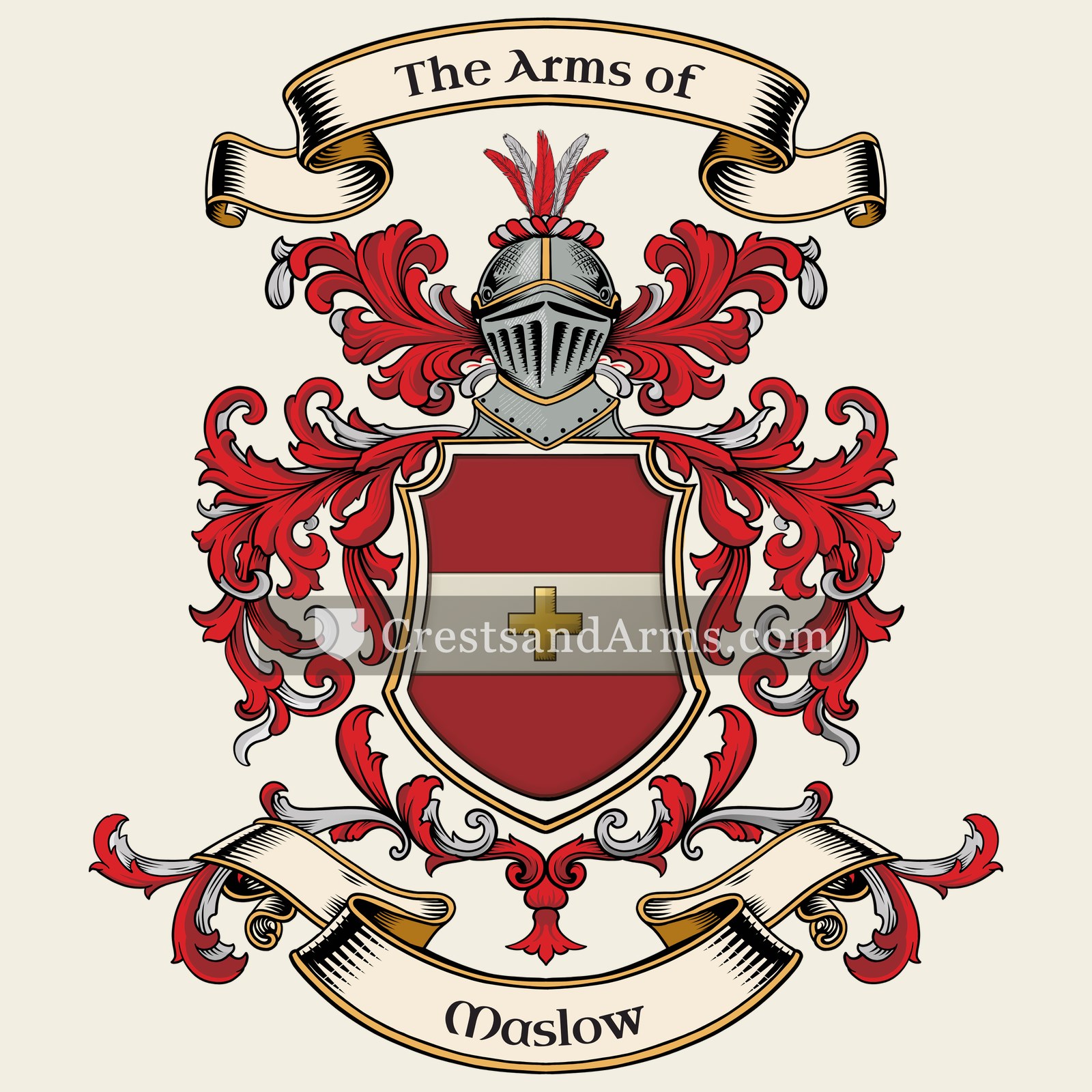
 fessThe military belt, and readiness to serve
 cross symbolChristian faith and service
 fessThe military belt, and readiness to serve
 cross symbolChristian faith and service