Map of France showing where the Mass arms are recorded
The Mass arms were recorded in France, c. 1776.
Arms such as these were typically recorded in Bretagne.
More families held coats of arms in Bretagne than anywhere else in France. The land was divided into many small estates rather than a few large ones, so far more households counted as gentry, and each needed a shield of its own to be told apart.
This is where the arms were entered in the register. Families often moved to other parts of the country, so the same name can turn up in more than one region.
The body that granted and recorded arms in France in this period.
Louis XVI of France
Sovereign of the period
Louis XVI of France
1774–1791
Reigning in France when the Mass arms are first recorded.
How Arms Worked in France
In France, a coat of arms was a mark of honor that passed down through the male line to all legitimate descendants. Families often used the same shield without changes to show their shared heritage. If a branch wanted to stand out, they could add a small mark to their shield to show their specific place in the family tree.
Granting authority
The Juge d'armes de France acted as the official authority that regulated and verified coats of arms across the country.
How they got arms
Families typically inherited their arms from ancestors, though they could also receive them through royal grants or by proving their noble status.
Where arms were recorded
Coats of arms were officially recorded in the Armorial Général de France, which began its main collection in the year 1696.
The family's standing
Recorded among the armigerous families of France.
Origin & History of the Mass Family in France
The surname Mass has deep roots in the historical region of Brittany, where family members were documented as early as 1776. During this period, the name was closely tied to the social and agricultural structures of the French countryside. In the Breton language and local dialects, names often evolved from nicknames or descriptions of a person's trade or physical traits. The name Mass likely originated as a shortened form of names related to the church or as a descriptive term for someone living near a specific landmark. By the late 18th century, families bearing this name were well-integrated into the local parish systems, which served as the primary way for the government to track births, marriages, and deaths. These early ancestors were part of a resilient community that navigated the significant political changes occurring in France during the lead-up to the French Revolution. Their presence in Brittany highlights a long history of regional identity and the steady development of family lineages within the rural landscape of western France.
Meaning of the Mass family crest colors & symbols
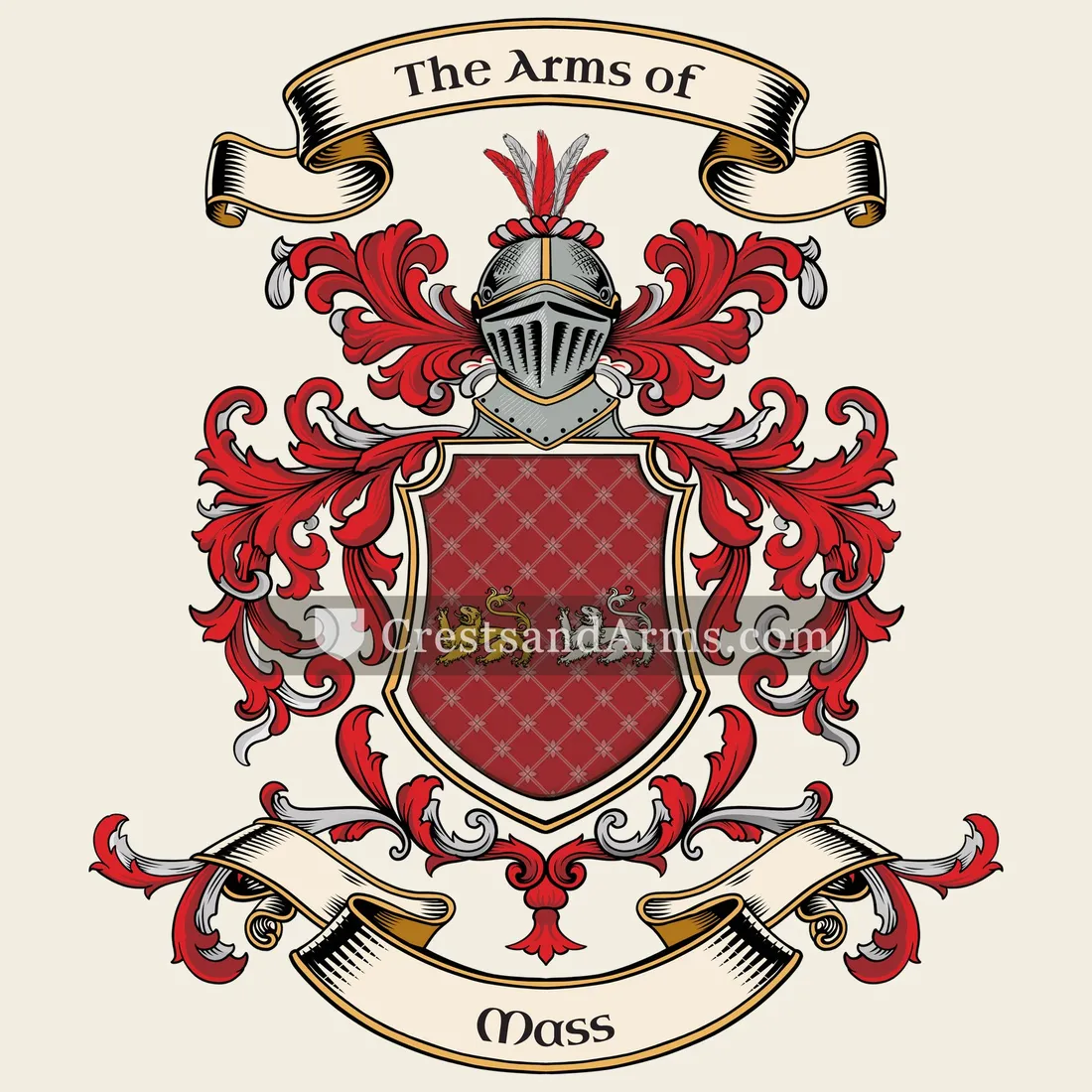
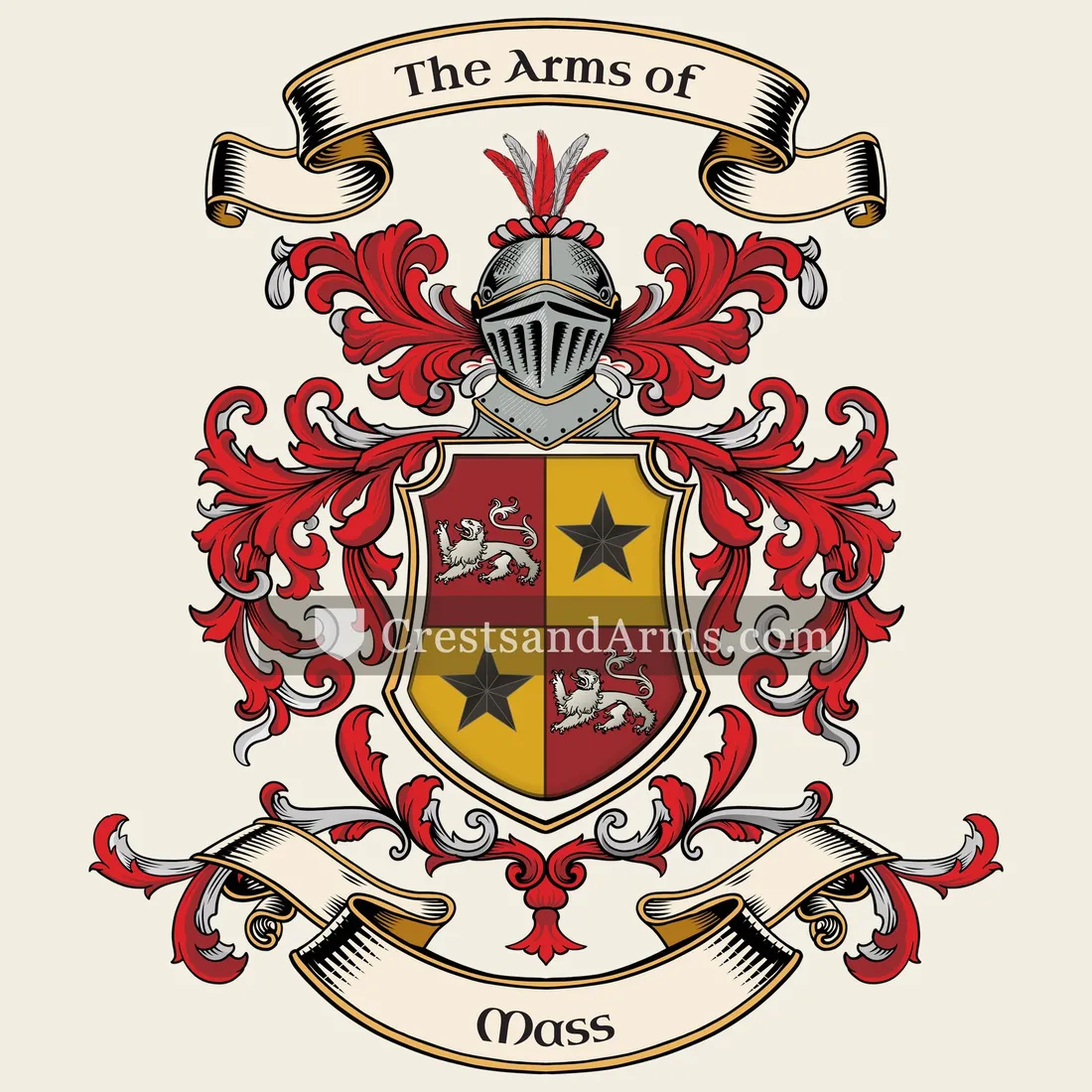
Symbols on this shield
lionCourage, strength and royalty
mulletThe third son, and a divine quality from above
Colours
Red (Gules)Means: Military strength
Gold (Or)Means: Generosity
Silver (Argent)Means: Peace and sincerity
Black (Sable)Means: Constancy
Historical info
Source
Sir Bernard Burke, The General Armory of England, Scotland, Ireland and Wales, London: Harrison & Sons, 1884
Blazon (the actual original written record)
“Quarterly, gu. and or, in the 1st and 4th quarters a lion pass. ar.; in the 2nd and 3rd, a mullet sa”
ChesterAllerborough · Chester, c. 1620
Digital archive packCoat of arms PNG, gold border print PDF, vector SVG and the certificate of authenticity. Sent to your email in minutes.
Map of England showing where the Mass arms are recorded
The Mass arms were recorded in Chester, c. 1620.
Cheshire was governed apart from the rest of England for much of its history, with its own courts and its own gentry. That separateness bred a strong local landed class, and landed families carried arms.
This is where the arms were entered in the register. Families often moved to other parts of the country, so the same name can turn up in more than one region.
The body that granted and recorded arms in England in this period.
James VI and I
Sovereign of the period
James VI and I
1603–1625
Reigning in France when the Mass arms are first recorded.
How Arms Worked in England
English heraldry allowed arms to be shared by all legitimate descendants of the original owner. These symbols were treated as personal property that moved through the generations to all children. While the eldest son kept the original design, other family members could use the same shield without needing to change it or register their own unique versions.
Granting authority
The College of Arms in London has regulated the use of coats of arms throughout England and Wales since 1484.
How they got arms
Families typically obtained their coats of arms through a formal grant from the Crown or by proving their ancient right to them.
Where arms were recorded
All official coats of arms are recorded in the registers kept at the College of Arms, which date back to the fifteenth century.
The family's standing
Recorded among the armigerous families of Chester.
Origin & History of the Mass Family in England
The surname Mass has deep roots in the historical landscape of England, particularly within the city of Chester. By the year 1620, records confirm that members of the Mass family were already established residents in this important regional hub. During the seventeenth century, Chester served as a vital center for trade and military activity, which likely influenced the family’s daily life and professional pursuits. The name itself may have originated as a shortened version of longer occupational or baptismal names common in the region, or it could have been linked to the local dialect of the time. As the family settled into the urban environment of Chester, they became part of the growing merchant and artisan classes that defined the city’s social structure. Their presence in such a well-documented location suggests that the family was integrated into the local community, participating in the civic and religious life that characterized English society during the early modern period.
Meaning of the Mass family crest colors & symbols
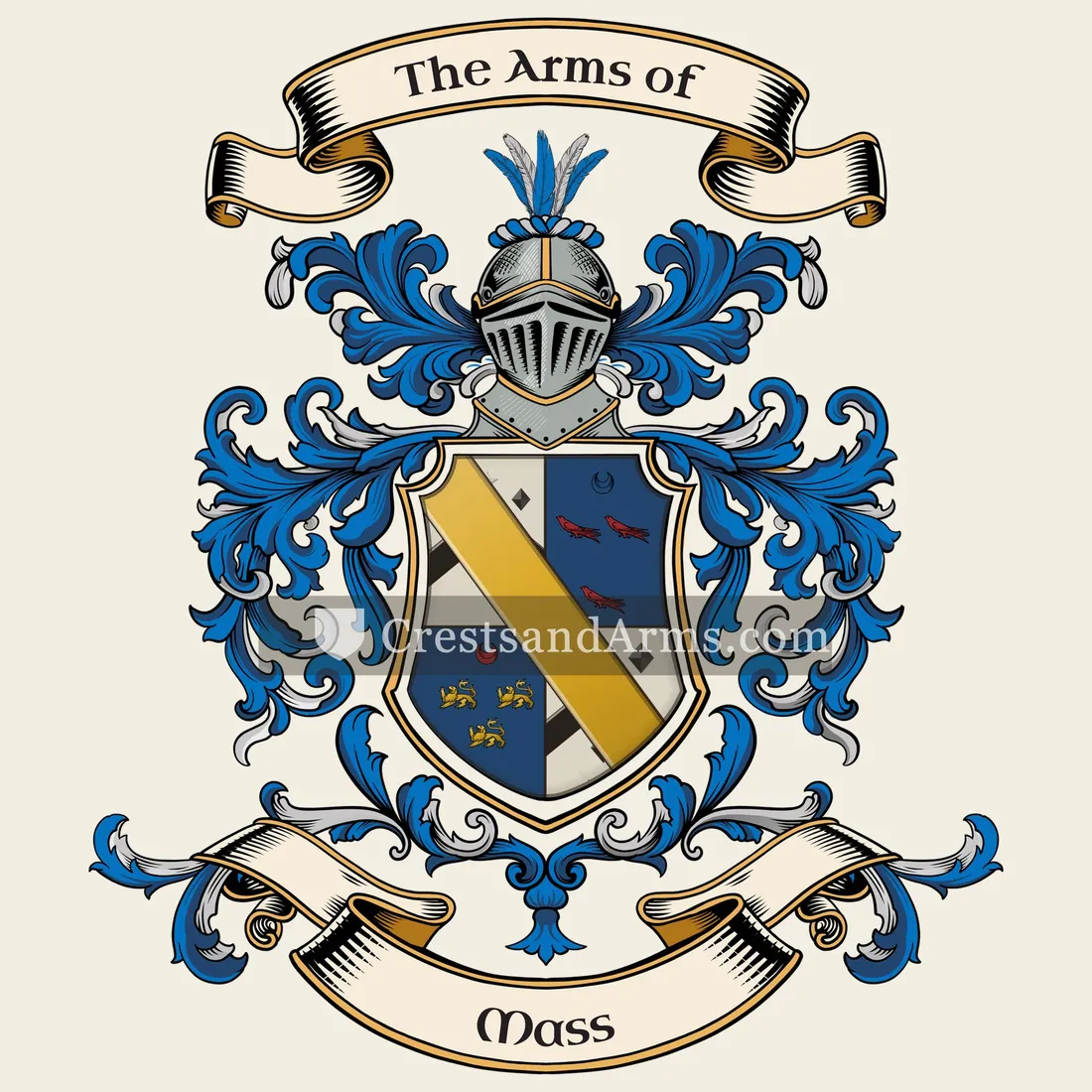
Symbols on this shield
chevronProtection, and faithful service completed
bendDefence, and the scarf of a commander
lozengeHonour and nobility, and the arms of a woman
lionCourage, strength and royalty
mulletThe third son, and a divine quality from above
martletA younger son, who must win his own land
crescentHonour by the sovereign, and the second son
Colours
Silver (Argent)Means: Peace and sincerity
Blue (Azure)Means: Loyalty and truth
Gold (Or)Means: Generosity
Black (Sable)Means: Constancy
Red (Gules)Means: Military strength
Historical info
Source
Sir Bernard Burke, The General Armory of England, Scotland, Ireland and Wales, London: Harrison & Sons, 1884
Blazon (the actual original written record)
“Quarterly, 1st and 4th, ar. on a chev. betw. three fusils sa. a lion pass. or, a mullet for diff., for MASSY; 2nd, az. on bend engr. or, three martlets gu., a crescent for diff., for DAWSON; 3rd, or, on a chev. gu. three lions couchant of the first, a crescent for diff., for BOLTON”
DublinDublin, c. 1842
Digital archive packCoat of arms PNG, gold border print PDF, vector SVG and the certificate of authenticity. Sent to your email in minutes.
Map of Ireland showing where the Mass arms are recorded
The Mass arms were recorded in Dublin, c. 1842.
Dublin was the seat of government in Ireland and the place where grants were sought and recorded. Families with business at the castle or the courts settled nearby, and settling there put their arms on record.
This is where the arms were entered in the register. Families often moved to other parts of the country, so the same name can turn up in more than one region.
The body that granted and recorded arms in Ireland in this period.
Victoria
Sovereign of the period
Victoria
1837–1901
Reigning in France when the Mass arms are first recorded.
How Arms Worked in Ireland
The Ulster King of Arms granted coats of arms to individuals who proved their social standing and good character. These symbols were typically inherited by all legitimate descendants of the original holder. If a family branch wanted a unique look, they could apply for a specific change to their design through the office to ensure their identity remained distinct.
Granting authority
The Ulster King of Arms acted as the official body that regulated and issued all coats of arms throughout Ireland.
How they got arms
Families obtained their arms through formal grants issued by the office after proving their eligibility and paying the required fees.
Where arms were recorded
All official grants were recorded in the registers held by the Ulster King of Arms starting from the year 1552.
The family's standing
Recorded among the armigerous families of Dublin.
Origin & History of the Mass Family in Ireland
The history of the Mass family in Ireland is closely tied to the urban development of Dublin during the mid-nineteenth century. While the name likely arrived in Ireland through migration from continental Europe or Great Britain, records confirm that family members were firmly established in the capital city by 1842. During this period, Dublin was a bustling center of trade and industry, and families like the Masses often integrated into the city’s growing professional and merchant classes. They lived through a time of significant social change, witnessing the expansion of the city’s infrastructure and the shifting economic landscape of the Victorian era. By settling in Dublin, the family became part of the city's diverse cultural fabric, contributing to the local community as the nation moved toward the modern age.
Mass Meaning & Related Branches
Root word
Thomas
Derived from the Aramaic word for twin.
This name
MassA patronymic surname originating as a shortened form of the given name Thomas.
also spelled
Massie
Masi
Massey
Macey
Documented Sources
J. B. Rietstap, Armorial Général, Gouda: G. B. van Goor Zonen, 1884–87
Archives départementales du Finistère, Registres paroissiaux et d'état civil
Archives départementales d'Ille-et-Vilaine, Collection de l'état civil
Dauzat, Albert, Dictionnaire étymologique des noms de famille et prénoms de France, 1951
Morlet, Marie-Thérèse, Dictionnaire étymologique des noms de famille, 1991
Digital archive packCoat of arms PNG, gold border print PDF, vector SVG and the certificate of authenticity. Sent to your email in minutes.


 lionCourage, strength and royalty
 lionCourage, strength and royalty


 mulletThe third son, and a divine quality from above


 chevronProtection, and faithful service completed
 bendDefence, and the scarf of a commander
 lozengeHonour and nobility, and the arms of a woman
 martletA younger son, who must win his own land
 crescentHonour by the sovereign, and the second son