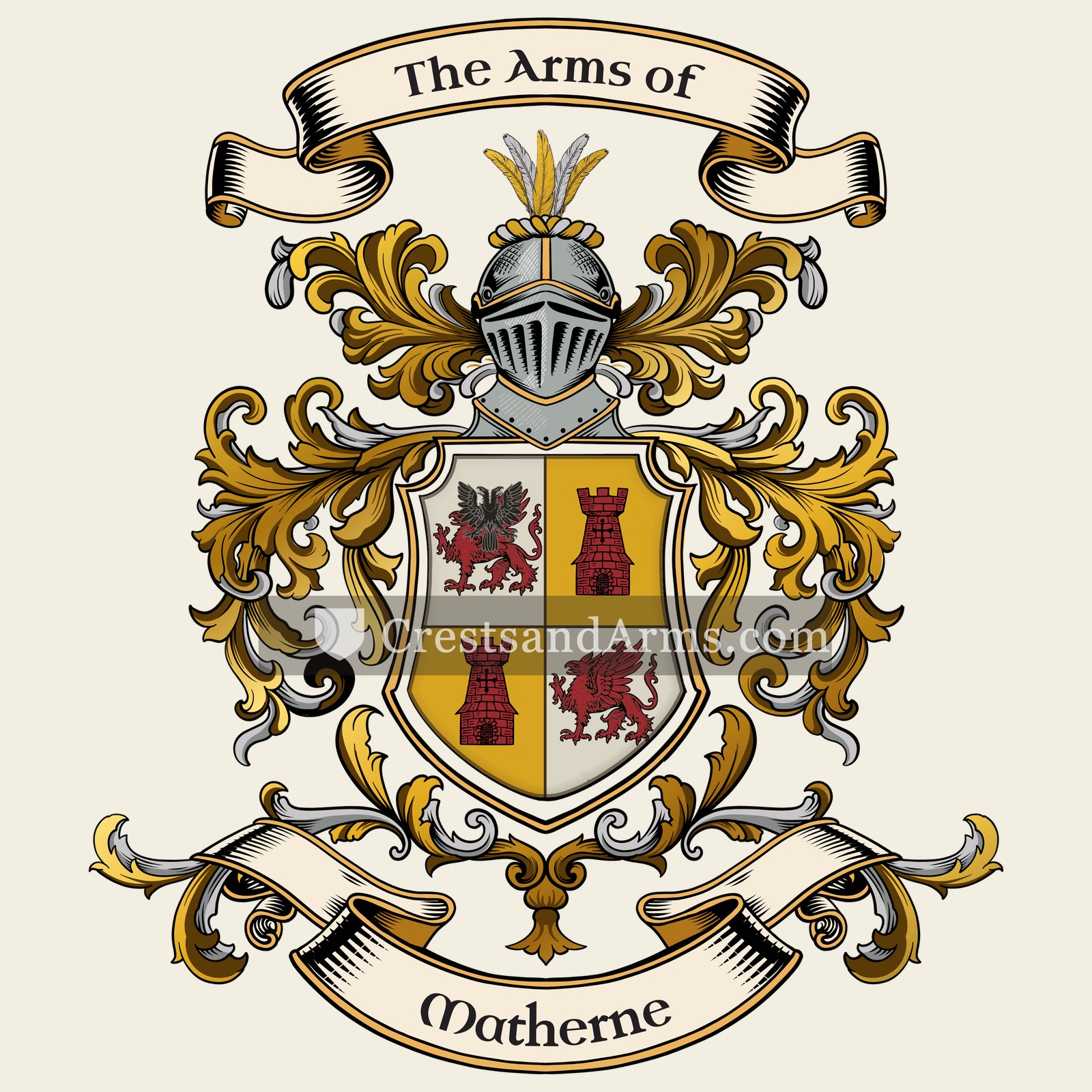
A record of documented arms, meaning and origin, researched for the Matherne family of Germany.
Reg. 1829 · German, M–O
Coat of Arms & Family Crest Details
Symbols on this shield
eagleNobility, strength and a keen mind
griffinValour and vigilance, guarding great treasure
towerGrandeur and solidity, and a stronghold defended
Colours
Silver (Argent)Means: Peace and sincerity
Gold (Or)Means: Generosity
Black (Sable)Means: Constancy
Red (Gules)Means: Military strength
Historical info
Source
J. B. Rietstap, Armorial Général, Gouda: G. B. van Goor Zonen, 1884–87
Blazon (the actual original written record)
“Ec.: aux 1 et 4 d'arg. à un griffon de gu., tenant de ses pattes une verge d'arg. en pal; aux 2 et 3 d'or à une tour de gu., s'élevant de cinq bastions du même. Sur le tout d'arg. à une aigle de sa., bq. et m. d'or. Cq. cour. C.: une aigle iss. de sa., bq. d'or. L.: à dextre d'arg. et de sa., à sen. d'or et de gu.”
Germanyc. 1734
Digital archive packCoat of arms PNG, gold border print PDF, vector SVG and the certificate of authenticity. Sent to your email in minutes.
Map of Germany showing where the Matherne arms are recorded
The Matherne arms were recorded in Germany, c. 1734.
Arms such as these were typically recorded in Bavaria.
Bavaria was a country of old landed families and walled market towns. Estates passed down the same line for centuries, and both the landowners and the leading townsmen kept arms, which is why so many Bavarian names sit in the registers.
This is where the arms were entered in the register. Families often moved to other parts of the country, so the same name can turn up in more than one region.
The body that granted and recorded arms in Germany in this period.
Charles VI, Holy Roman Emperor
Sovereign of the period
Charles VI, Holy Roman Emperor
1711–1740
Reigning in Germany when the Matherne arms are first recorded.
How Arms Worked in Germany
In the Holy Roman Empire, coats of arms were often granted to individuals by the Emperor or his representatives. These arms were then passed down through the generations to all legitimate descendants of the original holder. Younger branches of a family usually kept the same shield design without needing to change it, as the arms belonged to the entire lineage.
Granting authority
The Holy Roman Emperor held the sole power to grant new coats of arms throughout his vast imperial territories.
How they got arms
Families typically obtained their coats of arms through a formal imperial grant or by proving their noble status to the authorities.
Where arms were recorded
These grants were officially recorded in the Imperial Chancery registers, which began keeping formal records of such honors during the Middle Ages.
The family's standing
Recorded among the armigerous families of Germany.
Origin & History of the Matherne Family in Germany
The Matherne family name finds its historical roots in the region of Bavaria during the early eighteenth century. Records confirm that members of the family were established in this German territory by 1734. During this era, Bavaria was a landscape defined by small agricultural communities and strict social structures. Families like the Mathernes often lived in rural villages where they worked the land or practiced specialized trades to support their local economy. As the eighteenth century progressed, political instability and economic shifts prompted many families from this region to seek new opportunities abroad. This migration pattern eventually led members of the Matherne family to leave their ancestral home in Central Europe and travel across the Atlantic to settle in new territories, where they helped shape the development of their new communities.
Related Branches & Arms
Root word
Matthäus
Derived from the Hebrew name Matityahu meaning gift of God.
This name
MatherneA locative or patronymic surname indicating a descendant of someone named Matthew.
Documented Sources
J. B. Rietstap, Armorial Général, Gouda: G. B. van Goor Zonen, 1884–87


 eagleNobility, strength and a keen mind
 griffinValour and vigilance, guarding great treasure
 towerGrandeur and solidity, and a stronghold defended
 eagleNobility, strength and a keen mind
 griffinValour and vigilance, guarding great treasure
 towerGrandeur and solidity, and a stronghold defended