A record of documented arms, meaning and origin, researched for the Matyi family lines. Documented in 2 countries.
Reg. 3086 · German, M–O
Meaning of the Matyi family crest colors & symbols
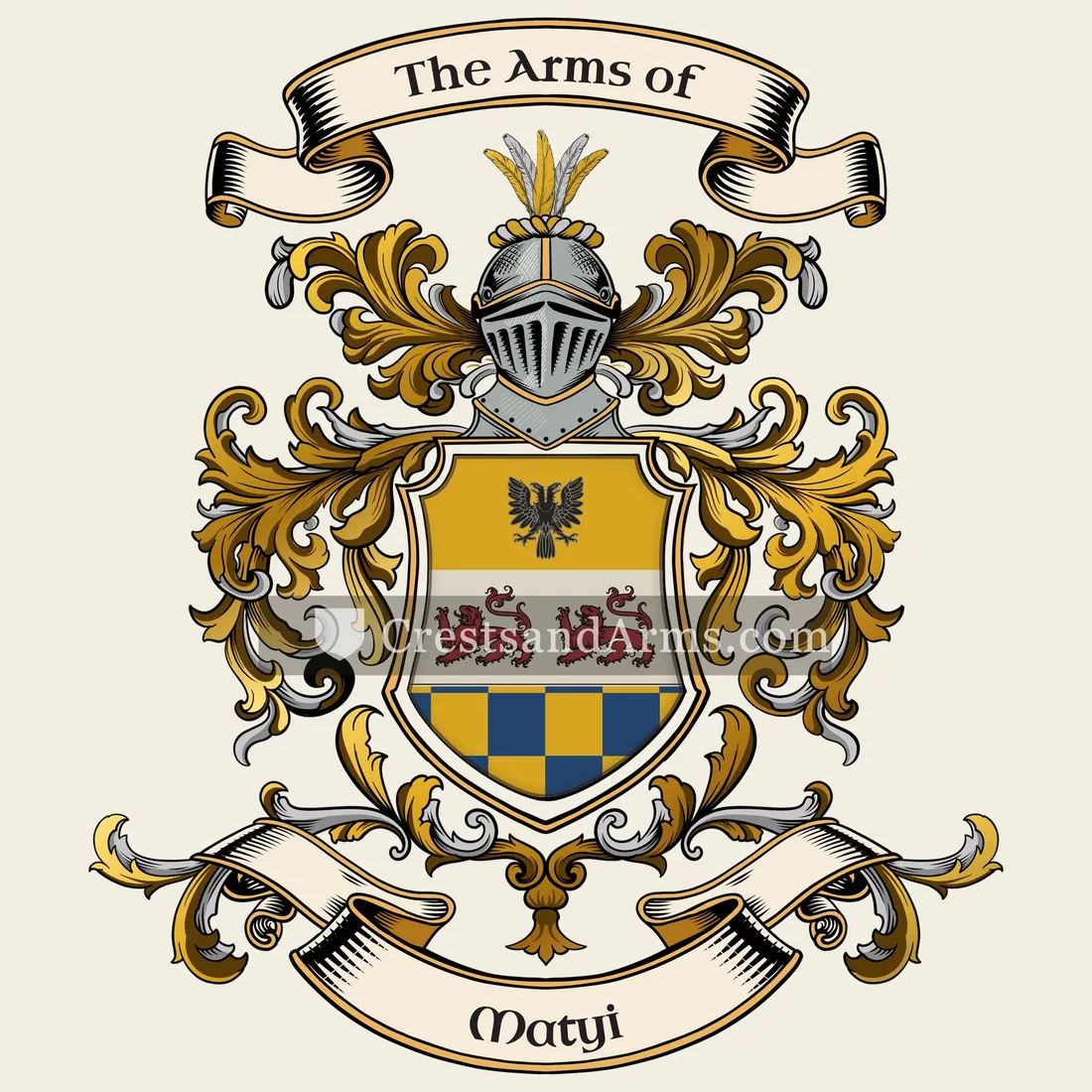
Symbols on this shield
chequyConstancy, and the counting-board
eagleNobility, strength and a keen mind
lionCourage, strength and royalty
Colours
Gold (Or)Means: Generosity
Silver (Argent)Means: Peace and sincerity
Black (Sable)Means: Constancy
Red (Gules)Means: Military strength
Blue (Azure)Means: Loyalty and truth
Historical info
Source
J. B. Rietstap, Armorial Général, Gouda: G. B. van Goor Zonen, 1884–87
Blazon (the actual original written record)
“Tiercé en fasce: au 1 d'or à l'aigle de sa., bq., m. et cour. du champ; au 2 d'arg. à deux lions affr. de gu.; au 3 échiq. d'or et d'azur. C.: trois pl. d'aut.: de gu., d'arg. et d'azur. L.: à dextre d'arg. et de gu., à sen. d'or et d'azur.”
GermanyNuremberg, c. 1765
Digital archive packCoat of arms PNG, gold border print PDF, vector SVG and the certificate of authenticity. Sent to your email in minutes.
Map of Germany showing where the Matyi arms are recorded
The Matyi arms were recorded in Nuremberg, c. 1765.
This is where the arms were entered in the register. Families often moved to other parts of the country, so the same name can turn up in more than one region.
The body that granted and recorded arms in Germany in this period.
Francis I, Holy Roman Emperor
Sovereign of the period
Francis I, Holy Roman Emperor
1745–1765
Reigning in Germany when the Matyi arms are first recorded.
How Arms Worked in Germany
In the Holy Roman Empire, coats of arms were often granted to individuals by the Emperor or his representatives. These arms were then passed down through the generations to all legitimate descendants of the original holder. Younger branches of a family usually kept the same shield design without needing to change it, as the arms belonged to the entire lineage.
Granting authority
The Holy Roman Emperor held the sole power to grant new coats of arms throughout his vast imperial territories.
How they got arms
Families typically obtained their coats of arms through a formal imperial grant or by proving their noble status to the authorities.
Where arms were recorded
These grants were officially recorded in the Imperial Chancery registers, which began keeping formal records of such honors during the Middle Ages.
The family's standing
Recorded among the armigerous families of Germany.
Origin & History of the Matyi Family in Germany
The family name Matyi has roots that trace back to the vibrant urban landscape of eighteenth-century Germany. By 1765, records confirm that members of the family were established in the city of Nuremberg. During this period, Nuremberg served as a major center for trade and skilled craftsmanship, attracting families who sought to build lives within its bustling guild system. The name itself likely evolved as a regional variation of traditional given names, reflecting the linguistic shifts common in Central Europe at the time. As the family integrated into the local community, they participated in the social and economic life of the city, contributing to the diverse tapestry of residents that defined Nuremberg during the Enlightenment. This early presence in such a significant German city suggests that the family was part of the growing middle class that helped shape the urban identity of the region during the mid-1700s.
Meaning of the Matyi family crest colors & symbols
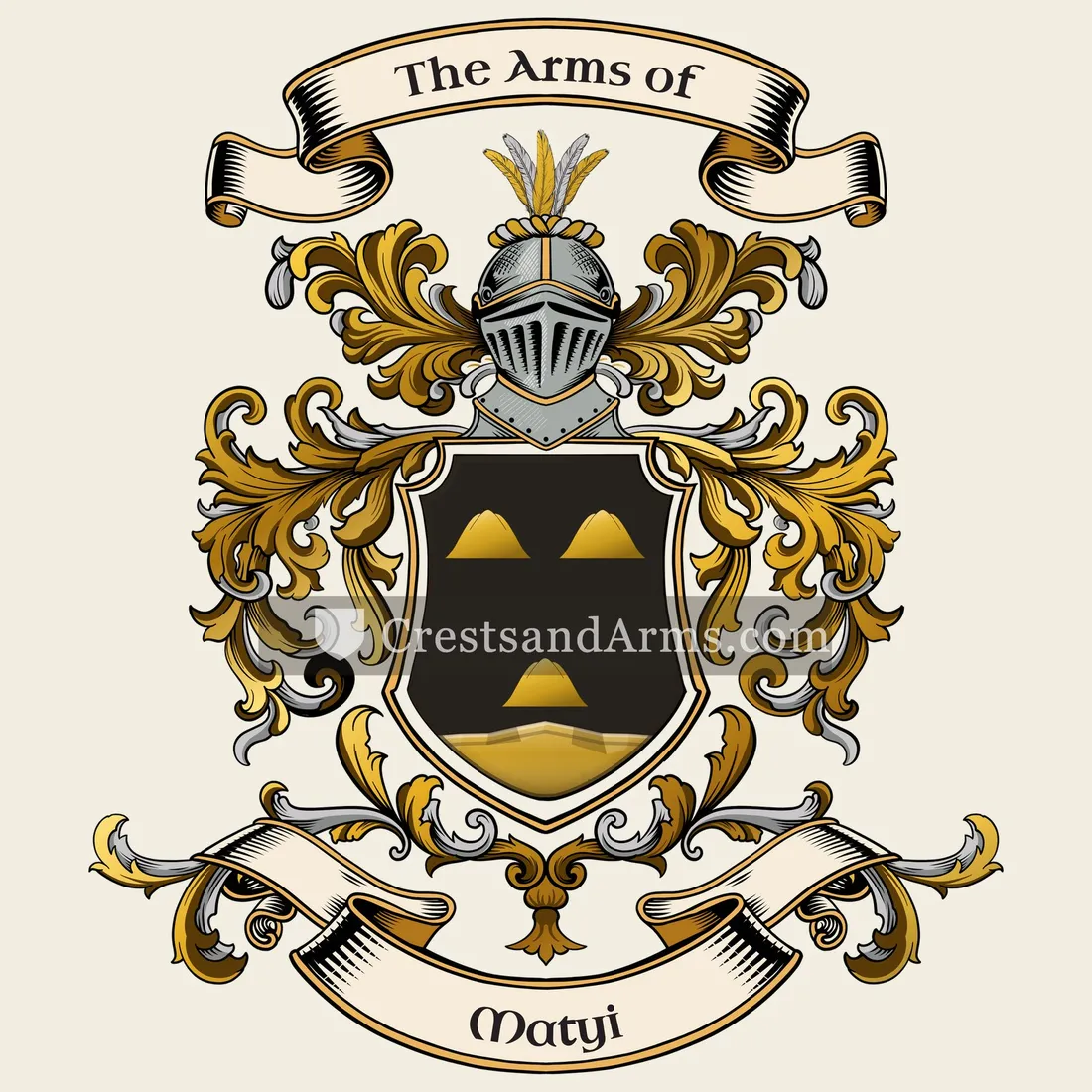
Symbols on this shield
mountThe ground held, and steadfastness upon it
Colours
Black (Sable)Means: Constancy
Gold (Or)Means: Generosity
Historical info
Source
J. B. Rietstap, Armorial Général, Gouda: G. B. van Goor Zonen, 1884–87
Blazon (the actual original written record)
“De sa. à trois rochers accostés d'or, mouv. de la p., surm. d'un croiss. du même. C.: un croiss. d'or.”
SwitzerlandBerne, c. 1745
Digital archive packCoat of arms PNG, gold border print PDF, vector SVG and the certificate of authenticity. Sent to your email in minutes.
Map of Switzerland showing where the Matyi arms are recorded
The Matyi arms were recorded in Berne, c. 1745.
This is where the arms were entered in the register. Families often moved to other parts of the country, so the same name can turn up in more than one region.
The body that granted and recorded arms in Switzerland in this period.
How Arms Worked in Switzerland
In Switzerland, coats of arms were not restricted to the nobility and were often adopted by common citizens and families. These symbols were passed down through generations to show family identity. When branches of a family grew, they often changed small details of the design to distinguish their own line from the original group.
Granting authority
Cantonal and civic authorities managed the use of coats of arms within their specific regions and local jurisdictions.
How they got arms
Families typically assumed their own coats of arms based on local custom rather than receiving them from a central monarch.
Where arms were recorded
Arms were recorded in various cantonal and civic registers starting from the fourteenth century throughout the Swiss region.
The family's standing
Recorded among the armigerous families of Switzerland.
Origin & History of the Matyi Family in Switzerland
The history of the Matyi family in Switzerland is rooted in the mid-eighteenth century, specifically appearing in the records of Berne by 1745. During this period, the city of Berne served as a major administrative and cultural hub, attracting families who were often involved in trade, craftsmanship, or local governance. While the name itself carries linguistic connections to Eastern European roots, its presence in the Swiss cantons suggests a period of migration and integration into the local social fabric. Families like the Matyis would have navigated the strict citizenship laws of the time, which required them to establish a stable trade or profession to gain recognition within the city walls. By settling in Berne, they became part of a diverse population that helped shape the city’s reputation for stability and economic growth during the Enlightenment era. Their early presence indicates that the family successfully adapted to the unique political landscape of the Swiss Confederation, securing a place for themselves within the local community through diligent work and social participation.
Matyi Meaning & Related Branches
Root word
Matthias
Derived from the Hebrew name Mattityahu meaning gift of God.
This name
MatyiA Hungarian diminutive form of Matthew, traditionally signifying a gift from the divine.
also spelled
Matty
Mattie
Mattye
Mati
Documented Sources
J. B. Rietstap, Armorial Général, Gouda: G. B. van Goor Zonen, 1884–87
Stadtarchiv Nürnberg, Bürgerbücher der Stadt Nürnberg (1765)
Endres, Rudolf, Nürnberg im 18. Jahrhundert, 1974
Digital archive packCoat of arms PNG, gold border print PDF, vector SVG and the certificate of authenticity. Sent to your email in minutes.


 chequyConstancy, and the counting-board
 eagleNobility, strength and a keen mind
 lionCourage, strength and royalty
 chequyConstancy, and the counting-board
 eagleNobility, strength and a keen mind
 lionCourage, strength and royalty


 mountThe ground held, and steadfastness upon it