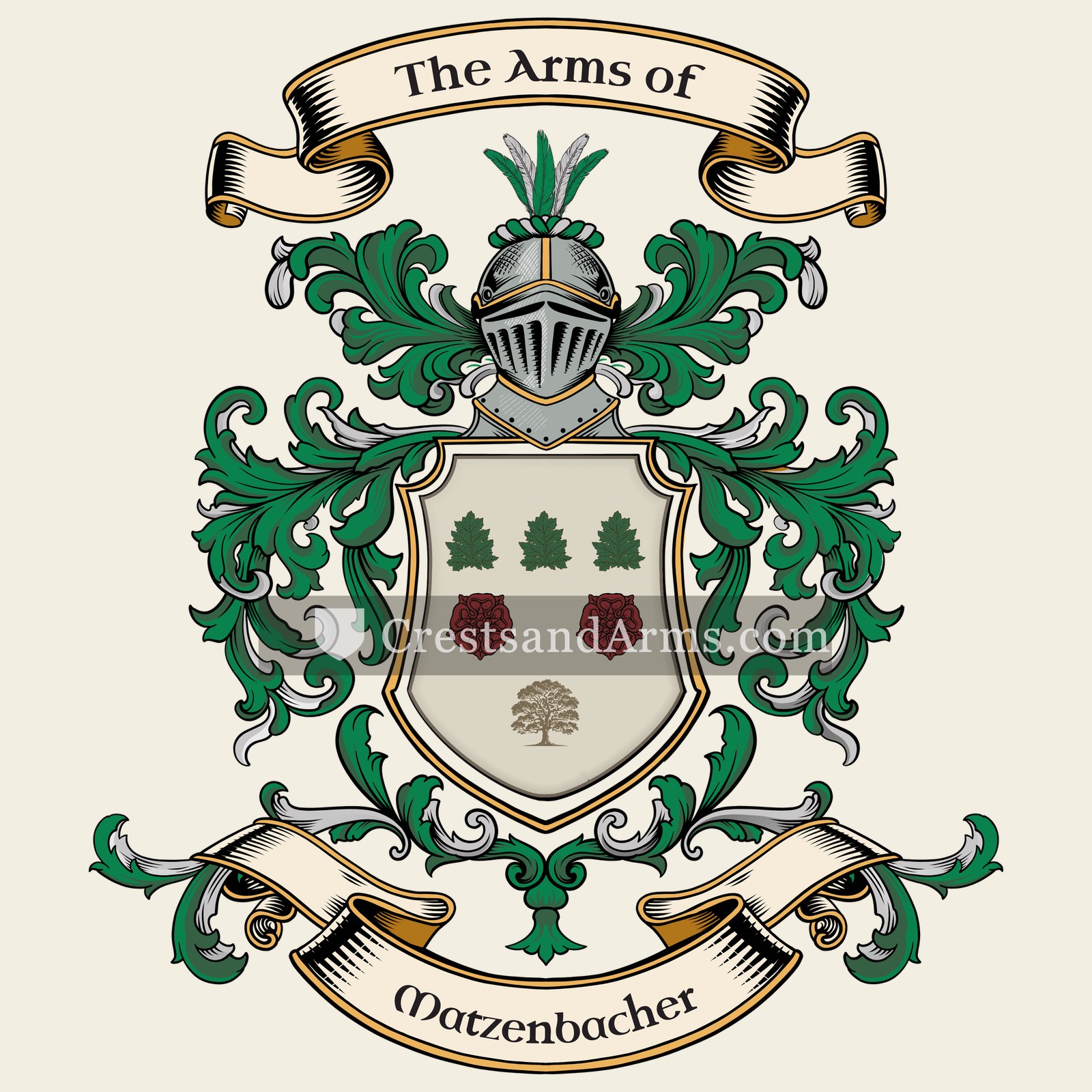
A record of documented arms, meaning and origin, researched for the Matzenbacher family of Germany.
Reg. 6843 · German, M–O
Coat of Arms & Family Crest Details
Symbols on this shield
treeLife, endurance and deep roots
leafHappiness and abundance
roseThe seventh son, and beauty with grace
Colours
Silver (Argent)Means: Peace and sincerity
Green (Vert)Means: Hope
Red (Gules)Means: Military strength
Historical info
Source
J. B. Rietstap, Armorial Général, Gouda: G. B. van Goor Zonen, 1884–87
Blazon (the actual original written record)
“D'arg. à un tronc de rosier de couleur brunâtre, posé en bande, portant sur le côté sen. trois feuilles de sin. et sur le côté dextre deux roses de gu., bout. d'or. Cq. cour. C.: une coupe couverte ciselée d'or. L. d'arg. et de gu.”
GermanyHambourg, c. 1875
Digital archive packCoat of arms PNG, gold border print PDF, vector SVG and the certificate of authenticity. Sent to your email in minutes.
Map of Germany showing where the Matzenbacher arms are recorded
The Matzenbacher arms were recorded in Hambourg, c. 1875.
This is where the arms were entered in the register. Families often moved to other parts of the country, so the same name can turn up in more than one region.
The body that granted and recorded arms in Germany in this period.
Wilhelm I
Sovereign of the period
Wilhelm I
1861–1888
Reigning in Germany when the Matzenbacher arms are first recorded.
How Arms Worked in Germany
Prussian heraldry was strictly tied to social rank and noble status rather than being a free choice for every citizen. These symbols were treated as permanent family property that moved through the generations to all legitimate heirs. If a family branch wanted to change their design to stand out, they had to apply for official permission to alter their specific version of the shield.
Granting authority
The Prussian Heroldsamt acted as the central state office that managed and strictly controlled all noble titles and coats of arms.
How they got arms
Families usually obtained their arms through formal royal grants or by proving their long-standing noble status to the state authorities.
Where arms were recorded
All official coats of arms were kept in the rolls of the Prussian Heroldsamt, which functioned from 1706 until 1918.
The family's standing
Recorded among the armigerous families of Germany.
Origin & History of the Matzenbacher Family in Germany
The surname Matzenbacher is a topographic name that originated in the German-speaking regions of Europe. It is composed of two parts, with the suffix "bacher" indicating that the family lived near a stream or a brook. The prefix "Matzen" likely refers to a specific local place name or a shortened form of a given name, suggesting that the family’s earliest ancestors were identified by the specific landscape where they resided. By 1875, records confirm that members of the Matzenbacher family were established in Hamburg. During this period, Hamburg served as a major center for trade and migration. The family’s presence in this bustling port city suggests they were likely involved in the maritime economy or the rapid industrial growth that defined the region during the late nineteenth century.
Related Branches & Arms
Root word
Matz and Bach
A diminutive of Matthias and a German word for a stream.
This name
MatzenbacherRefers to a person living near a stream associated with the Matthias family.
also spelled
Mutzenbecker
Mutzenbacher
Mutzenbecherer
Mutsenbeker
Documented Sources
J. B. Rietstap, Armorial Général, Gouda: G. B. van Goor Zonen, 1884–87
Bahlow, Hans, Deutsches Namenlexikon: Familien- und Vornamen nach Ursprung und Sinn erklärt, 1967


 treeLife, endurance and deep roots
 leafHappiness and abundance
 roseThe seventh son, and beauty with grace
 treeLife, endurance and deep roots
 leafHappiness and abundance
 roseThe seventh son, and beauty with grace