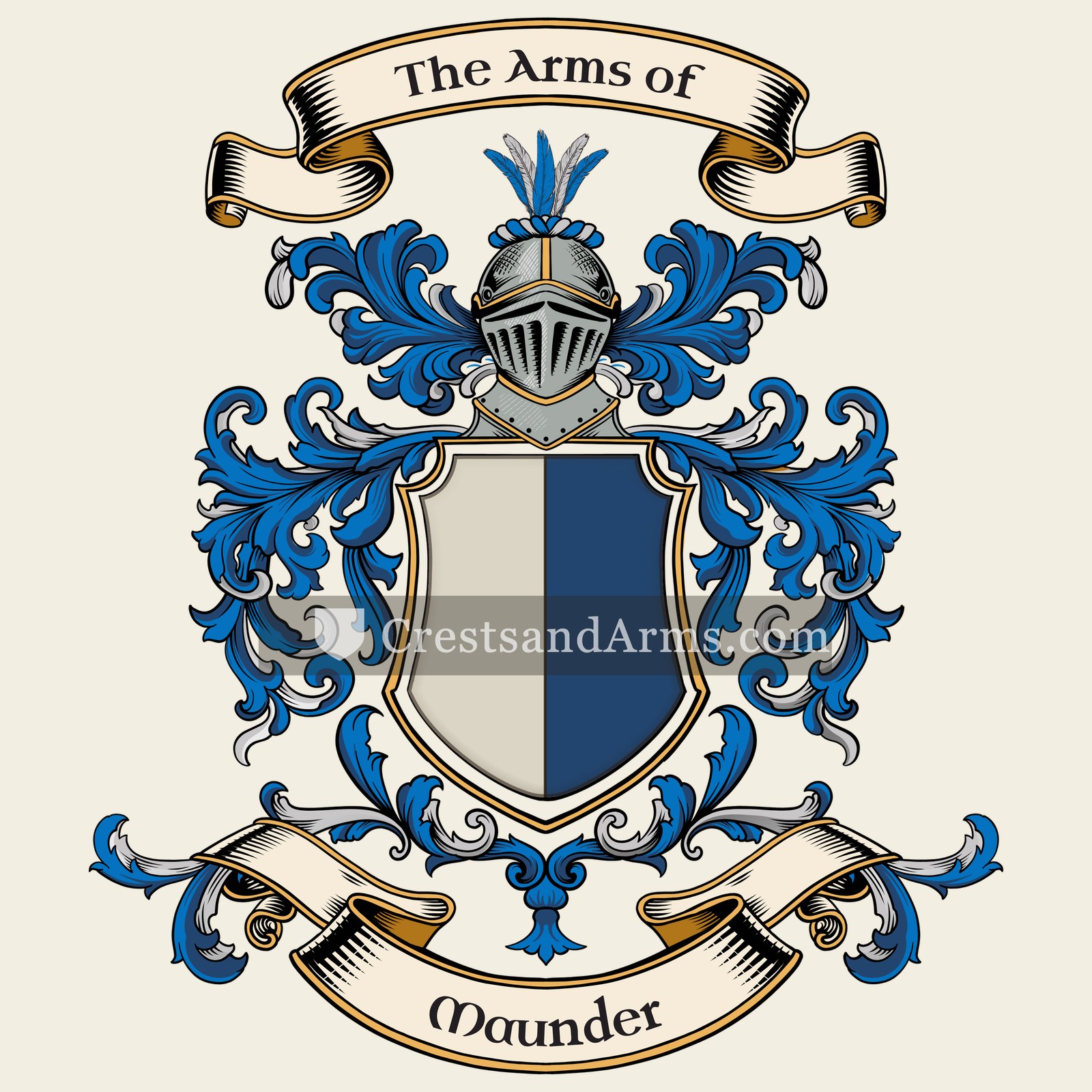
A record of documented arms, meaning and origin, researched for the Maunder family of Denmark.
Reg. 1572 · Danish, M–O
Coat of Arms & Family Crest Details
Colours
Silver (Argent)Means: Peace and sincerity
Blue (Azure)Means: Loyalty and truth
Historical info
Source
J. B. Rietstap, Armorial Général, Gouda: G. B. van Goor Zonen, 1884–87
Blazon (the actual original written record)
“Parti d'arg. et d'azur; à deux forces de l'un à l'autre, posées en pals, les bouts en haut. C.: une force en pal, les bouts en haut, la moitié dextre d'azur et la moitié”
Denmarkc. 1722
Digital archive packCoat of arms PNG, gold border print PDF, vector SVG and the certificate of authenticity. Sent to your email in minutes.
Map of Denmark showing where the Maunder arms are recorded
The Maunder arms were recorded in Denmark, c. 1722.
Arms such as these were typically recorded in Sjaælland.
Zealand held the Danish court, the crown's offices and Copenhagen itself. Families who served the king kept estates within reach of it, and royal service was the ordinary route to a coat of arms.
This is where the arms were entered in the register. Families often moved to other parts of the country, so the same name can turn up in more than one region.
The body that granted and recorded arms in Denmark in this period.
Frederik IV of Denmark
Sovereign of the period
Frederik IV of Denmark
1699–1730
Reigning in Denmark when the Maunder arms are first recorded.
How Arms Worked in Denmark
Danish heraldry during this period was closely tied to noble status and royal favor rather than being open to all citizens. Arms were typically granted by the monarch to individuals, and these symbols were then shared by all members of the noble house. If a family line died out, the right to use those specific arms ended with them.
Granting authority
The Danish royal chancery held the power to issue and regulate official coats of arms for the kingdom.
How they got arms
Families usually received their arms through a formal royal grant that confirmed their noble status and rights.
Where arms were recorded
These grants were officially recorded in the Danish Royal Chancery records starting in the sixteenth century.
The family's standing
Recorded among the armigerous families of Denmark.
Origin & History of the Maunder Family in Denmark
The surname Maunder is traditionally linked to the occupational history of medieval England, where it likely evolved as a nickname for a beggar or a person who wandered from place to place seeking charity. While the name has deep roots in British history, the family also established a significant presence in Scandinavia by the early eighteenth century. Records confirm that members of the Maunder family were living on the island of Zealand, known as Sjælland in Danish, by 1722. During this period, the family likely integrated into the local agrarian or artisan communities of the region. Their presence in Denmark suggests a history of migration, perhaps driven by trade routes or the movement of skilled laborers across the North Sea. Over time, these early settlers helped transition the name from its humble linguistic origins into a distinct branch of the family tree that flourished in Northern Europe.
Related Branches & Arms
Root word
Mund
Old Norse term referring to protection or a hand.
This name
MaunderA professional surname denoting a protector, guardian, or someone who works with their hands.
also spelled
Manderupp
Manderupe
Documented Sources
J. B. Rietstap, Armorial Général, Gouda: G. B. van Goor Zonen, 1884–87
Reaney, P.H., A Dictionary of English Surnames, 1991
Rigsarkivet (The Danish National Archives), Kirkebøger for Sjællands Stift (Parish registers for the Diocese of Zealand), 1722
Digital archive packCoat of arms PNG, gold border print PDF, vector SVG and the certificate of authenticity. Sent to your email in minutes.