A record of documented arms, meaning and origin, researched for the Maurer family lines. Documented in 3 countries.
Reg. 7491 · Austrian, M–O
Coat of Arms & Family Crest Details
Symbols on this shield
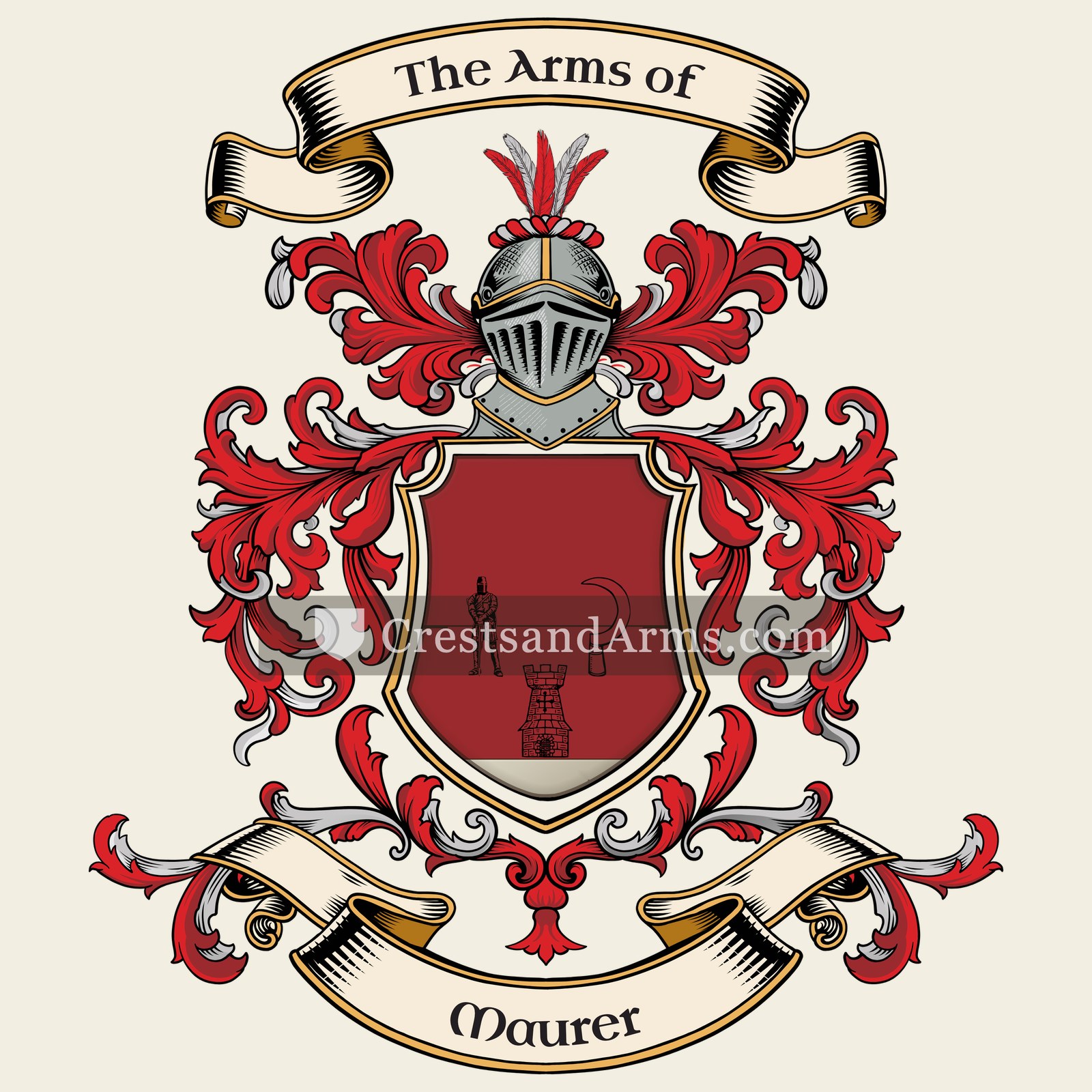
fessThe military belt, and readiness to serve
towerGrandeur and solidity, and a stronghold defended
knightChivalry and service in arms
sickleThe harvest, and the reaping of what was sown
Colours
Red (Gules)Means: Military strength
Silver (Argent)Means: Peace and sincerity
Historical info
Source
J. B. Rietstap, Armorial Général, Gouda: G. B. van Goor Zonen, 1884–87
Blazon (the actual original written record)
“De gu. à un mur crén. de trois pièces d'arg., maconné de sa., occupant la moitié inférieure de l'écu et percé de trois archières rondes de sa., rangées en fasce; le gu. ch. d'un homme barbu iss., mouv. dudit mur, hab. d'un parti d'or et de sa., rebr. de l'un à l'autre et ceint de l'un en l'autre, coiffé d'un bonnet pointu parti d'or et de sa., retr. de l'un en l'autre, la main sen. posée sur son coeur et tenant de sa dextre une truelle au nat., emm. d'or, en pal. C.: l'homme iss., entre deux prob. de gu., chacune ch. d'une fasce d'arg. et ornée dans son embouchure de trois plumes de paon au nat. L.: à dextre d'or et de sa., à sen. d'arg. et de gu.”
TyrolTyrol, c. 1701
Digital archive packCoat of arms PNG, gold border print PDF, vector SVG and the certificate of authenticity. Sent to your email in minutes.
Map of Austria showing where the Maurer arms are recorded
The Maurer arms were recorded in Tyrol, c. 1701.
Tyrol was mountain country in western Austria, where the valleys were held by families who had been there a very long time. Old tenure counted for more than money, and old families carried arms.
This is where the arms were entered in the register. Families often moved to other parts of the country, so the same name can turn up in more than one region.
Region
Tyrol
First recorded
1701
Granting Authority for the Maurer Arms
Imperial and Royal chancery
Sodacan · CC BY-SA 3.0
The body that granted and recorded arms in Austria in this period.
Leopold I, Holy Roman Emperor
Sovereign of the period
Leopold I, Holy Roman Emperor
1658–1705
Reigning in Austria when the Maurer arms are first recorded.
How Arms Worked in Austria
Austrian coats of arms were often linked directly to noble titles granted by the Emperor. These symbols belonged to the entire family line rather than just one individual. When a family grew, new branches kept the original design without needing to change it. This system allowed all members of a noble house to share the same identity across many generations.
Granting authority
The Imperial and Royal chancery managed all heraldic matters and controlled the official granting of arms throughout the Austrian lands.
How they got arms
Families typically received their arms through a formal imperial decree that often accompanied the elevation of a person to noble status.
Where arms were recorded
Official records of these grants were kept in the Imperial Register of Nobility which began its formal documentation process in 1453.
The family's standing
Recorded among the armigerous families of Tyrol.
Origin & History of the Maurer Family in Austria
The surname Maurer originated as an occupational name derived from the Middle High German word *mūrer*, which refers to a stonemason or a builder. During the medieval period, as towns and villages across the Alpine regions began to expand, individuals skilled in masonry became essential for constructing the stone fortifications, churches, and homes that defined the landscape. By the time records place the family in the Tyrol region in 1701, the name had already become a well-established identifier for families whose livelihoods were tied to the construction trades. Living in the rugged terrain of western Austria, these early ancestors likely worked on the stone structures that allowed communities to thrive despite the harsh mountain environment. Because masonry was a specialized skill passed down through generations, the name Maurer became a permanent marker of a family’s professional identity and their contribution to the development of early Austrian infrastructure.
Coat of Arms & Family Crest Details
Symbols on this shield
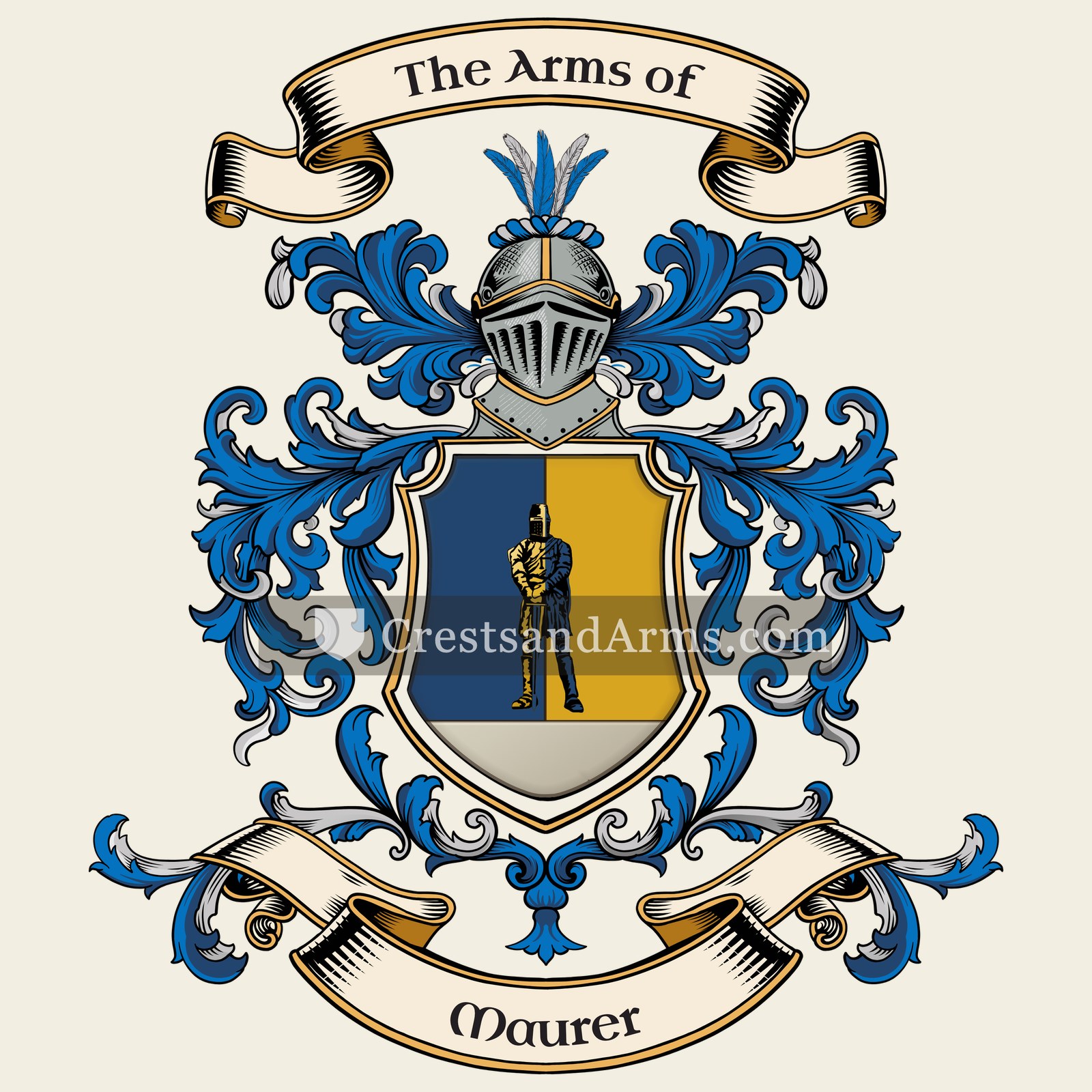
knightChivalry and service in arms
Colours
Blue (Azure)Means: Loyalty and truth
Gold (Or)Means: Generosity
Silver (Argent)Means: Peace and sincerity
Historical info
Source
J. B. Rietstap, Armorial Général, Gouda: G. B. van Goor Zonen, 1884–87
Blazon (the actual original written record)
“Parti d'azur et d'or; à un mur crén. d'arg., maconné de sa., br. en p.; en chef, br. sur le parti, un homme iss., hab. de l'un en l'autre, mouv. du mur, le col environné d'une fraise d'arg., tenant un maillet de sa., posé sur son épaule. C.: les meubles de l'écu; entre deux prob., coupées alt. d'or et d'azur. L. d'or et d'azur.”
GermanyNuremberg, c. 1765
Digital archive packCoat of arms PNG, gold border print PDF, vector SVG and the certificate of authenticity. Sent to your email in minutes.
Map of Germany showing where the Maurer arms are recorded
The Maurer arms were recorded in Nuremberg, c. 1765.
This is where the arms were entered in the register. Families often moved to other parts of the country, so the same name can turn up in more than one region.
The body that granted and recorded arms in Germany in this period.
Francis I, Holy Roman Emperor
Sovereign of the period
Francis I, Holy Roman Emperor
1745–1765
Reigning in Austria when the Maurer arms are first recorded.
How Arms Worked in Germany
In the Holy Roman Empire, coats of arms were often granted to individuals by the Emperor or his representatives. These arms were then passed down through the generations to all legitimate descendants of the original holder. Younger branches of a family usually kept the same shield design without needing to change it, as the arms belonged to the entire lineage.
Granting authority
The Holy Roman Emperor held the sole power to grant new coats of arms throughout his vast imperial territories.
How they got arms
Families typically obtained their coats of arms through a formal imperial grant or by proving their noble status to the authorities.
Where arms were recorded
These grants were officially recorded in the Imperial Chancery registers, which began keeping formal records of such honors during the Middle Ages.
The family's standing
Recorded among the armigerous families of Germany.
Origin & History of the Maurer Family in Germany
The surname Maurer is a classic example of an occupational name that emerged during the Middle Ages in German-speaking regions. Derived from the Middle High German word *mūrer*, it was used to identify individuals who worked as stonemasons or bricklayers. Because construction was essential to the growth of medieval towns, these craftsmen were highly valued members of society. By the time records place the family in Nuremberg in 1765, the name had been established for centuries as a reflection of the family’s historical role in building the infrastructure of German cities. During this era, Nuremberg was a thriving center of trade and craftsmanship, and families like the Maurers were often part of the skilled guilds that maintained the city’s impressive stone fortifications and grand architecture. This connection to the trade meant that the family name was tied to the physical development and permanence of the urban landscape.
Coat of Arms & Family Crest Details
Symbols on this shield
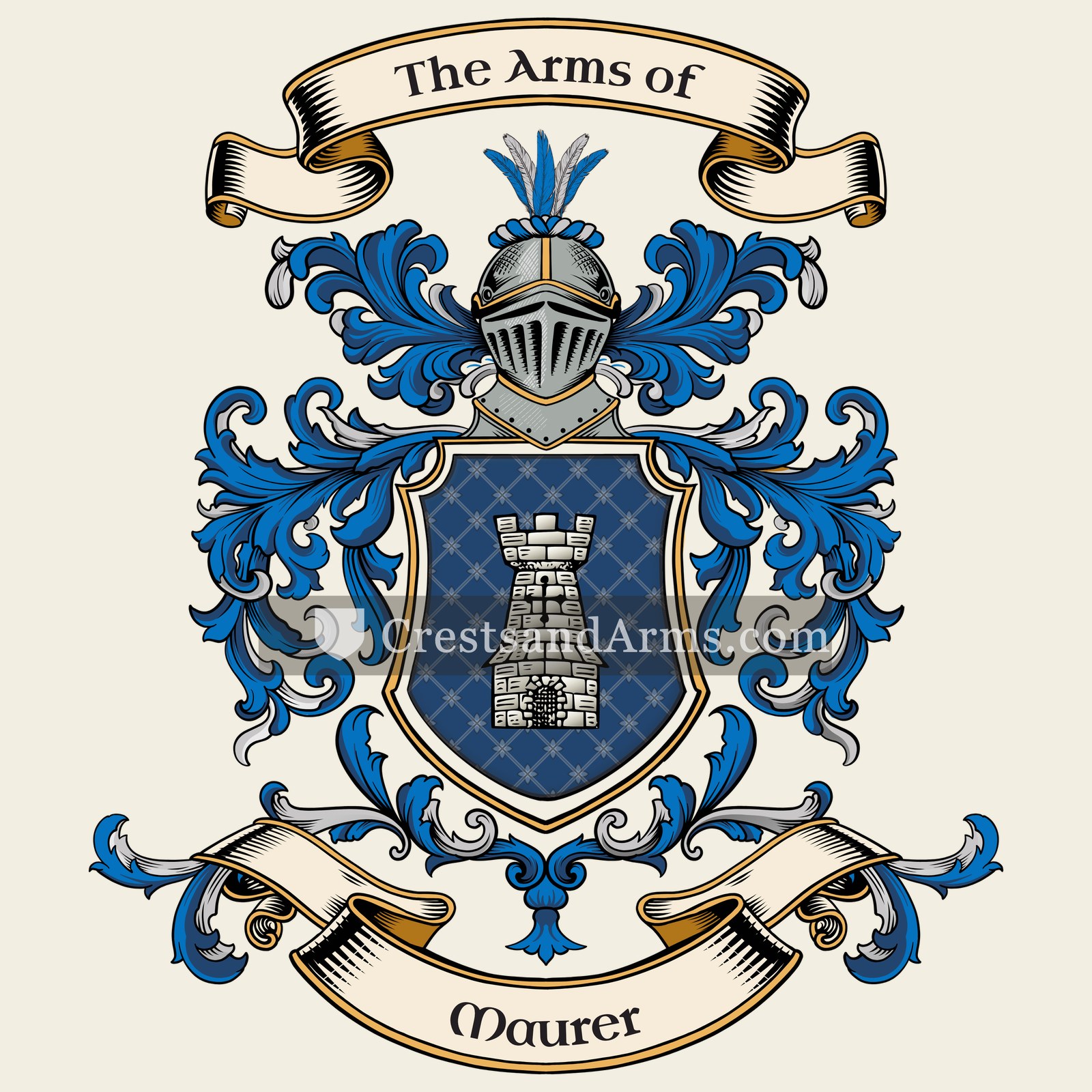
towerGrandeur and solidity, and a stronghold defended
Colours
Blue (Azure)Means: Loyalty and truth
Silver (Argent)Means: Peace and sincerity
Historical info
Source
J. B. Rietstap, Armorial Général, Gouda: G. B. van Goor Zonen, 1884–87
Blazon (the actual original written record)
“D'azur à un mur crén. d'arg., maconné de sa., posé en fasce, touchant les flancs de l'écu, les quatre créneaux essorés de gu. C.: un lion iss. d'arg., lamp. de gu.”
SwitzerlandBâle, c. 1745
Digital archive packCoat of arms PNG, gold border print PDF, vector SVG and the certificate of authenticity. Sent to your email in minutes.
Map of Switzerland showing where the Maurer arms are recorded
The Maurer arms were recorded in Bâle, c. 1745.
This is where the arms were entered in the register. Families often moved to other parts of the country, so the same name can turn up in more than one region.
The body that granted and recorded arms in Switzerland in this period.
How Arms Worked in Switzerland
In Switzerland, coats of arms were not restricted to the nobility and were often adopted by common citizens and families. These symbols were passed down through generations to show family identity. When branches of a family grew, they often changed small details of the design to distinguish their own line from the original group.
Granting authority
Cantonal and civic authorities managed the use of coats of arms within their specific regions and local jurisdictions.
How they got arms
Families typically assumed their own coats of arms based on local custom rather than receiving them from a central monarch.
Where arms were recorded
Arms were recorded in various cantonal and civic registers starting from the fourteenth century throughout the Swiss region.
The family's standing
Recorded among the armigerous families of Switzerland.
Origin & History of the Maurer Family in Switzerland
The surname Maurer is a classic occupational name that originated from the Middle High German word for a builder or a stonemason. In the context of Switzerland, the name reflects the vital role that skilled craftsmen played in the development of medieval and early modern urban centers. By the time members of the family were documented in Basel in 1745, the name had already been established for centuries across German-speaking regions as a marker of those who worked with stone and mortar to construct homes, churches, and defensive walls. These early ancestors were likely part of the guild system, which was a powerful social and economic structure in Swiss cities that regulated trade standards and ensured that families like the Maurers held a respected place in the local community. As the family settled into the social fabric of Basel, their name served as a permanent record of their professional contribution to the physical growth and infrastructure of the city.
Related Branches & Arms
Root word
murus
Latin term meaning wall or fortification.
This name
MaurerAn occupational surname for a mason or a builder of stone walls.
also spelled
Mauerer
Morer
Mower
Carpenter
Related arms
Schlechta Edle von Hrochowsimilar arms
Mauerervariant spelling
Tastnerrecorded with Maurer, same area
Documented Sources
J. B. Rietstap, Armorial Général, Gouda: G. B. van Goor Zonen, 1884–87
Kohlheim, Rosa and Volker Kohlheim. Duden Familiennamen: Herkunft und Bedeutung von 20.000 Nachnamen. 2005
Tyrol State Archives (Tiroler Landesarchiv). Tiroler Heirats- und Taufbücher. 1701
Udolph, Jürgen. Duden Familiennamen: Herkunft und Bedeutung. 2000
Digital archive packCoat of arms PNG, gold border print PDF, vector SVG and the certificate of authenticity. Sent to your email in minutes.


 fessThe military belt, and readiness to serve
 towerGrandeur and solidity, and a stronghold defended
 knightChivalry and service in arms
 sickleThe harvest, and the reaping of what was sown
 fessThe military belt, and readiness to serve
 towerGrandeur and solidity, and a stronghold defended
 knightChivalry and service in arms
 sickleThe harvest, and the reaping of what was sown