A record of documented arms, meaning and origin, researched for the Maust family lines. Documented in 2 countries.
Reg. 0362 · Dutch, M–O
Meaning of the Maust family crest colors & symbols
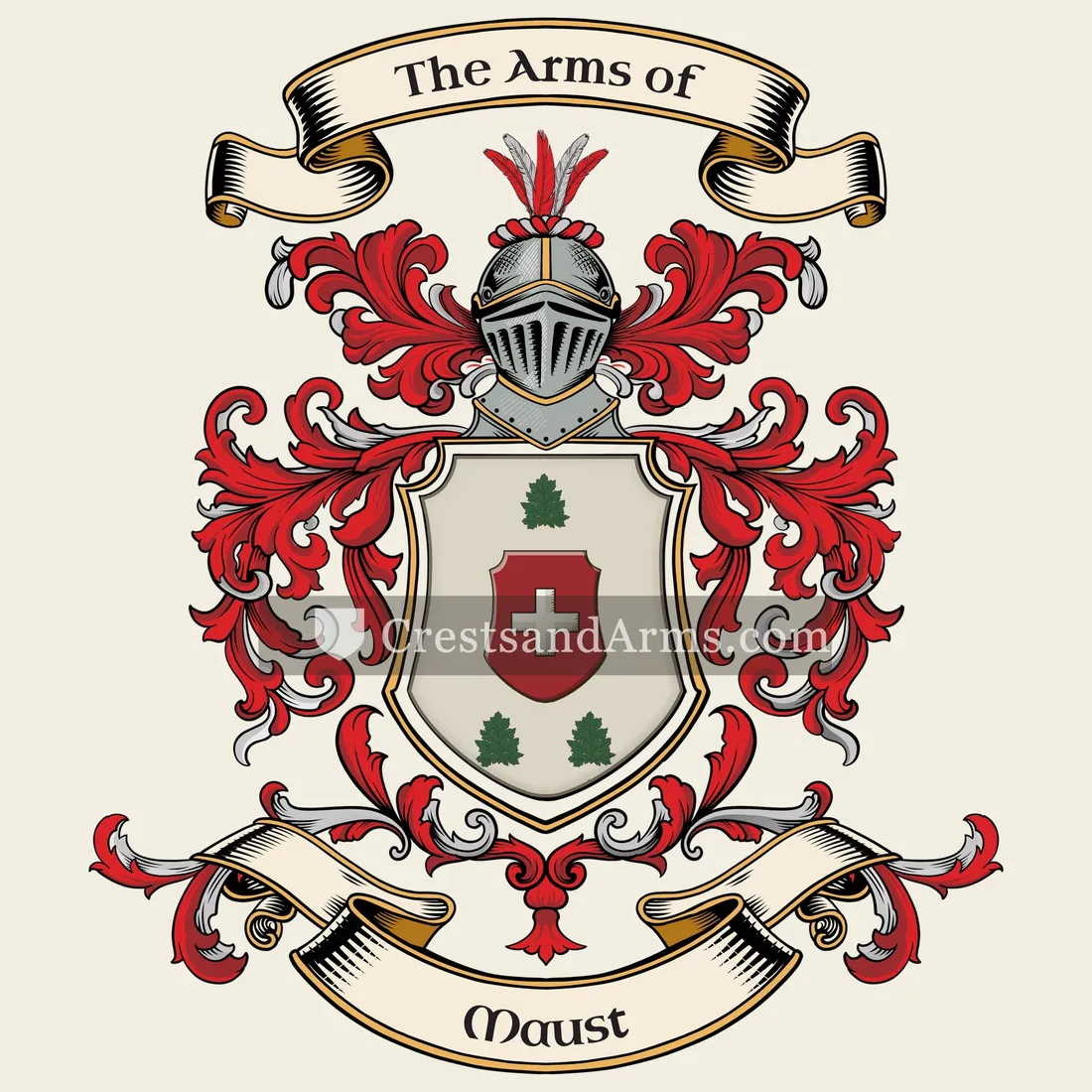
Symbols on this shield
cross symbolChristian faith and service
leafHappiness and abundance
Colours
Silver (Argent)Means: Peace and sincerity
Red (Gules)Means: Military strength
Green (Vert)Means: Hope
Historical info
Source
J. B. Rietstap, Armorial Général, Gouda: G. B. van Goor Zonen, 1884–87
Blazon (the actual original written record)
“D'arg. à un écusson de gu. en abime, ch. d'une croix du champ, et acc. de trois feuilles de sin., les tiges en bas; ou, l'écusson en abîme acc. de trois coquilles de gu. et surm. d'un croiss. du même.”
NetherlandsLeyde, c. 1815
Digital archive packCoat of arms PNG, gold border print PDF, vector SVG and the certificate of authenticity. Sent to your email in minutes.
Map of Netherlands showing where the Maust arms are recorded
The Maust arms were recorded in Leyde, c. 1815.
This is where the arms were entered in the register. Families often moved to other parts of the country, so the same name can turn up in more than one region.
Region
Leyde
Town
Leyde
First recorded
1815
Granting Authority for the Maust Arms
Hoge Raad van Adel
Photograph made by me · CC BY-SA 3.0
The body that granted and recorded arms in Netherlands in this period.
William I of the Netherlands
Sovereign of the period
William I of the Netherlands
1815–1840
Reigning in Netherlands when the Maust arms are first recorded.
How Arms Worked in Netherlands
In the Netherlands, coats of arms were often used by noble families and those who held specific public offices. These arms were passed down through the generations to legitimate descendants. Younger branches of a family usually kept the original design without needing to add special marks. This system ensured that the family identity remained clear and consistent over many years.
Granting authority
The Hoge Raad van Adel is the official body that regulates and manages noble titles and coats of arms in the Netherlands.
How they got arms
Families typically obtained their coats of arms through official royal grants or by proving their long-standing historical use of the symbols.
Where arms were recorded
Coats of arms are officially recorded in the registers held by the Hoge Raad van Adel, which began its work in 1814.
The family's standing
Recorded among the armigerous families of Netherlands.
Origin & History of the Maust Family in Netherlands
The surname Maust carries a history deeply rooted in the social and industrial shifts of the Netherlands during the early nineteenth century. By 1815, records confirm that members of the family were established in the city of Leiden, a location known for its long tradition of textile manufacturing and academic excellence. During this period, the Netherlands was transitioning from the Napoleonic era into the newly formed United Kingdom of the Netherlands, a time when the government began strictly enforcing the registration of family names for tax and census purposes. Families like the Mausts often lived in urban centers where they contributed to the local economy as skilled laborers or tradespeople. The name itself reflects the linguistic patterns of the Low Countries, where surnames were frequently derived from specific occupations, physical traits, or geographic markers. As the family navigated the changing political landscape of the 1800s, their presence in Leiden suggests they were part of the growing urban middle class that helped define the modern Dutch identity.
Meaning of the Maust family crest colors & symbols
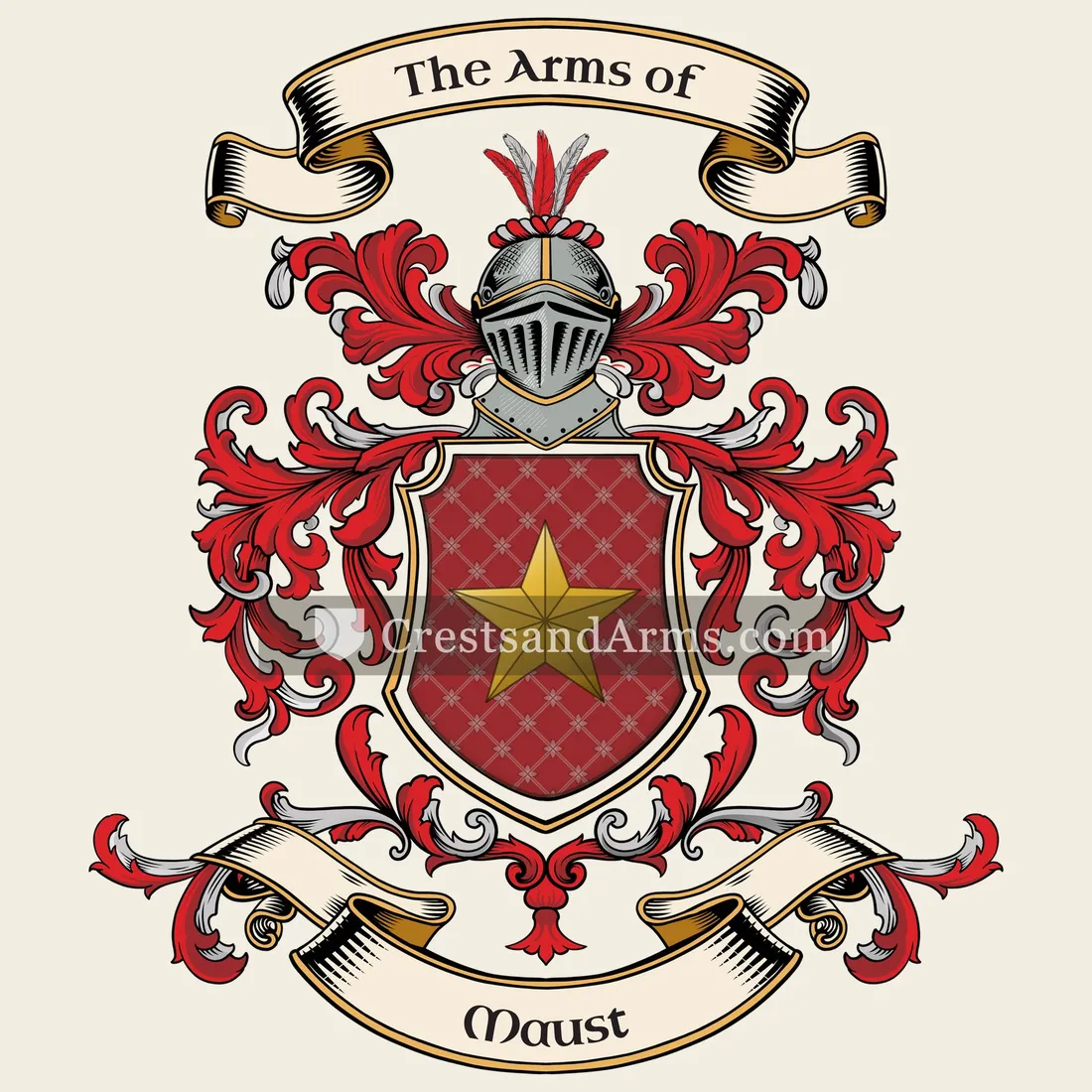
Symbols on this shield
mulletThe third son, and a divine quality from above
Colours
Red (Gules)Means: Military strength
Gold (Or)Means: Generosity
Historical info
Source
J. B. Rietstap, Armorial Général, Gouda: G. B. van Goor Zonen, 1884–87
Blazon (the actual original written record)
“De gu. à une étoile (8) d'or. C.: l'étoile; entre deux prob., coupées d'or sur gu.”
SwitzerlandBâle, c. 1745
Digital archive packCoat of arms PNG, gold border print PDF, vector SVG and the certificate of authenticity. Sent to your email in minutes.
Map of Switzerland showing where the Maust arms are recorded
The Maust arms were recorded in Bâle, c. 1745.
This is where the arms were entered in the register. Families often moved to other parts of the country, so the same name can turn up in more than one region.
The body that granted and recorded arms in Switzerland in this period.
How Arms Worked in Switzerland
In Switzerland, coats of arms were not restricted to the nobility and were often adopted by common citizens and families. These symbols were passed down through generations to show family identity. When branches of a family grew, they often changed small details of the design to distinguish their own line from the original group.
Granting authority
Cantonal and civic authorities managed the use of coats of arms within their specific regions and local jurisdictions.
How they got arms
Families typically assumed their own coats of arms based on local custom rather than receiving them from a central monarch.
Where arms were recorded
Arms were recorded in various cantonal and civic registers starting from the fourteenth century throughout the Swiss region.
The family's standing
Recorded among the armigerous families of Switzerland.
Origin & History of the Maust Family in Switzerland
The Maust family name finds its historical roots in the German-speaking regions of Switzerland, where the name was closely tied to the agrarian life of the eighteenth century. By 1745, records confirm that members of the family were established in the city of Bâle, a major center for trade and intellectual exchange along the Rhine River. During this period, the name was often associated with families who lived near the borderlands, moving between rural farming communities and the growing urban influence of the city. These early ancestors were likely part of the skilled artisan or merchant classes that helped define the region’s economy. As they navigated the social and political landscape of the Swiss cantons, the Maust family became part of the broader migration patterns that eventually led many Swiss families to seek new opportunities across Europe and beyond. Their presence in Bâle serves as a key marker of their integration into the structured society of the Swiss Confederation before the major waves of emigration in the following century.
Maust Meaning & Related Branches
Root word
Muis
A small rodent or mouse.
This name
MaustA nickname for a quiet, timid, or small person.
also spelled
Maste
Documented Sources
J. B. Rietstap, Armorial Général, Gouda: G. B. van Goor Zonen, 1884–87
Nationaal Archief, Burgerlijke Stand van de gemeenten in Zuid-Holland
Regionaal Archief Leiden, Bevolkingsregister van Leiden
Blok, D.P., Algemene Geschiedenis der Nederlanden, 1977
Van Driel, L., Nederlandse Familienamen: Herkomst en Betekenis, 2005
Digital archive packCoat of arms PNG, gold border print PDF, vector SVG and the certificate of authenticity. Sent to your email in minutes.


 cross symbolChristian faith and service
 leafHappiness and abundance
 cross symbolChristian faith and service
 leafHappiness and abundance


 mulletThe third son, and a divine quality from above