Map of England showing where the Maxson arms are recorded
The Maxson arms were recorded in Huntingdon, c. 1620.
Huntingdonshire was small, flat fen-edge country. Drainage made new farmland and new fortunes, and families who gained by it bought manors and took arms to match.
This is where the arms were entered in the register. Families often moved to other parts of the country, so the same name can turn up in more than one region.
The body that granted and recorded arms in England in this period.
James VI and I
Sovereign of the period
James VI and I
1603–1625
Reigning in England when the Maxson arms are first recorded.
How Arms Worked in England
English heraldry allowed arms to be shared by all legitimate descendants of the original owner. These symbols were treated as personal property that moved through the generations to all children. While the eldest son kept the original design, other family members could use the same shield without needing to change it or register their own unique versions.
Granting authority
The College of Arms in London has regulated the use of coats of arms throughout England and Wales since 1484.
How they got arms
Families typically obtained their coats of arms through a formal grant from the Crown or by proving their ancient right to them.
Where arms were recorded
All official coats of arms are recorded in the registers kept at the College of Arms, which date back to the fifteenth century.
The family's standing
Recorded among the armigerous families of Huntingdon.
Origin & History of the Maxson Family in England
The surname Maxson is a patronymic name, which means it originated as a way to identify a person as the son of a man named Max or Mack. In medieval England, surnames often shifted based on the first name of a father, and the transition to a permanent family name became more common as local populations grew and tax records became more detailed. By the early 17th century, the family was well-established in the town of Huntingdon. This location was a significant market town in the county of Huntingdonshire, situated along the Great Ouse River. Families living in this region during the 1620s were often involved in local trade or agriculture, and they lived through a period of great social and political change in England. The presence of the Maxson name in these official parish and legal records from that time serves as a clear link to the family's roots in the English Midlands before many individuals began to migrate across the Atlantic.
Meaning of the Maxson family crest colors & symbols
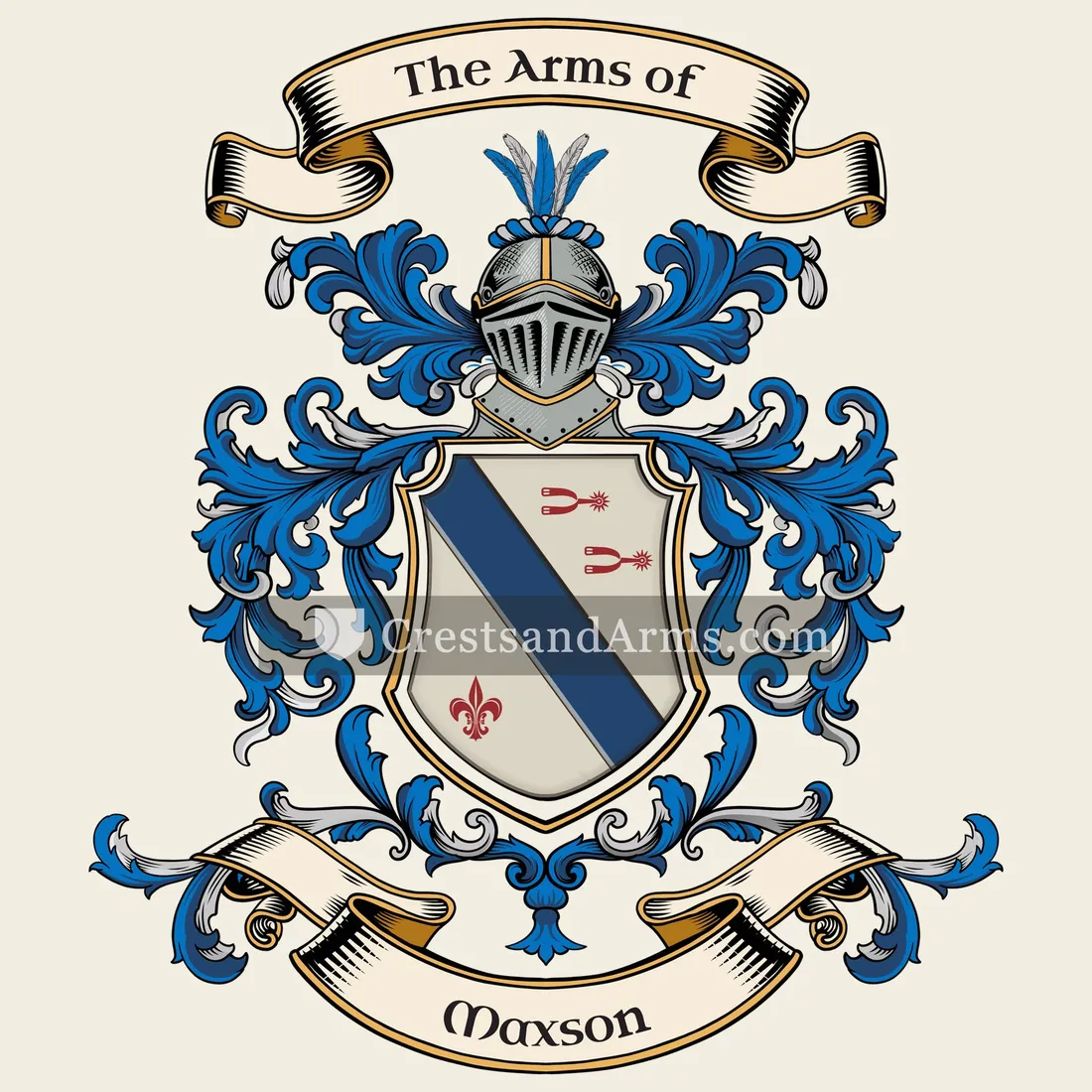
Symbols on this shield
bendDefence, and the scarf of a commander
spurKnighthood, and readiness to spur on
fleur de lisPurity, light, and the sixth son
Colours
Silver (Argent)Means: Peace and sincerity
Blue (Azure)Means: Loyalty and truth
Red (Gules)Means: Military strength
Historical info
Source
Sir Bernard Burke, The General Armory of England, Scotland, Ireland and Wales, London: Harrison & Sons, 1884
Blazon (the actual original written record)
“Ar. a bend wavy az. betw. two spur-rowels in chief and a fleur-de-lis in base gu”
AyrRosebank · Ayr, c. 1748
Digital archive packCoat of arms PNG, gold border print PDF, vector SVG and the certificate of authenticity. Sent to your email in minutes.
Map of Scotland showing where the Maxson arms are recorded
The Maxson arms were recorded in Ayr, c. 1748.
Ayrshire was farming country along Scotland's south-west coast, held in a great many small estates. Its lairds were numerous rather than rich, and each holding brought its own claim to arms.
This is where the arms were entered in the register. Families often moved to other parts of the country, so the same name can turn up in more than one region.
The body that granted and recorded arms in Scotland in this period.
George II of Great Britain
Sovereign of the period
George II of Great Britain
1727–1760
Reigning in England when the Maxson arms are first recorded.
How Arms Worked in Scotland
Scottish heraldry is unique because it treats a coat of arms as a piece of personal property protected by law. Only one person can own a specific design at any given time. When a family grows, the head keeps the original shield while other relatives must apply for their own distinct version with slight changes to prove their specific identity.
Granting authority
The Court of the Lord Lyon acts as the official body that regulates and controls all heraldic matters throughout Scotland.
How they got arms
Individuals obtain a legal right to their arms through a formal petition process that confirms their identity and family connection.
Where arms were recorded
All valid coats of arms are officially entered into the Public Register of All Arms and Bearings starting from 1672.
The family's standing
Recorded among the armigerous families of Ayr.
Origin & History of the Maxson Family in Scotland
The surname Maxson carries a history deeply rooted in the coastal landscape of southwestern Scotland. While the name is often associated with later migrations, records confirm that families bearing this name were well-established in the royal burgh of Ayr by 1748. During this period, Ayr served as a vital center for trade and maritime activity, placing the Maxson family at the heart of a bustling port town that connected Scotland to the wider Atlantic world. Life in eighteenth-century Ayr was defined by the transition from traditional agricultural practices to the early stages of industrial growth, and families like the Maxsons were likely involved in the local commerce or skilled trades that sustained the region. By settling in such a prominent administrative and economic hub, these early ancestors helped establish the name within the social fabric of the Lowlands long before many of their descendants ventured across the sea.
Meaning of the Maxson family crest colors & symbols
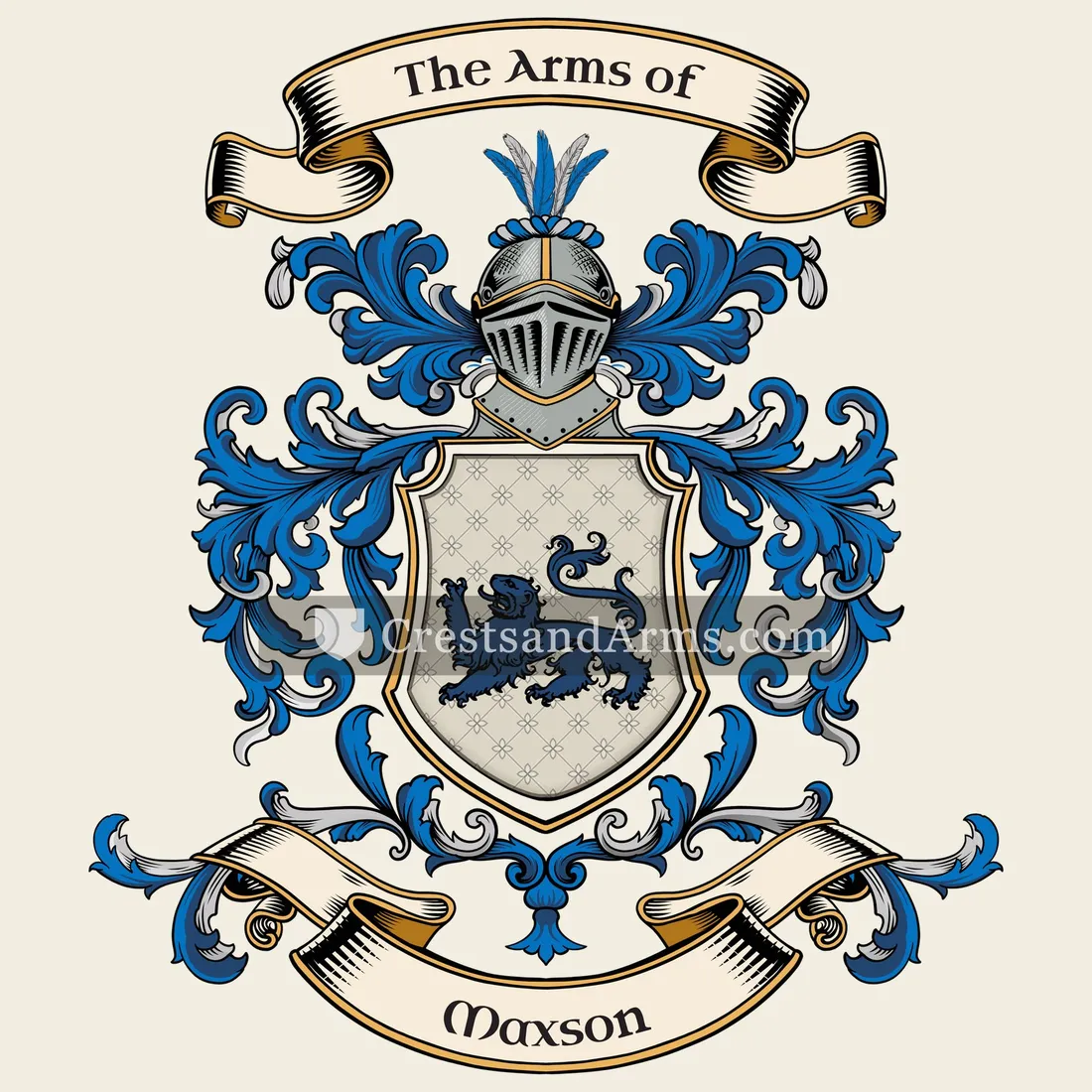
Symbols on this shield
lionCourage, strength and royalty
Colours
Silver (Argent)Means: Peace and sincerity
Blue (Azure)Means: Loyalty and truth
Historical info
Source
Sir Bernard Burke, The General Armory of England, Scotland, Ireland and Wales, London: Harrison & Sons, 1884
Blazon (the actual original written record)
“Ar. a lion ramp. with two heads az”
Irelandc. 1645
Digital archive packCoat of arms PNG, gold border print PDF, vector SVG and the certificate of authenticity. Sent to your email in minutes.
Map of Ireland showing where the Maxson arms are recorded
The Maxson arms were recorded in Ireland, c. 1645.
Arms such as these were typically recorded in Dublin.
Dublin was the seat of government in Ireland and the place where grants were sought and recorded. Families with business at the castle or the courts settled nearby, and settling there put their arms on record.
This is where the arms were entered in the register. Families often moved to other parts of the country, so the same name can turn up in more than one region.
The body that granted and recorded arms in Ireland in this period.
Charles I of England
Sovereign of the period
Charles I of England
1625–1649
Reigning in England when the Maxson arms are first recorded.
How Arms Worked in Ireland
The Ulster King of Arms granted coats of arms to individuals who proved their social standing and good character. These symbols were typically inherited by all legitimate descendants of the original holder. If a family branch wanted a unique look, they could apply for a specific change to their design through the office to ensure their identity remained distinct.
Granting authority
The Ulster King of Arms acted as the official body that regulated and issued all coats of arms throughout Ireland.
How they got arms
Families obtained their arms through formal grants issued by the office after proving their eligibility and paying the required fees.
Where arms were recorded
All official grants were recorded in the registers held by the Ulster King of Arms starting from the year 1552.
The family's standing
Recorded among the armigerous families of Ireland.
Origin & History of the Maxson Family in Ireland
The Maxson family name has roots that reach into the complex social landscape of seventeenth-century Dublin. By 1645, members of the family were established within the city during a period of intense political and religious upheaval in Ireland. During this era, Dublin served as a central hub for trade and administration, attracting families who were often involved in the merchant class or the growing colonial bureaucracy. Because the name suggests a patronymic origin, meaning it likely evolved from "son of Max," it reflects a naming tradition common among families of English or Anglo-Norman descent living in the Pale. These early residents navigated a city defined by shifting loyalties and the aftermath of the Irish Rebellion, positioning themselves within the urban fabric of a capital undergoing rapid transition. Their presence in the historical record of Dublin provides a glimpse into the lives of families who helped shape the city’s demographic character during the mid-seventeenth century.
Maxson Meaning & Related Branches
Root word
Maximus
Latin for greatest or largest.
This name
MaxsonPatronymic form meaning son of Max, a shortened version of Maximilian or Magnus.
also spelled
Mayson
Maison
Documented Sources
Sir Bernard Burke, The General Armory of England, Scotland, Ireland and Wales, London: Harrison & Sons, 1884
Reaney, P.H., A Dictionary of British Surnames, 1958
Cottle, Basil, The Penguin Dictionary of Surnames, 1967
Cambridgeshire Archives, Huntingdon Parish Registers (St. Mary and All Saints), 1600–1650
Digital archive packCoat of arms PNG, gold border print PDF, vector SVG and the certificate of authenticity. Sent to your email in minutes.


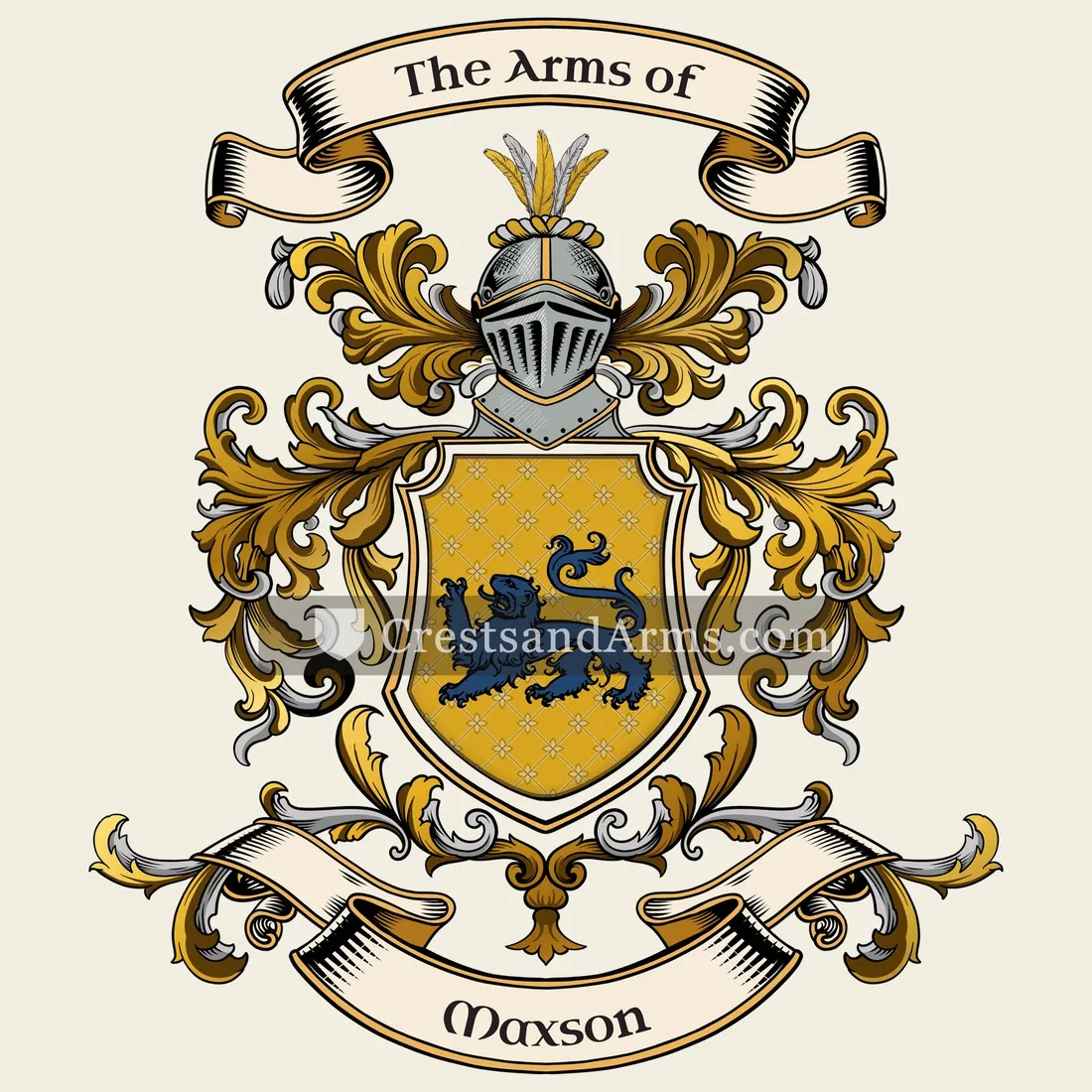
 lionCourage, strength and royalty
 lionCourage, strength and royalty


 bendDefence, and the scarf of a commander
 spurKnighthood, and readiness to spur on
 fleur de lisPurity, light, and the sixth son