Map of France showing where the May arms are recorded
The May arms were recorded in Forez, c. 1663.
Forez was a small upland county in central France, thick with minor gentry holding modest estates. Its families were more numerous than wealthy, and even a small holding was enough for a shield of one's own.
This is where the arms were entered in the register. Families often moved to other parts of the country, so the same name can turn up in more than one region.
The body that granted and recorded arms in France in this period.
Louis XIV of France
Sovereign of the period
Louis XIV of France
1643–1715
Reigning in France when the May arms are first recorded.
How Arms Worked in France
In France, a coat of arms was a mark of honor that passed down through the male line to all legitimate descendants. Families often used the same shield without changes to show their shared heritage. If a branch wanted to stand out, they could add a small mark to their shield to show their specific place in the family tree.
Granting authority
The Juge d'armes de France acted as the official authority that regulated and verified coats of arms across the country.
How they got arms
Families typically inherited their arms from ancestors, though they could also receive them through royal grants or by proving their noble status.
Where arms were recorded
Coats of arms were officially recorded in the Armorial Général de France, which began its main collection in the year 1696.
The family's standing
Recorded among the armigerous families of Forez.
Origin & History of the May Family in France
The family name May has deep roots in the historical province of Forez, where records confirm the presence of family members as early as 1663. In the context of French history, the name likely emerged from the linguistic traditions of the region, where surnames often evolved from nicknames, occupations, or specific geographic markers. During the seventeenth century, the Forez area was a landscape defined by its transition from feudal structures to a more centralized royal administration under the French crown. Families living in this region were often tied to the land through agriculture or local trade, and the name May may have been used to identify individuals who were born in the month of May or who held roles related to the spring season. As the family established itself in the local community, they became part of the social fabric of the Forez countryside, navigating the challenges of rural life and the shifting political landscape of pre-revolutionary France. By maintaining a documented presence in this specific area, the family participated in the long-term development of local society and the preservation of regional identity.
Meaning of the May family crest colors & symbols
Symbols on this shield
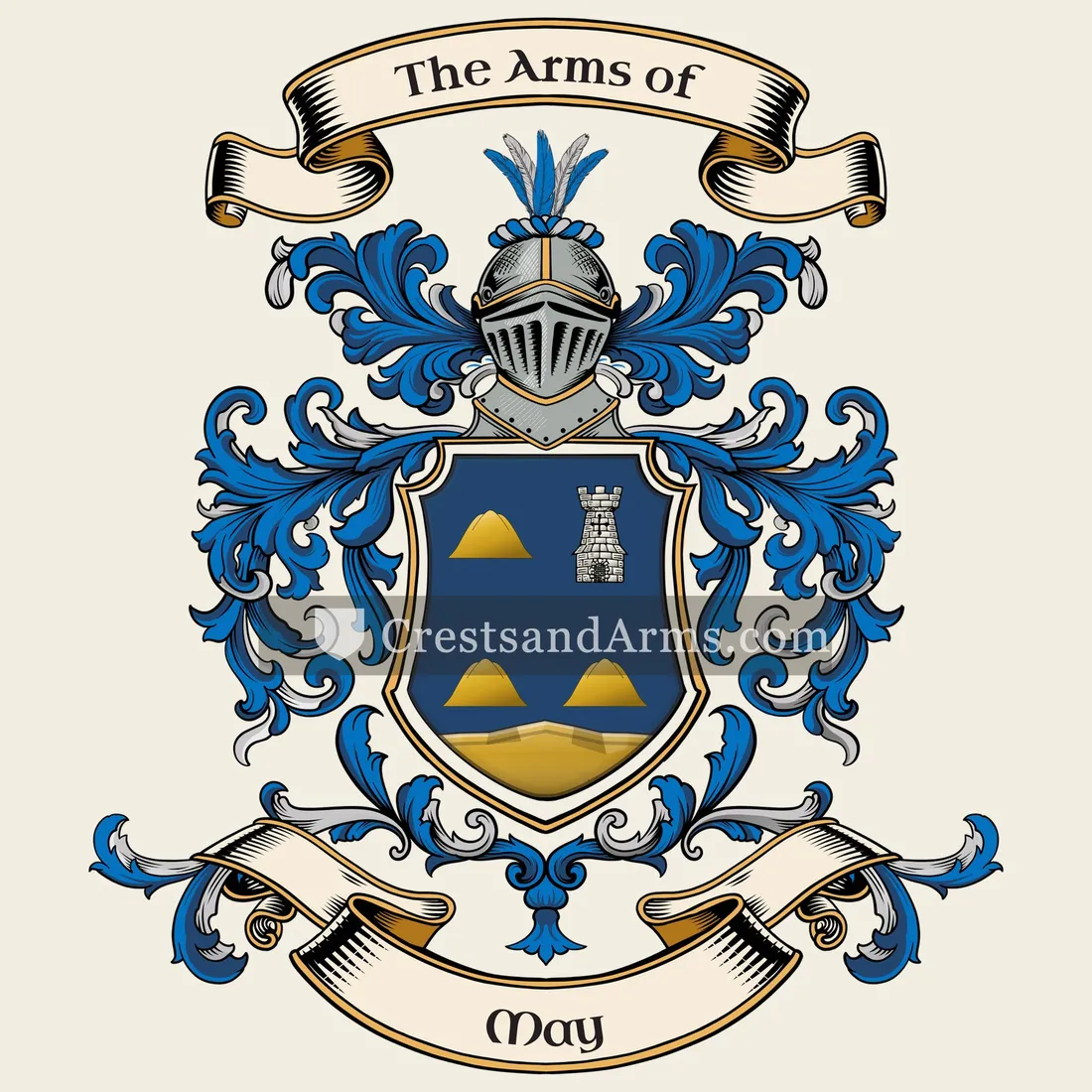
chevronProtection, and faithful service completed
lionCourage, strength and royalty
shipEnterprise, and a great voyage undertaken
Colours
Silver (Argent)Means: Peace and sincerity
Red (Gules)Means: Military strength
Gold (Or)Means: Generosity
Black (Sable)Means: Constancy
Historical info
Source
Sir Bernard Burke, The General Armory of England, Scotland, Ireland and Wales, London: Harrison & Sons, 1884
Blazon (the actual original written record)
“Ar. on a chev. gu. betw. three ancient galleys with three masts, sails furled, flags flying sa. a lion ramp. or, armed and langued az”
DublinDublin, c. 1616
Digital archive packCoat of arms PNG, gold border print PDF, vector SVG and the certificate of authenticity. Sent to your email in minutes.
Map of Ireland showing where the May arms are recorded
The May arms were recorded in Dublin, c. 1616.
Dublin was the seat of government in Ireland and the place where grants were sought and recorded. Families with business at the castle or the courts settled nearby, and settling there put their arms on record.
This is where the arms were entered in the register. Families often moved to other parts of the country, so the same name can turn up in more than one region.
The body that granted and recorded arms in Ireland in this period.
James VI and I
Sovereign of the period
James VI and I
1603–1625
Reigning in France when the May arms are first recorded.
How Arms Worked in Ireland
The Ulster King of Arms granted coats of arms to individuals who proved their social standing and good character. These symbols were typically inherited by all legitimate descendants of the original holder. If a family branch wanted a unique look, they could apply for a specific change to their design through the office to ensure their identity remained distinct.
Granting authority
The Ulster King of Arms acted as the official body that regulated and issued all coats of arms throughout Ireland.
How they got arms
Families obtained their arms through formal grants issued by the office after proving their eligibility and paying the required fees.
Where arms were recorded
All official grants were recorded in the registers held by the Ulster King of Arms starting from the year 1552.
The family's standing
Recorded among the armigerous families of Dublin.
Origin & History of the May Family in Ireland
The history of the May family in Ireland is deeply rooted in the urban development of Dublin during the early seventeenth century. By 1616, records confirm that members of the family were already established residents within the city, a time when Dublin was undergoing significant social and economic shifts under English administration. The name itself likely arrived in Ireland through waves of migration from England, where it had long been used as a descriptive term for someone born in the month of May or as a nickname for a person with a cheerful disposition. As these early settlers integrated into the bustling port city, they participated in the local merchant and administrative classes that defined Dublin’s growth. Over the following decades, the family name became firmly embedded in the local landscape, transitioning from newcomers to permanent members of the Irish capital’s civic life.
Meaning of the May family crest colors & symbols
Symbols on this shield
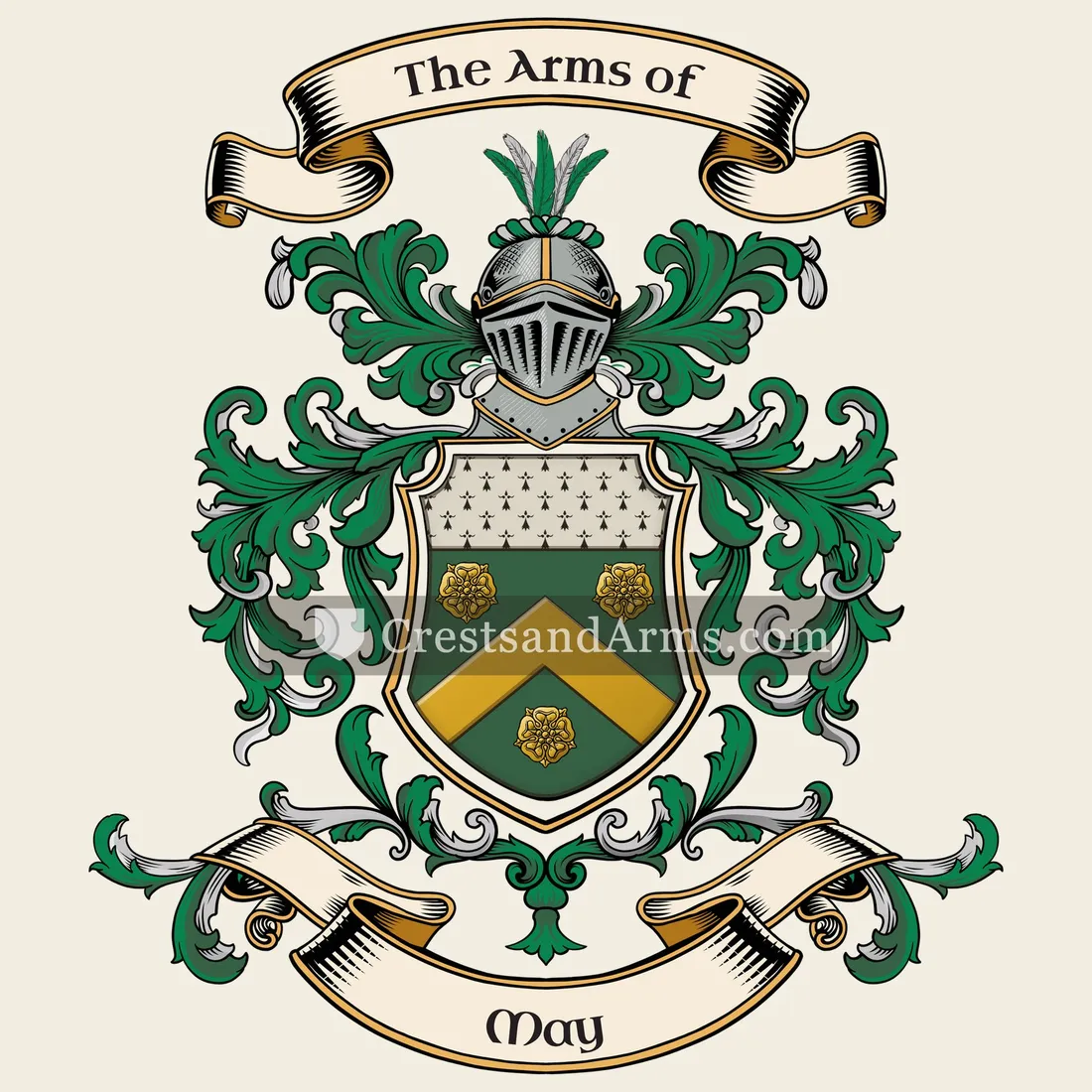
chevronProtection, and faithful service completed
chiefAuthority, wisdom and dominion
roseThe seventh son, and beauty with grace
Colours
Green (Vert)Means: Hope
Gold (Or)Means: Generosity
ErmineMeans: Dignity
Historical info
Source
Sir Bernard Burke, The General Armory of England, Scotland, Ireland and Wales, London: Harrison & Sons, 1884
Blazon (the actual original written record)
“Vert a chev. betw. three roses or, a chief indented erm”
Englandc. 1590
Digital archive packCoat of arms PNG, gold border print PDF, vector SVG and the certificate of authenticity. Sent to your email in minutes.
Map of England showing where the May arms are recorded
The May arms were recorded in England, c. 1590.
Arms such as these were typically recorded in York.
Yorkshire is the largest of the English counties, and it held more gentry families than any other. Land there was split among a great many households rather than a few, so a great many of them carried arms.
This is where the arms were entered in the register. Families often moved to other parts of the country, so the same name can turn up in more than one region.
The body that granted and recorded arms in England in this period.
Elizabeth I of England
Sovereign of the period
Elizabeth I of England
1558–1603
Reigning in France when the May arms are first recorded.
How Arms Worked in England
English heraldry allowed arms to be shared by all legitimate descendants of the original owner. These symbols were treated as personal property that moved through the generations to all children. While the eldest son kept the original design, other family members could use the same shield without needing to change it or register their own unique versions.
Granting authority
The College of Arms in London has regulated the use of coats of arms throughout England and Wales since 1484.
How they got arms
Families typically obtained their coats of arms through a formal grant from the Crown or by proving their ancient right to them.
Where arms were recorded
All official coats of arms are recorded in the registers kept at the College of Arms, which date back to the fifteenth century.
The family's standing
Recorded among the armigerous families of England.
Origin & History of the May Family in England
The surname May has deep roots in the English landscape, often serving as a descriptive name for individuals born during the month of May or those known for a cheerful disposition. By the late sixteenth century, the name was well-established in northern England, with records confirming that families bearing the name were living in the city of York by 1590. During this era, York was a bustling center of trade and religious life, and families like the Mays were often integrated into the local merchant classes or the skilled craft guilds that defined the city’s economy. As the family grew, they moved through the shifting social structures of the Tudor and Stuart periods, leaving traces in parish registers and local tax rolls. These early ancestors lived through a time of significant transition in England, where the stability of city life in places like York allowed families to build lasting legacies that persisted long after the sixteenth century.
May Meaning & Related Branches
Root word
Maius
Latin name for the month of May or the goddess Maia.
This name
MayA locative surname for someone born in May or living near a Maypole.
also spelled
Mai
Mey
Maie
Related arms
Lightsame arms
Meyvariant spelling
Documented Sources
J. B. Rietstap, Armorial Général, Gouda: G. B. van Goor Zonen, 1884–87
Archives départementales de la Loire, Registres paroissiaux et d'état civil du Forez, 1663
Gras, Pierre, Le Forez féodal, 1880
Gonon, Marguerite, La vie quotidienne en Forez au XVIIe siècle, 1960
Digital archive packCoat of arms PNG, gold border print PDF, vector SVG and the certificate of authenticity. Sent to your email in minutes.


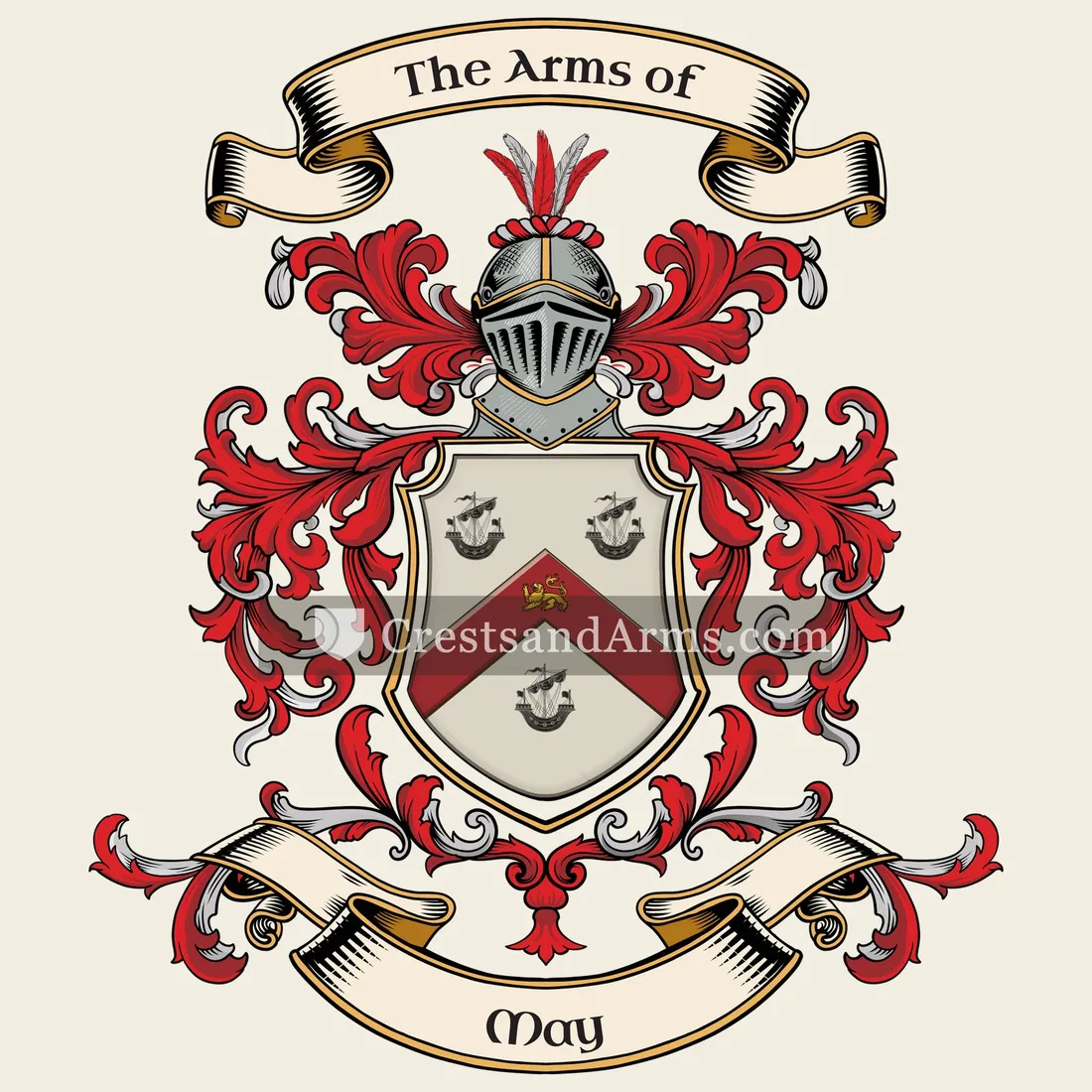
 mountThe ground held, and steadfastness upon it
 towerGrandeur and solidity, and a stronghold defended
 mountThe ground held, and steadfastness upon it
 towerGrandeur and solidity, and a stronghold defended


 chevronProtection, and faithful service completed
 lionCourage, strength and royalty
 shipEnterprise, and a great voyage undertaken


 chiefAuthority, wisdom and dominion
 roseThe seventh son, and beauty with grace