A record of documented arms, meaning and origin, researched for the Maya family lines. Documented in 2 countries.
Reg. 2103 · French, M–O
Meaning of the Maya family crest colors & symbols
Symbols on this shield
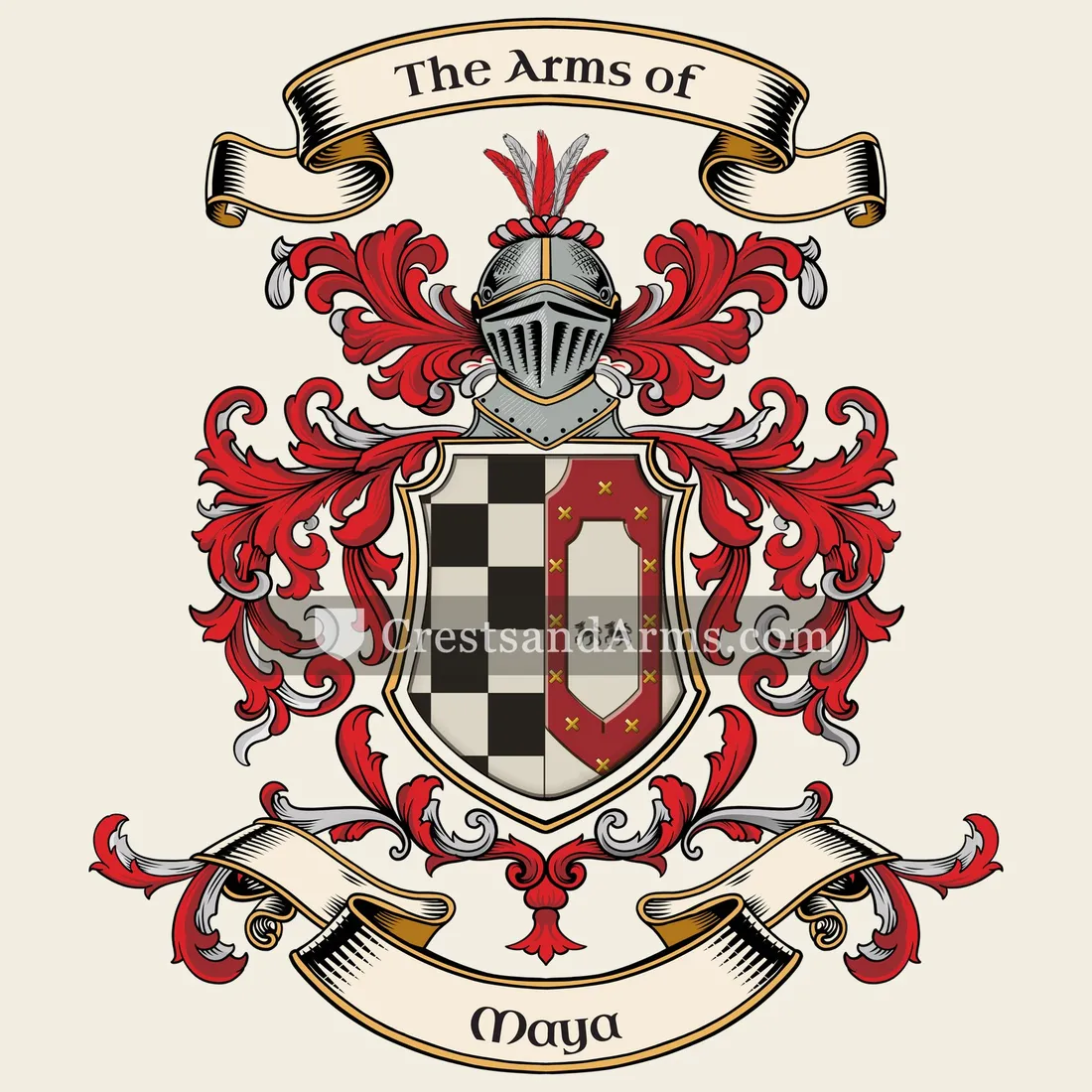
chequyConstancy, and the counting-board
wolfReward from long service and hard work
saltire coupedResolution, and the cross of St Andrew
Colours
Silver (Argent)Means: Peace and sincerity
Red (Gules)Means: Military strength
Black (Sable)Means: Constancy
Gold (Or)Means: Generosity
Historical info
Source
J. B. Rietstap, Armorial Général, Gouda: G. B. van Goor Zonen, 1884–87
Blazon (the actual original written record)
“Parti: au 1 échiq. d'arg. et de sa.; au 2 d'arg. à deux loups pass. de sa., l'un sur l'autre, et une bord. de gu. ch. de quatorze flanchis d'or, 2 en chef, 5 à chaque flanc l'un sur l'autre, et 2 en p. [V. Amaya.]”
NavarreNavarre, c. 1663
Digital archive packCoat of arms PNG, gold border print PDF, vector SVG and the certificate of authenticity. Sent to your email in minutes.
Map of France showing where the Maya arms are recorded
The Maya arms were recorded in Navarre, c. 1663.
Navarre was mountain country straddling the Pyrenees, with a strong class of small independent landholders. A great many households counted as gentry there, and each needed a shield to be told apart.
This is where the arms were entered in the register. Families often moved to other parts of the country, so the same name can turn up in more than one region.
The body that granted and recorded arms in France in this period.
Louis XIV of France
Sovereign of the period
Louis XIV of France
1643–1715
Reigning in France when the Maya arms are first recorded.
How Arms Worked in France
In France, a coat of arms was a mark of honor that passed down through the male line to all legitimate descendants. Families often used the same shield without changes to show their shared heritage. If a branch wanted to stand out, they could add a small mark to their shield to show their specific place in the family tree.
Granting authority
The Juge d'armes de France acted as the official authority that regulated and verified coats of arms across the country.
How they got arms
Families typically inherited their arms from ancestors, though they could also receive them through royal grants or by proving their noble status.
Where arms were recorded
Coats of arms were officially recorded in the Armorial Général de France, which began its main collection in the year 1696.
The family's standing
Recorded among the armigerous families of Navarre.
Origin & History of the Maya Family in France
The history of the Maya family name in France is deeply connected to the rugged landscape of the Pyrenees mountains and the historical region of Navarre. By the year 1663, records confirm that family members were firmly established in this area, which served as a vital crossroads between French and Spanish cultures. During this period, the name was closely tied to the social structure of rural communities where families often identified themselves by the specific farmstead or house they occupied. Because the region of Navarre maintained unique local customs and legal traditions, the Maya family likely lived as part of a close-knit agricultural society that placed great importance on land ownership and ancestral heritage. Over time, these early settlers helped shape the local identity of the region, leaving behind a legacy that reflects the resilience of families living in the borderlands of southwestern France.
Meaning of the Maya family crest colors & symbols
Symbols on this shield
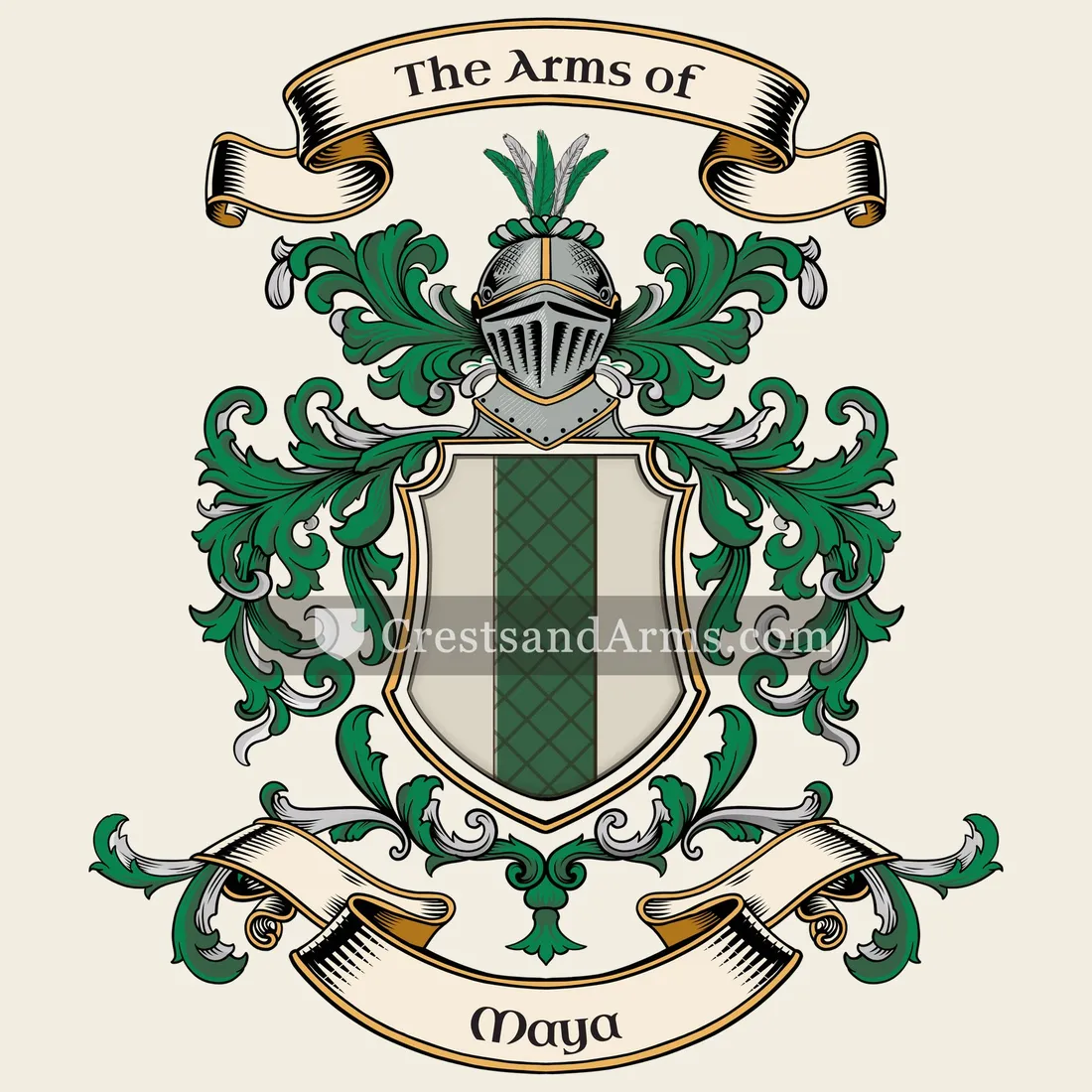
paleMilitary strength, and a fortified defence
Colours
Silver (Argent)Means: Peace and sincerity
Green (Vert)Means: Hope
Historical info
Source
J. B. Rietstap, Armorial Général, Gouda: G. B. van Goor Zonen, 1884–87
Blazon (the actual original written record)
“D'arg. au pal de sin.”
Spainc. 1722
Digital archive packCoat of arms PNG, gold border print PDF, vector SVG and the certificate of authenticity. Sent to your email in minutes.
Map of Spain showing where the Maya arms are recorded
The Maya arms were recorded in Spain, c. 1722.
Arms such as these were typically recorded in Castile.
Castile was the heart of Spain and the source of most of its noble families. Land won in the long wars against the Moors was granted out to fighting men, and a man granted land was granted arms along with it.
This is where the arms were entered in the register. Families often moved to other parts of the country, so the same name can turn up in more than one region.
The body that granted and recorded arms in Spain in this period.
Philip V of Spain
Sovereign of the period
Philip V of Spain
1714–1724
Reigning in France when the Maya arms are first recorded.
How Arms Worked in Spain
In Spain, a coat of arms was considered a form of property that belonged to the entire family line. These arms were passed down from a father to all his children equally. Younger branches of the family usually kept the original design without needing to add any special marks to distinguish their specific line.
Granting authority
The Cronista Rey de Armas was the official body that regulated and granted coats of arms throughout Spain.
How they got arms
Families often obtained their arms through royal grants or by proving their noble status to the official heraldic authority.
Where arms were recorded
Coats of arms were officially recorded in the registers of the Cronista Rey de Armas starting in 1496.
The family's standing
Recorded among the armigerous families of Spain.
Origin & History of the Maya Family in Spain
The surname Maya finds its historical roots in the rugged landscapes of the Castile region of Spain. By the early 18th century, records confirm that families bearing this name were well-established members of the local community. During this era, Castile served as the political and cultural heart of the Spanish kingdom. Families like the Mayas often lived in small agricultural villages or growing towns where they contributed to the local economy through farming or trade. Because the name appears in parish registers and municipal documents from 1722, we know that these individuals were integrated into the social fabric of the Spanish countryside. They lived through a period of transition as the Bourbon dynasty began to reshape the administration of Spain. Over time, the family name became a permanent part of the regional identity, reflecting the deep historical connection between the people of Castile and the lands they cultivated for generations.
Maya Meaning & Related Branches
Root word
Maia
Greek and Roman mythological figure associated with growth and spring.
This name
MayaDerived from the month of May or the goddess of nurturing and earth.
also spelled
Maia
May
Related arms
Mayvariant spelling
Documented Sources
J. B. Rietstap, Armorial Général, Gouda: G. B. van Goor Zonen, 1884–87
Archives Départementales des Pyrénées-Atlantiques, Registres paroissiaux de la commune de Navarre
Caro Baroja, Julio, Los vascos, 1971
Goyhenetche, Manex, Histoire générale du Pays basque, 1991
Digital archive packCoat of arms PNG, gold border print PDF, vector SVG and the certificate of authenticity. Sent to your email in minutes.


 chequyConstancy, and the counting-board
 wolfReward from long service and hard work
 saltire coupedResolution, and the cross of St Andrew
 chequyConstancy, and the counting-board
 wolfReward from long service and hard work
 saltire coupedResolution, and the cross of St Andrew


 paleMilitary strength, and a fortified defence