Map of Germany showing where the Mayer arms are recorded
The Mayer arms were recorded in Thuringe, c. 1765.
This is where the arms were entered in the register. Families often moved to other parts of the country, so the same name can turn up in more than one region.
The body that granted and recorded arms in Germany in this period.
Francis I, Holy Roman Emperor
Sovereign of the period
Francis I, Holy Roman Emperor
1745–1765
Reigning in Germany when the Mayer arms are first recorded.
How Arms Worked in Germany
In the Holy Roman Empire, coats of arms were often granted to individuals by the Emperor or his representatives. These arms were then passed down through the generations to all legitimate descendants of the original holder. Younger branches of a family usually kept the same shield design without needing to change it, as the arms belonged to the entire lineage.
Granting authority
The Holy Roman Emperor held the sole power to grant new coats of arms throughout his vast imperial territories.
How they got arms
Families typically obtained their coats of arms through a formal imperial grant or by proving their noble status to the authorities.
Where arms were recorded
These grants were officially recorded in the Imperial Chancery registers, which began keeping formal records of such honors during the Middle Ages.
The family's standing
Recorded among the armigerous families of Germany.
Origin & History of the Mayer Family in Germany
The surname Mayer is rooted in the social structure of medieval Germany, where it functioned as an occupational title rather than a name assigned at birth. The word originated from the Latin term *maior*, meaning greater or superior, and it was used to identify a person who served as a steward or a bailiff for a local landowner. These individuals were responsible for managing agricultural estates, overseeing harvests, and settling disputes among tenant farmers. By the time your ancestors were documented in Thuringia in 1765, the name had transitioned from a job description into a hereditary family name passed down through generations. Living in the Thuringian region, your family likely occupied a stable place within the local community, as the name reflects a long history of involvement in the management and administration of rural lands. This evolution from a professional role to a family identifier shows how the social hierarchies of early Germany shaped the naming traditions that persist today.
Coat of Arms & Family Crest Details
Symbols on this shield
fessThe military belt, and readiness to serve
Colours
Silver (Argent)Means: Peace and sincerity
Blue (Azure)Means: Loyalty and truth
Historical info
Source
J. B. Rietstap, Armorial Général, Gouda: G. B. van Goor Zonen, 1884–87
Blazon (the actual original written record)
“D'arg. à deux fasces d'azur. C.: une tête et col de chien braque d'arg., le col ch. de deux fasces d'azur [V. Mayer-Tschudi et Meyer d'Altsteten.]”
Switzerlandc. 1745
Digital archive packCoat of arms PNG, gold border print PDF, vector SVG and the certificate of authenticity. Sent to your email in minutes.
Map of Switzerland showing where the Mayer arms are recorded
The Mayer arms were recorded in Switzerland, c. 1745.
Arms such as these were typically recorded in Bern.
Bern was the largest of the Swiss cantons and ran itself, with its own council and its own courts. Its governing families held office for generations, and office of that kind carried a shield with it.
This is where the arms were entered in the register. Families often moved to other parts of the country, so the same name can turn up in more than one region.
The body that granted and recorded arms in Switzerland in this period.
How Arms Worked in Switzerland
In Switzerland, coats of arms were not restricted to the nobility and were often adopted by common citizens and families. These symbols were passed down through generations to show family identity. When branches of a family grew, they often changed small details of the design to distinguish their own line from the original group.
Granting authority
Cantonal and civic authorities managed the use of coats of arms within their specific regions and local jurisdictions.
How they got arms
Families typically assumed their own coats of arms based on local custom rather than receiving them from a central monarch.
Where arms were recorded
Arms were recorded in various cantonal and civic registers starting from the fourteenth century throughout the Swiss region.
The family's standing
Recorded among the armigerous families of Switzerland.
Origin & History of the Mayer Family in Switzerland
The name Mayer is an occupational surname that traces its roots back to the Middle Ages, originating from the Latin word *maior*, which means a superior or a steward. In the context of Switzerland, the name was often given to individuals who managed land or served as local administrators for noble estates. By the time members of the family were documented in Bern in 1745, the name had already become well-established across German-speaking regions. These early ancestors in Bern were likely part of the growing middle class, as the title had shifted from a specific job description to a hereditary family name. During the eighteenth century, families with this name often integrated into the civic life of Swiss cantons, contributing to the local economy and administrative systems. Because the name was tied to a common profession, it appeared independently in many different towns, meaning that families named Mayer in Switzerland often share a common linguistic origin rather than a single ancestral line.
Coat of Arms & Family Crest Details
Symbols on this shield
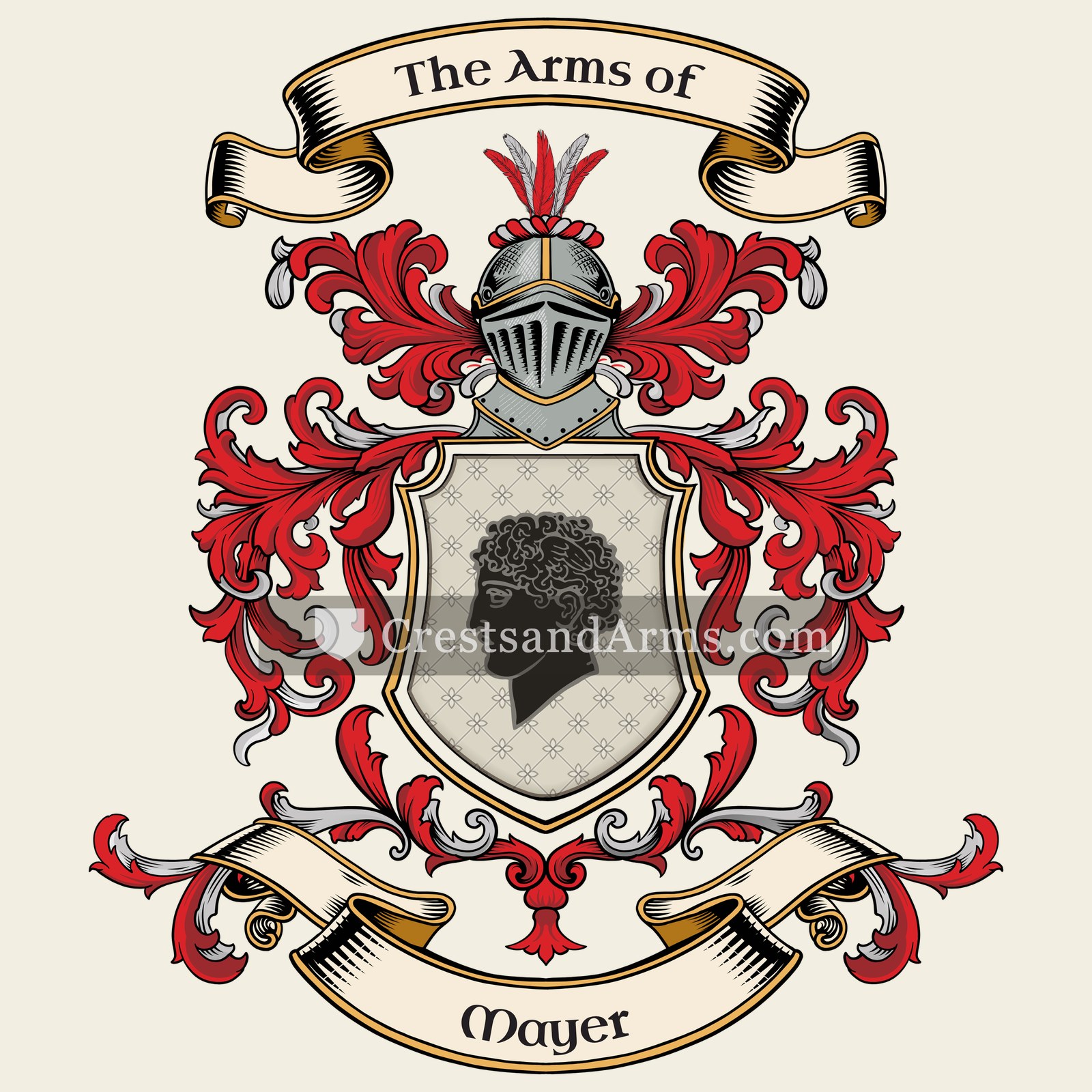
chequyConstancy, and the counting-board
savages head affrontyAn enemy overcome
Colours
Silver (Argent)Means: Peace and sincerity
Black (Sable)Means: Constancy
Historical info
Source
Sir Bernard Burke, The General Armory of England, Scotland, Ireland and Wales, London: Harrison & Sons, 1884
Blazon (the actual original written record)
“Ar. a Moor, the sinister hand touching the head sa. bound round the temples, and holding in the dexter hand a sword blade wavy or, vested round the waist chequy of the last and of the second, fringed gold”
Jerseyc. 1688
Digital archive packCoat of arms PNG, gold border print PDF, vector SVG and the certificate of authenticity. Sent to your email in minutes.
The body that granted and recorded arms in Jersey in this period.
James II of England
Sovereign of the period
James II of England
1685–1688
Reigning in Germany when the Mayer arms are first recorded.
How Arms Worked in Jersey
Arms in the Channel Islands were granted and recorded by the College of Arms in London, under the same law of arms as England. They could be used by all legitimate descendants of the original owner: the eldest son kept the original design, and other family members used the same shield without registering a version of their own.
Granting authority
The College of Arms in London has regulated the use of coats of arms for Jersey and the other Channel Islands since 1484.
How they got arms
Families typically obtained their coats of arms through a formal grant from the Crown or by proving their ancient right to them.
Where arms were recorded
All official coats of arms are recorded in the registers kept at the College of Arms, which date back to the fifteenth century.
The family's standing
Recorded among the armigerous families of Jersey.
Origin & History of the Mayer Family in Jersey
The family name Mayer has deep roots in the history of Jersey, with records confirming that members of the family were established on the island by 1688. The name itself is derived from the Middle High German word for a steward or a person who managed land, which suggests that the earliest ancestors were likely skilled administrators or farmers who held positions of responsibility within their communities. When these individuals arrived in Jersey, they integrated into a unique society that blended French traditions with English influence. Over time, the family became part of the island’s distinct social fabric, adapting to the local customs and the maritime economy that defined life in the Channel Islands. By settling in Jersey during the late seventeenth century, the Mayer family helped shape the local landscape and contributed to the diverse heritage that continues to define the island today.
Mayer Meaning & Related Branches
Root word
maior
Latin term meaning greater or superior in rank.
This name
MayerAn occupational title for a steward, bailiff, or the head of a village.
also spelled
Maier
Meyer
Myer
Mayre
Maire
Related arms
Capellini dit Stechinellisimilar arms
Kunitzsimilar arms
Kuttner de Kutnitzsimilar arms
Maiervariant spelling
Documented Sources
J. B. Rietstap, Armorial Général, Gouda: G. B. van Goor Zonen, 1884–87
Bahlow, Hans, Deutsches Namenlexikon: Familien- und Vornamen nach Ursprung und Sinn erklärt, 1967
Gottschald, Max, Deutsche Namenkunde: Unsere Familiennamen nach ihrer Entstehung und Bedeutung, 1971
Thüringisches Staatsarchiv Rudolstadt, Kirchenbücher und Personenstandsregister, 1765
Digital archive packCoat of arms PNG, gold border print PDF, vector SVG and the certificate of authenticity. Sent to your email in minutes.


 fleur de lisPurity, light, and the sixth son
 fleur de lisPurity, light, and the sixth son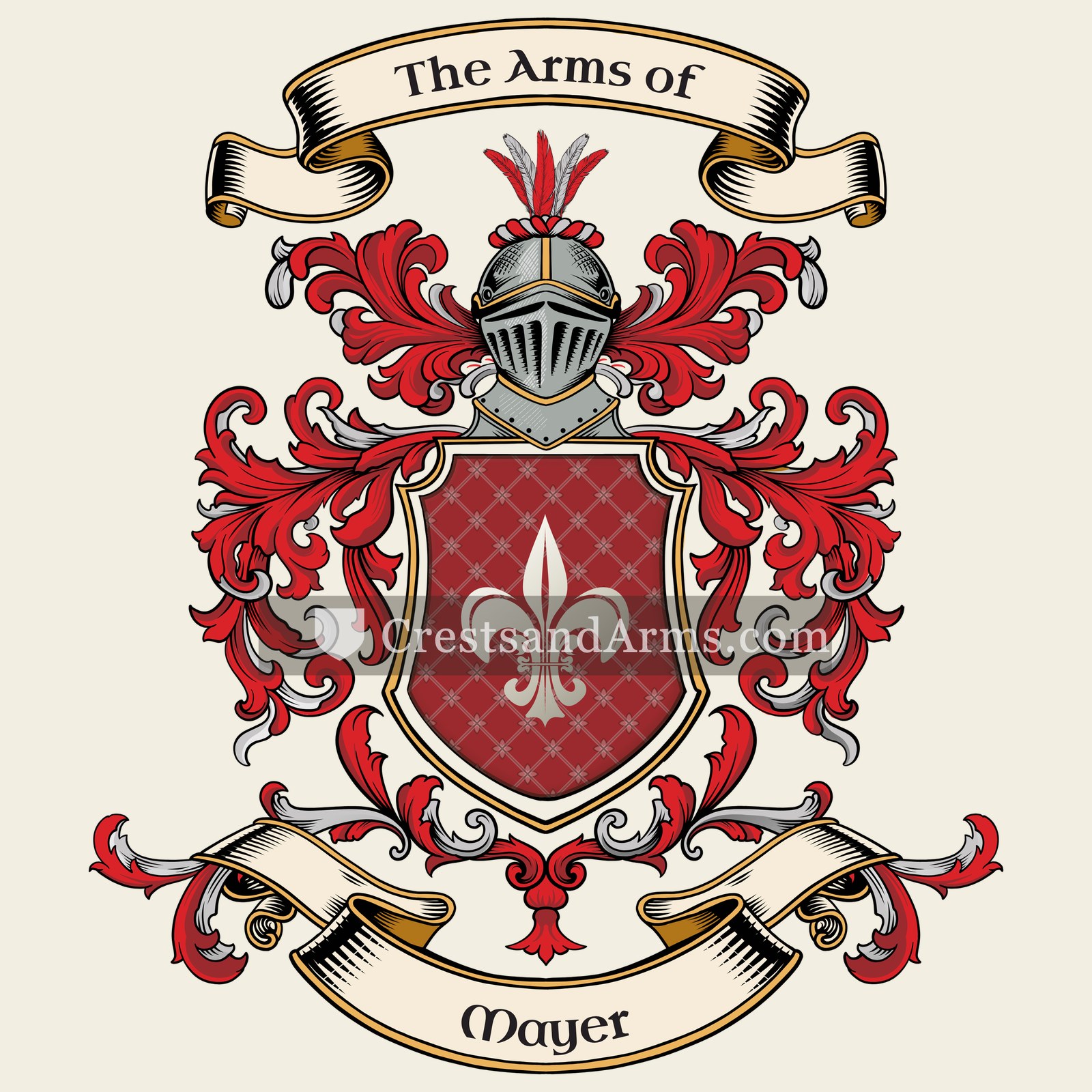


 fessThe military belt, and readiness to serve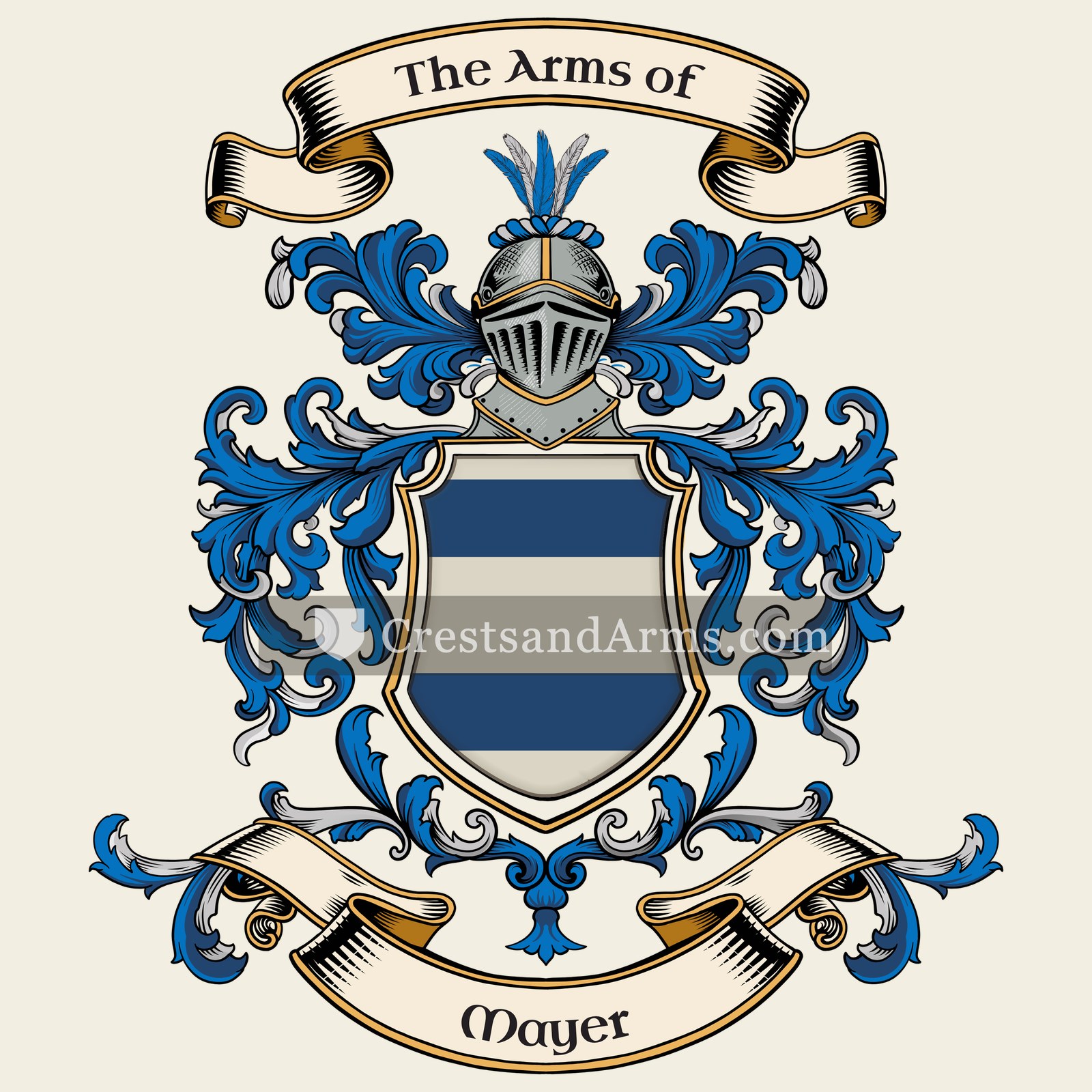

 chequyConstancy, and the counting-board
 savages head affrontyAn enemy overcome