Map of Britain showing where the Mayeux arms are recorded
The Mayeux arms were recorded in Britain, c. 1641.
Arms such as these were typically recorded in Kent.
Kent sits between London and the short crossing to Europe, and the trade passing through made it wealthy. Merchant families bought land with that money, and it was landowners who took coats of arms.
This is where the arms were entered in the register. Families often moved to other parts of the country, so the same name can turn up in more than one region.
The body that granted and recorded arms in Britain in this period.
Charles I of England
Sovereign of the period
Charles I of England
1625–1649
Reigning in Britain when the Mayeux arms are first recorded.
How Arms Worked in Britain
English heraldry allowed arms to be shared by all legitimate descendants of the original owner. These symbols were treated as personal property that moved through the generations to all children. While the eldest son kept the original design, other family members could use the same shield without needing to change it or register their own unique versions.
Granting authority
The College of Arms in London has regulated the use of coats of arms throughout England and Wales since 1484.
How they got arms
Families typically obtained their coats of arms through a formal grant from the Crown or by proving their ancient right to them.
Where arms were recorded
All official coats of arms are recorded in the registers kept at the College of Arms, which date back to the fifteenth century.
The family's standing
Recorded among the armigerous families of Britain.
Origin & History of the Mayeux Family in Britain
The history of the Mayeux family in Britain begins with their documented presence in the county of Kent during the year 1641. This period was a time of great social and political tension in England, as the country moved toward the outbreak of the Civil War. Many families with similar names arrived in the British Isles during the seventeenth century as refugees or skilled workers fleeing religious and economic instability in mainland Europe. In Kent, which served as a primary gateway for travel between England and the continent, the Mayeux family likely integrated into the local agricultural or trade-based economy. Over time, the spelling of the name often shifted to adapt to English pronunciation and record-keeping practices. By settling in the southeast of England, the early members of this family became part of the diverse cultural landscape that defined the region during the Stuart era.
Meaning of the Mayeux family crest colors & symbols
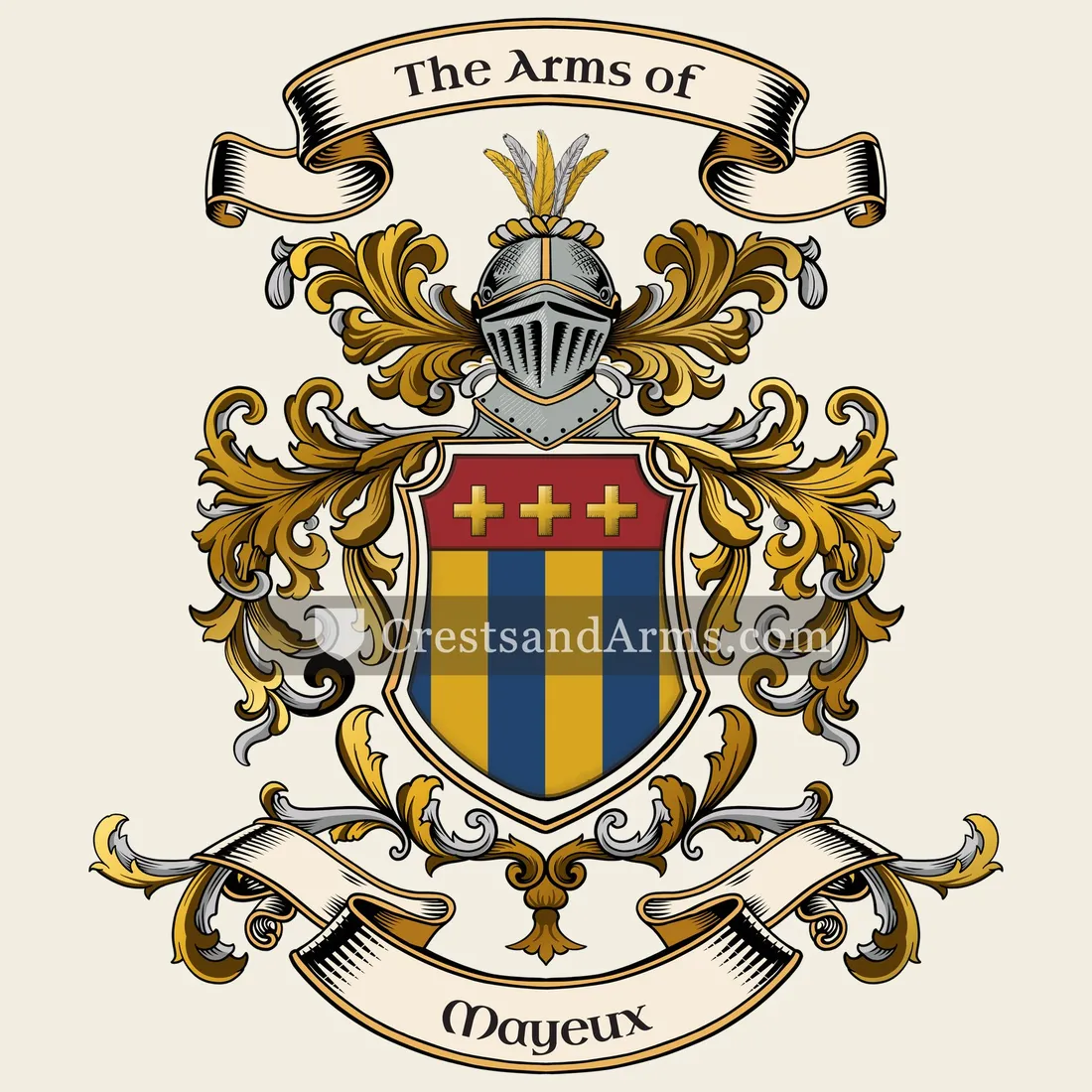
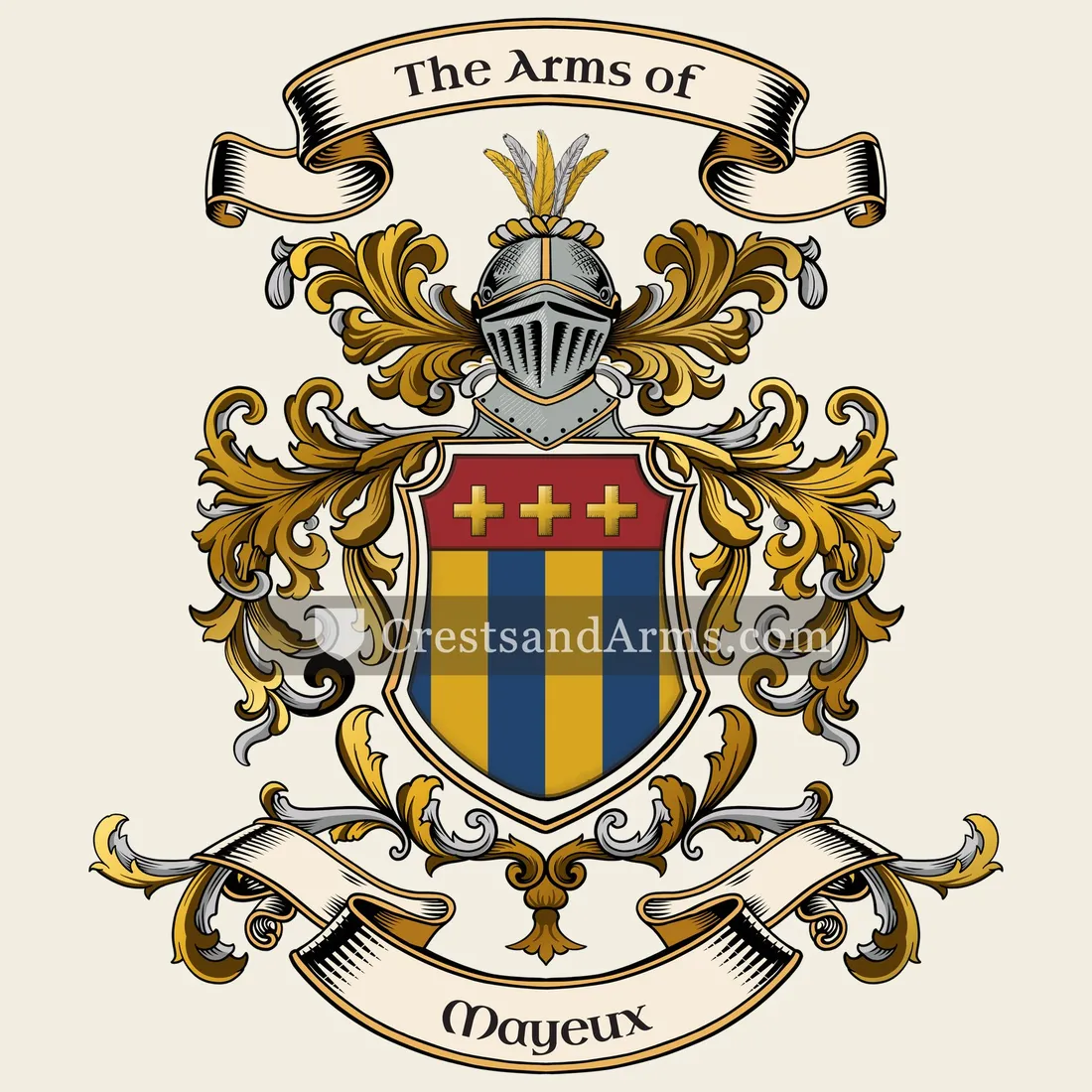
Symbols on this shield
chiefAuthority, wisdom and dominion
cross symbolChristian faith and service
Colours
Gold (Or)Means: Generosity
Red (Gules)Means: Military strength
Blue (Azure)Means: Loyalty and truth
Historical info
Source
Sir Bernard Burke, The General Armory of England, Scotland, Ireland and Wales, London: Harrison & Sons, 1884
Blazon (the actual original written record)
“Paly of six or and az. on a chief gu. three crosses pattée of the first”
HertfordTheobald's Park · Hertford, c. 1620
Digital archive packCoat of arms PNG, gold border print PDF, vector SVG and the certificate of authenticity. Sent to your email in minutes.
Map of England showing where the Mayeux arms are recorded
The Mayeux arms were recorded in Hertford, c. 1620.
Hertfordshire lay just north of London and filled with families who had made money in the City. Buying an estate within a day's ride was the usual next step, and an estate brought arms with it.
This is where the arms were entered in the register. Families often moved to other parts of the country, so the same name can turn up in more than one region.
The body that granted and recorded arms in England in this period.
James VI and I
Sovereign of the period
James VI and I
1603–1625
Reigning in Britain when the Mayeux arms are first recorded.
How Arms Worked in England
English heraldry allowed arms to be shared by all legitimate descendants of the original owner. These symbols were treated as personal property that moved through the generations to all children. While the eldest son kept the original design, other family members could use the same shield without needing to change it or register their own unique versions.
Granting authority
The College of Arms in London has regulated the use of coats of arms throughout England and Wales since 1484.
How they got arms
Families typically obtained their coats of arms through a formal grant from the Crown or by proving their ancient right to them.
Where arms were recorded
All official coats of arms are recorded in the registers kept at the College of Arms, which date back to the fifteenth century.
The family's standing
Recorded among the armigerous families of Hertford.
Origin & History of the Mayeux Family in England
The family name Mayeux carries a history that stretches back to the early seventeenth century in the English town of Hertford. By 1620, records indicate that members of the family were already established within this community, which served as an important market town and administrative center. During this period, the name was likely influenced by the linguistic shifts occurring in England as families navigated local parish life and trade. Because Hertford was a hub for travelers moving between London and the northern counties, the family would have been part of a growing middle class involved in local commerce or agriculture. Their presence in the town archives suggests they were settled residents who participated in the social and legal structures of the time. While the name itself has roots that suggest a connection to broader European naming conventions, its survival in the Hertford records highlights the family's role in the development of this historic English town during the early modern era.
Mayeux Meaning & Related Branches
Root word
Matthieu
Derived from the Hebrew name Matityahu meaning gift of God.
This name
MayeuxA diminutive form of Matthew, historically used as a nickname for someone named Matthew.
also spelled
Meuxe
Meuxs
Meuxz
Mu
Mews
Documented Sources
J. B. Rietstap, Armorial Général, Gouda: G. B. van Goor Zonen, 1884–87
House of Lords, Journal of the House of Lords: Volume 4, 1629-1642, 1802
The National Archives, State Papers Domestic: Charles I, SP 16/483
Digital archive packCoat of arms PNG, gold border print PDF, vector SVG and the certificate of authenticity. Sent to your email in minutes.


 paleMilitary strength, and a fortified defence
 chiefAuthority, wisdom and dominion
 cross symbolChristian faith and service
 paleMilitary strength, and a fortified defence
 chiefAuthority, wisdom and dominion
 cross symbolChristian faith and service