Map of Scotland showing where the Mayhan arms are recorded
The Mayhan arms were recorded in Scotland, c. 1748.
Arms such as these were typically recorded in Edinburgh.
Edinburgh was the seat of Scotland's government, its courts and its heralds. Families with business there settled nearby, and being close to where arms were recorded is exactly why so many of them appear.
This is where the arms were entered in the register. Families often moved to other parts of the country, so the same name can turn up in more than one region.
The body that granted and recorded arms in Scotland in this period.
George II of Great Britain
Sovereign of the period
George II of Great Britain
1727–1760
Reigning in Scotland when the Mayhan arms are first recorded.
How Arms Worked in Scotland
Scottish heraldry is unique because it treats a coat of arms as a piece of personal property protected by law. Only one person can own a specific design at any given time. When a family grows, the head keeps the original shield while other relatives must apply for their own distinct version with slight changes to prove their specific identity.
Granting authority
The Court of the Lord Lyon acts as the official body that regulates and controls all heraldic matters throughout Scotland.
How they got arms
Individuals obtain a legal right to their arms through a formal petition process that confirms their identity and family connection.
Where arms were recorded
All valid coats of arms are officially entered into the Public Register of All Arms and Bearings starting from 1672.
The family's standing
Recorded among the armigerous families of Scotland.
Origin & History of the Mayhan Family in Scotland
The surname Mayhan is deeply rooted in the historical landscape of Scotland, with confirmed records placing members of the family in Edinburgh as early as 1748. During the mid-eighteenth century, Edinburgh was a bustling center of the Scottish Enlightenment, and families like the Mayhans were part of a society undergoing rapid social and economic change. The name likely evolved from older Gaelic or localized roots, reflecting the linguistic shifts common in the Lowlands during that era. By establishing themselves in the capital, early Mayhan ancestors were positioned at the heart of Scottish commerce and urban development. These individuals were likely tradespeople or laborers who contributed to the growth of the city during a time when Edinburgh was expanding beyond its ancient medieval walls. Their presence in the city records suggests a family that was integrated into the daily life and administrative systems of a changing Scotland.
Mayhan Meaning & Related Branches
Root word
Mathghamhain
Derived from the Gaelic words for bear and calf.
This name
MayhanA Scottish and Irish surname signifying a descendant of the bear-calf.
Documented Sources
Sir Bernard Burke, The General Armory of England, Scotland, Ireland and Wales, London: Harrison & Sons, 1884
National Records of Scotland, Old Parish Registers of Edinburgh, Births and Baptisms (1748)
National Records of Scotland, Edinburgh City Archives, Register of Burgesses and Guild Brethren (1748)
Digital archive packCoat of arms PNG, gold border print PDF, vector SVG and the certificate of authenticity. Sent to your email in minutes.


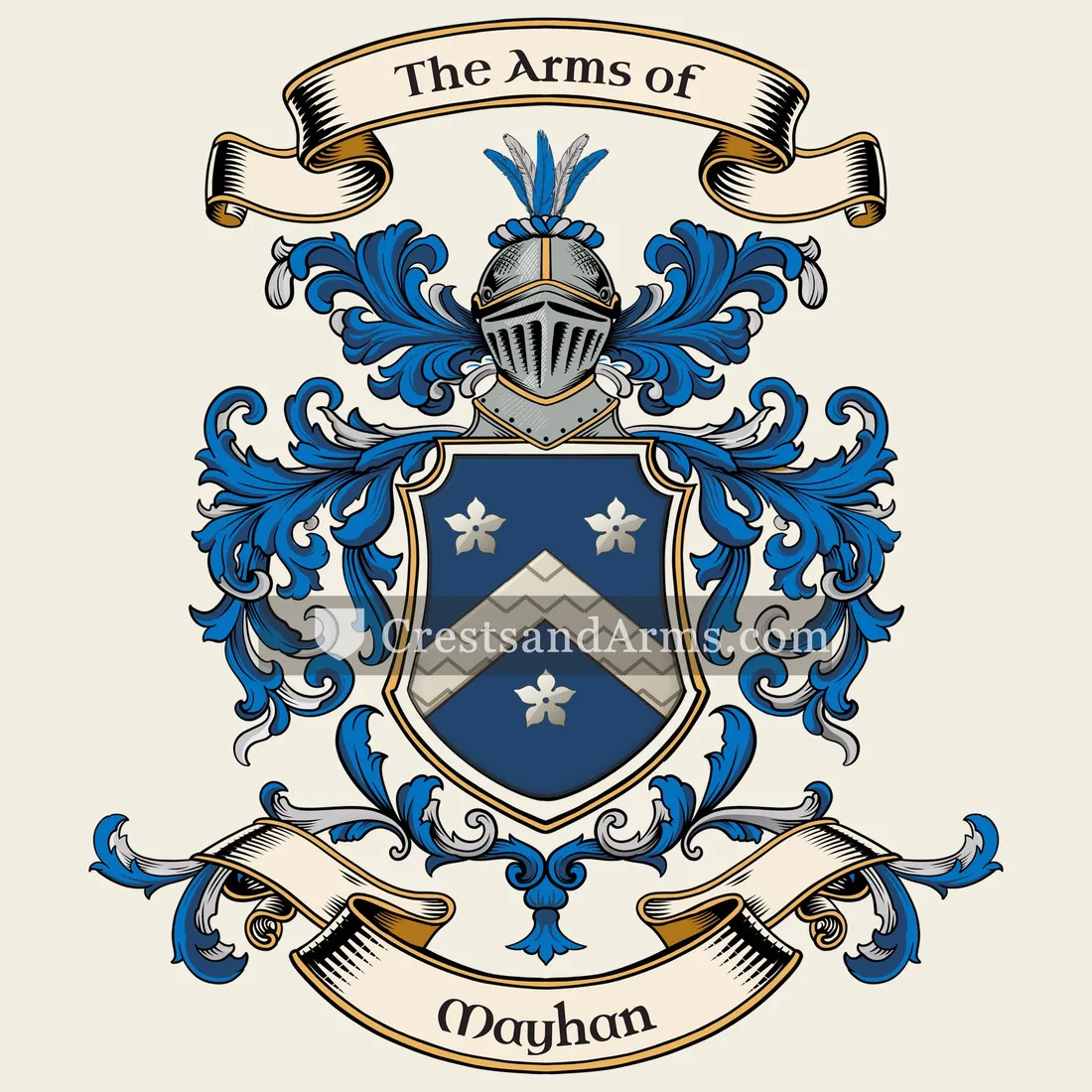
 chevronProtection, and faithful service completed
 cinquefoilHope and joy
 chevronProtection, and faithful service completed
 cinquefoilHope and joy