Map of England showing where the Mayle arms are recorded
The Mayle arms were recorded in Cornwall, c. 1300.
Cornwall was a county apart, with its own language and its own tight-knit gentry. Tin and the sea made money there, and families who made it bought land, which is what brought arms with it.
This is where the arms were entered in the register. Families often moved to other parts of the country, so the same name can turn up in more than one region.
The body that granted and recorded arms in England in this period.
Edward I of England
Sovereign of the period
Edward I of England
1272–1307
Reigning in England when the Mayle arms are first recorded.
How Arms Worked in England
English heraldry allowed arms to be shared by all legitimate descendants of the original owner. These symbols were treated as personal property that moved through the generations to all children. While the eldest son kept the original design, other family members could use the same shield without needing to change it or register their own unique versions.
Granting authority
The College of Arms in London has regulated the use of coats of arms throughout England and Wales since 1484.
How they got arms
Families typically obtained their coats of arms through a formal grant from the Crown or by proving their ancient right to them.
Where arms were recorded
All official coats of arms are recorded in the registers kept at the College of Arms, which date back to the fifteenth century.
The family's standing
Recorded among the armigerous families of Cornwall.
Origin & History of the Mayle Family in England
The surname Mayle has deep roots in the rugged landscape of Cornwall, where records confirm the family was established by the early 14th century. During this period, the name was likely linked to the Old English word "mægel," which often referred to a person with a gentle or mild temperament. Many families in medieval Cornwall lived in small, isolated farming communities, and the Mayles were no exception. They were part of a society that relied heavily on tin mining and coastal trade, which shaped their daily lives and local identity. As the centuries progressed, the family name became a permanent fixture in the region, reflecting the steady growth of local lineages that helped define the unique cultural history of the Cornish people.
Mayle Meaning & Related Branches
Root word
Maël
A Breton name derived from the word for prince or chief.
This name
MayleA locative surname referring to someone living near a sandbank or a meadow.
also spelled
Moile
Moyll
Moill
Documented Sources
Sir Bernard Burke, The General Armory of England, Scotland, Ireland and Wales, London: Harrison & Sons, 1884
Gover, J.E.B., Mawer, A., and Stenton, F.M., The Place-Names of Cornwall, 1948
Padel, O.J., A Popular Dictionary of Cornish Place-Names, 1988


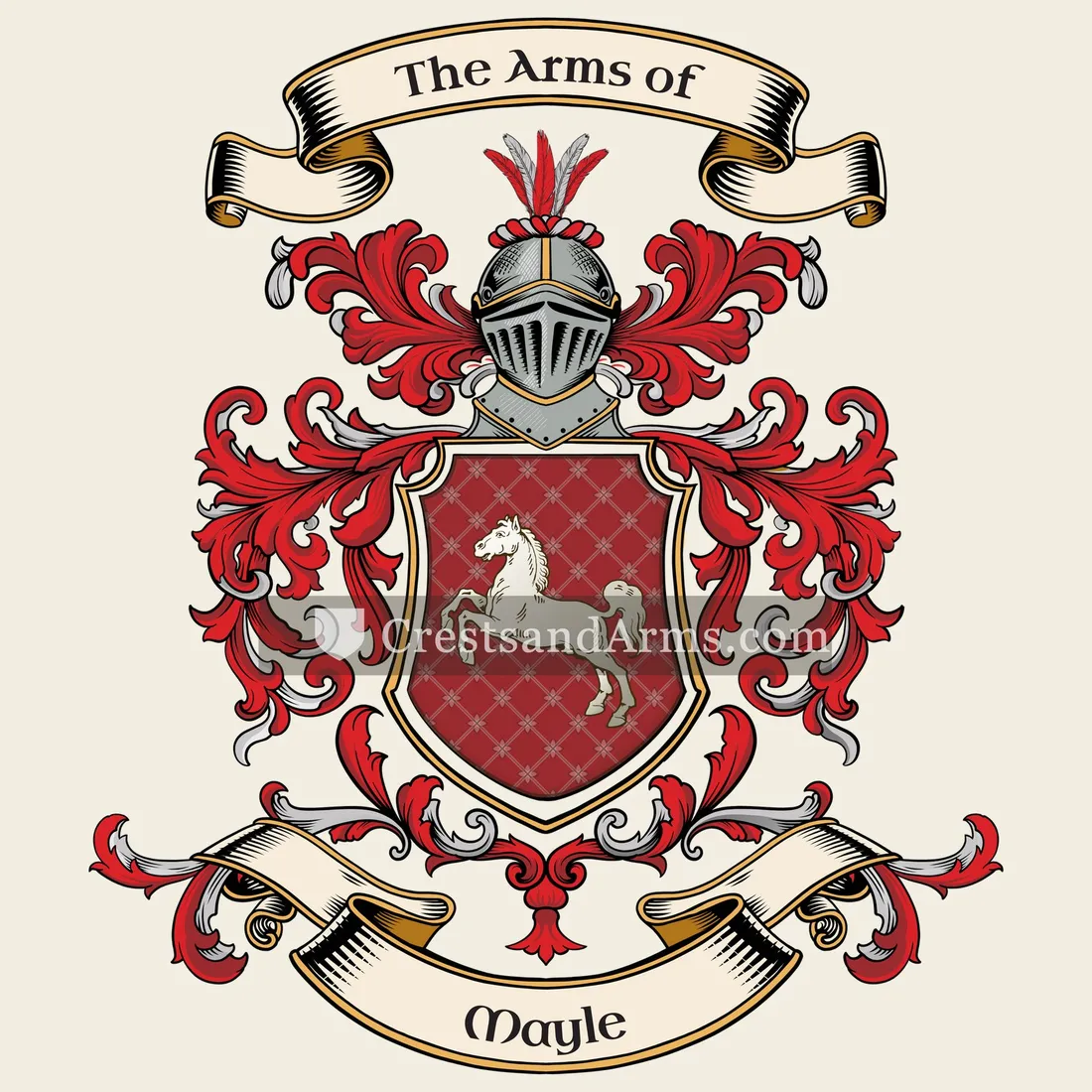
 horseReadiness to serve king and country
 horseReadiness to serve king and country