A record of documented arms, meaning and origin, researched for the Maynard family lines. Documented in 3 countries.
Reg. 5398 · French, M–O
Meaning of the Maynard family crest colors & symbols
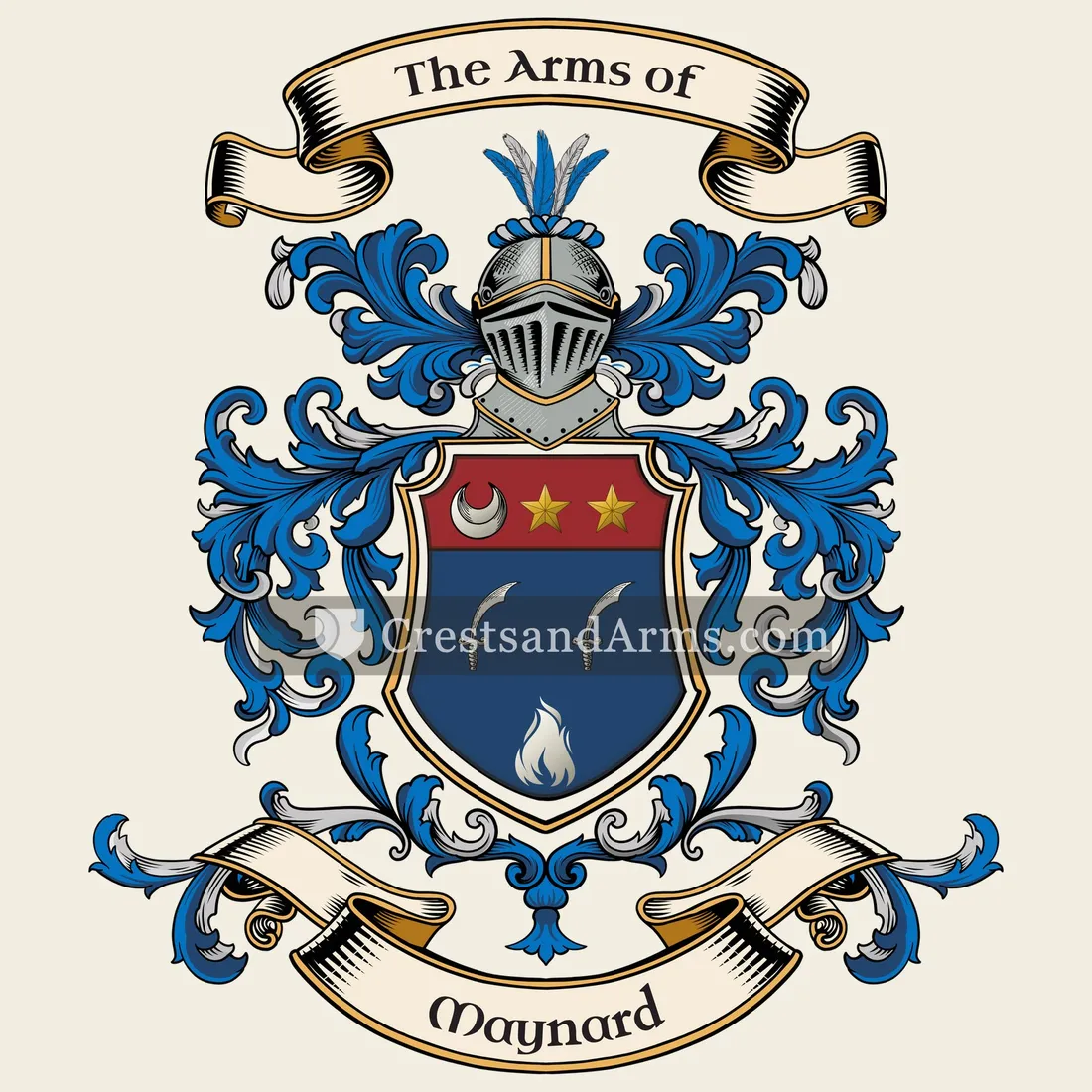
Symbols on this shield
chiefAuthority, wisdom and dominion
swordJustice, and military honour
fireZeal and purification
crescentHonour by the sovereign, and the second son
mulletThe third son, and a divine quality from above
Colours
Blue (Azure)Means: Loyalty and truth
Red (Gules)Means: Military strength
Silver (Argent)Means: Peace and sincerity
Gold (Or)Means: Generosity
Historical info
Source
J. B. Rietstap, Armorial Général, Gouda: G. B. van Goor Zonen, 1884–87
Blazon (the actual original written record)
“D'azur semé de flammes d'arg.; à deux épées du même, passées en saut., br. sur le tout; au chef de gu., ch. d'un croiss. d'arg., entre deux étoiles d'or.”
LanguedocLanguedoc, c. 1663
Digital archive packCoat of arms PNG, gold border print PDF, vector SVG and the certificate of authenticity. Sent to your email in minutes.
Map of France showing where the Maynard arms are recorded
The Maynard arms were recorded in Languedoc, c. 1663.
Languedoc stretched across the south of France, a country of small towns, vineyards and old local families. Its gentry were numerous rather than grand, and a great many of them held arms even where their estates were modest.
This is where the arms were entered in the register. Families often moved to other parts of the country, so the same name can turn up in more than one region.
The body that granted and recorded arms in France in this period.
Louis XIV of France
Sovereign of the period
Louis XIV of France
1643–1715
Reigning in France when the Maynard arms are first recorded.
How Arms Worked in France
In France, a coat of arms was a mark of honor that passed down through the male line to all legitimate descendants. Families often used the same shield without changes to show their shared heritage. If a branch wanted to stand out, they could add a small mark to their shield to show their specific place in the family tree.
Granting authority
The Juge d'armes de France acted as the official authority that regulated and verified coats of arms across the country.
How they got arms
Families typically inherited their arms from ancestors, though they could also receive them through royal grants or by proving their noble status.
Where arms were recorded
Coats of arms were officially recorded in the Armorial Général de France, which began its main collection in the year 1696.
The family's standing
Recorded among the armigerous families of Languedoc.
Origin & History of the Maynard Family in France
The origins of the Maynard name in France are deeply rooted in the historical landscape of the Languedoc region. By the year 1663, records confirm that members of the family were well-established in this southern territory, which was known for its distinct cultural identity and complex social structure. The name itself is thought to have evolved from ancient personal names of Germanic origin that became popular throughout France during the Middle Ages. Families like the Maynards often lived in rural communities where they contributed to the local agricultural economy and the development of regional trade. As the seventeenth century progressed, the family navigated the shifting political and religious climate of Languedoc, which was a period marked by significant change for many local lineages. Through these early generations, the name became a permanent fixture in the local records, reflecting the family's long-standing connection to the traditions and geography of the French south.
Meaning of the Maynard family crest colors & symbols
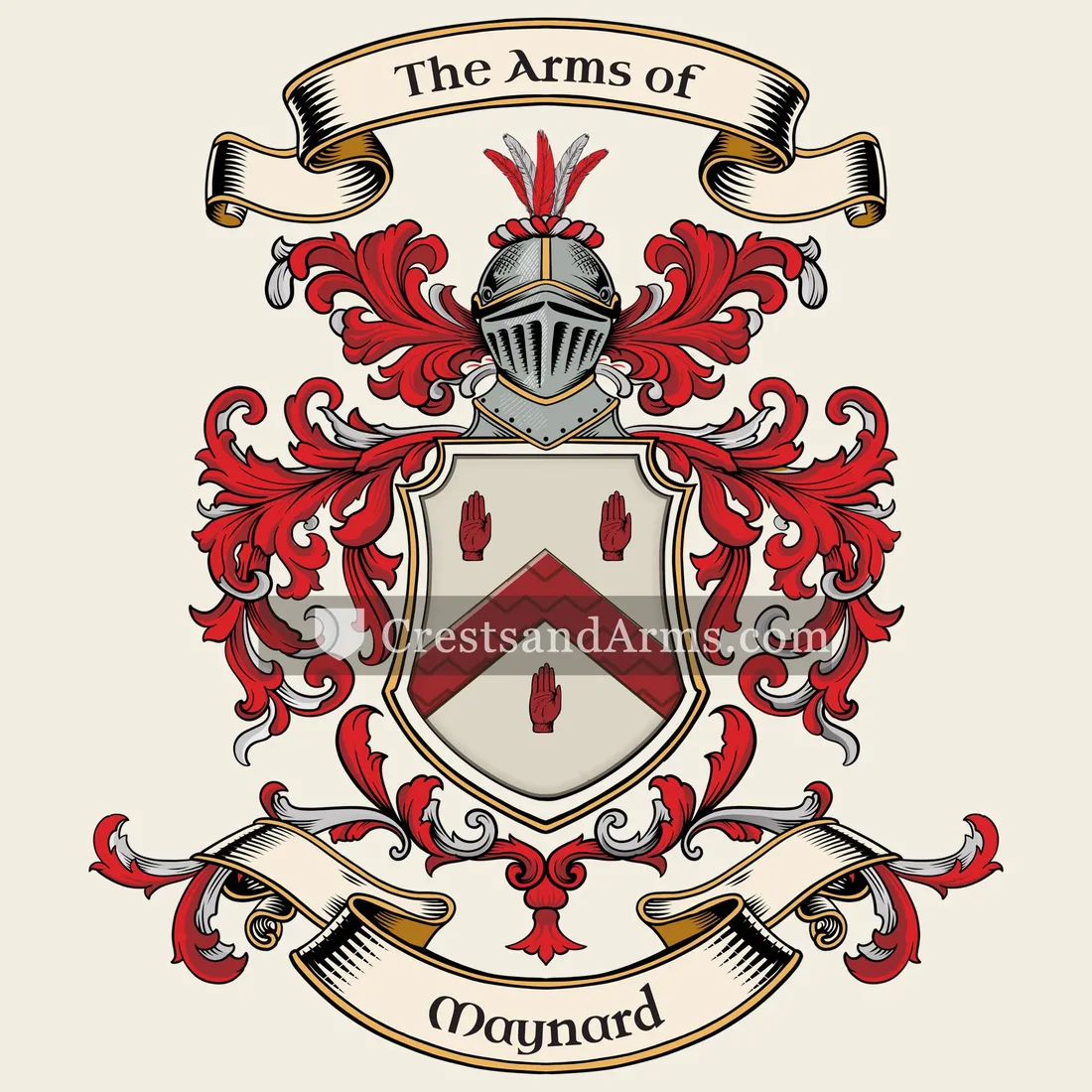
Symbols on this shield
chevronProtection, and faithful service completed
handFaith, sincerity and justice
Colours
Silver (Argent)Means: Peace and sincerity
Red (Gules)Means: Military strength
Historical info
Source
Sir Bernard Burke, The General Armory of England, Scotland, Ireland and Wales, London: Harrison & Sons, 1884
Blazon (the actual original written record)
“Ar. a chev. quarterly gu. and az. betw. three sinister hands couped of the second”
HertfordHertford, c. 1620
Digital archive packCoat of arms PNG, gold border print PDF, vector SVG and the certificate of authenticity. Sent to your email in minutes.
Map of England showing where the Maynard arms are recorded
The Maynard arms were recorded in Hertford, c. 1620.
Hertfordshire lay just north of London and filled with families who had made money in the City. Buying an estate within a day's ride was the usual next step, and an estate brought arms with it.
This is where the arms were entered in the register. Families often moved to other parts of the country, so the same name can turn up in more than one region.
The body that granted and recorded arms in England in this period.
James VI and I
Sovereign of the period
James VI and I
1603–1625
Reigning in France when the Maynard arms are first recorded.
How Arms Worked in England
English heraldry allowed arms to be shared by all legitimate descendants of the original owner. These symbols were treated as personal property that moved through the generations to all children. While the eldest son kept the original design, other family members could use the same shield without needing to change it or register their own unique versions.
Granting authority
The College of Arms in London has regulated the use of coats of arms throughout England and Wales since 1484.
How they got arms
Families typically obtained their coats of arms through a formal grant from the Crown or by proving their ancient right to them.
Where arms were recorded
All official coats of arms are recorded in the registers kept at the College of Arms, which date back to the fifteenth century.
The family's standing
Recorded among the armigerous families of Hertford.
Origin & History of the Maynard Family in England
The name Maynard has deep roots in England, originating as a given name that eventually transitioned into a hereditary surname during the Middle Ages. Derived from the Old French and Germanic elements meaning "hardy" or "brave" and "strength," the name was commonly used in various regions before it became a fixed family identifier. By the early 17th century, the Maynard family had established a notable presence in the town of Hertford. Records from 1620 confirm their residence in this area, where they participated in the local social and economic life of the period. As the family grew, they became integrated into the community through trade, land ownership, and local governance. This transition from a personal name to a stable family name reflects the broader historical trend of English families solidifying their identities during a time of significant social change.
Meaning of the Maynard family crest colors & symbols
Symbols on this shield
chevronProtection, and faithful service completed
handFaith, sincerity and justice
roundelA coin, and one who has been to the crusades
Colours
Gold (Or)Means: Generosity
Red (Gules)Means: Military strength
Blue (Azure)Means: Loyalty and truth
Black (Sable)Means: Constancy
Silver (Argent)Means: Peace and sincerity
Historical info
Source
Sir Bernard Burke, The General Armory of England, Scotland, Ireland and Wales, London: Harrison & Sons, 1884
Blazon (the actual original written record)
“Quarterly, 1st and 4th, or, a chev. gu. cotised az. betw. three dexter hands couped at the wrist and erect sa., for MAYNARD; 2nd and 3rd, ar. a chev. gu. betw. three torteaux, for BASKERVILE”
LongfordCarriglas · Longford, c. 1714
Digital archive packCoat of arms PNG, gold border print PDF, vector SVG and the certificate of authenticity. Sent to your email in minutes.
Map of Ireland showing where the Maynard arms are recorded
The Maynard arms were recorded in Longford, c. 1714.
Longford was small midland Irish country of bog and grazing. Its landed families were few but held their ground for centuries, and long holding fills a register.
This is where the arms were entered in the register. Families often moved to other parts of the country, so the same name can turn up in more than one region.
The body that granted and recorded arms in Ireland in this period.
Anne of Great Britain
Sovereign of the period
Anne of Great Britain
1707–1714
Reigning in France when the Maynard arms are first recorded.
How Arms Worked in Ireland
The Ulster King of Arms granted coats of arms to individuals who proved their social standing and good character. These symbols were typically inherited by all legitimate descendants of the original holder. If a family branch wanted a unique look, they could apply for a specific change to their design through the office to ensure their identity remained distinct.
Granting authority
The Ulster King of Arms acted as the official body that regulated and issued all coats of arms throughout Ireland.
How they got arms
Families obtained their arms through formal grants issued by the office after proving their eligibility and paying the required fees.
Where arms were recorded
All official grants were recorded in the registers held by the Ulster King of Arms starting from the year 1552.
The family's standing
Recorded among the armigerous families of Longford.
Origin & History of the Maynard Family in Ireland
The Maynard family name has roots that stretch back to the early eighteenth century in County Longford. By 1714, records confirm that members of the family were already established in this region of Ireland. The name itself is of Anglo-Norman origin, meaning it likely arrived in Ireland during the centuries of migration from Britain. Families like the Maynards often settled in the Irish Midlands as part of the shifting land ownership patterns of the era. They integrated into the local community and became part of the social fabric of Longford during a time of significant transition. Over the following generations, the family continued to live and work in the area, contributing to the local history of the county as it evolved through the eighteenth and nineteenth centuries.
Maynard Meaning & Related Branches
Root word
Meginhard
Derived from Germanic elements meaning strength and brave or hardy.
This name
MaynardA surname of Old French origin signifying a powerful or strong-hearted individual.
also spelled
Maynart
Mainard
Maynerd
Mainerd
Related arms
Mainardvariant spelling
Beverrecorded with Maynard, same area
Crisperecorded with Maynard, same area
Goodwinrecorded with Maynard, same area
Documented Sources
J. B. Rietstap, Armorial Général, Gouda: G. B. van Goor Zonen, 1884–87
Archives départementales de l'Hérault, Registres paroissiaux et d'état civil, 1663
Boutaric, Edgard, La France sous Philippe le Bel, 1861
Le Roy Ladurie, Emmanuel, Les Paysans de Languedoc, 1966
Digital archive packCoat of arms PNG, gold border print PDF, vector SVG and the certificate of authenticity. Sent to your email in minutes.


 chiefAuthority, wisdom and dominion
 swordJustice, and military honour
 fireZeal and purification
 crescentHonour by the sovereign, and the second son
 mulletThe third son, and a divine quality from above
 chiefAuthority, wisdom and dominion
 swordJustice, and military honour
 fireZeal and purification
 crescentHonour by the sovereign, and the second son
 mulletThe third son, and a divine quality from above


 chevronProtection, and faithful service completed
 handFaith, sincerity and justice


 roundelA coin, and one who has been to the crusades


