Map of France showing where the Mayne arms are recorded
The Mayne arms were recorded in Flandre, c. 1663.
Flandre grew rich on cloth, and its towns were among the busiest in Europe. Merchant families bought land with their profits and took arms to go with it, so trade put as many names in the registers here as land did.
This is where the arms were entered in the register. Families often moved to other parts of the country, so the same name can turn up in more than one region.
The body that granted and recorded arms in France in this period.
Louis XIV of France
Sovereign of the period
Louis XIV of France
1643–1715
Reigning in France when the Mayne arms are first recorded.
How Arms Worked in France
In France, a coat of arms was a mark of honor that passed down through the male line to all legitimate descendants. Families often used the same shield without changes to show their shared heritage. If a branch wanted to stand out, they could add a small mark to their shield to show their specific place in the family tree.
Granting authority
The Juge d'armes de France acted as the official authority that regulated and verified coats of arms across the country.
How they got arms
Families typically inherited their arms from ancestors, though they could also receive them through royal grants or by proving their noble status.
Where arms were recorded
Coats of arms were officially recorded in the Armorial Général de France, which began its main collection in the year 1696.
The family's standing
Recorded among the armigerous families of Flandre.
Origin & History of the Mayne Family in France
The family name Mayne has deep roots in the historical region of Flanders, which straddles the border between modern France and Belgium. By the year 1663, records confirm that family members were well-established in this area, living through a time when the region was a major center for trade and textile production. The name itself likely evolved from local linguistic traditions, serving as a way to identify individuals based on their occupation or their specific location within the landscape. Because Flanders was a crossroads for many different cultures and languages, the family name reflects the blending of Germanic and Romance influences that defined the area during the seventeenth century. These early ancestors were part of a resilient society that navigated constant political shifts and economic changes, helping to shape the identity of the region for generations to come.
Meaning of the Mayne family crest colors & symbols
Symbols on this shield
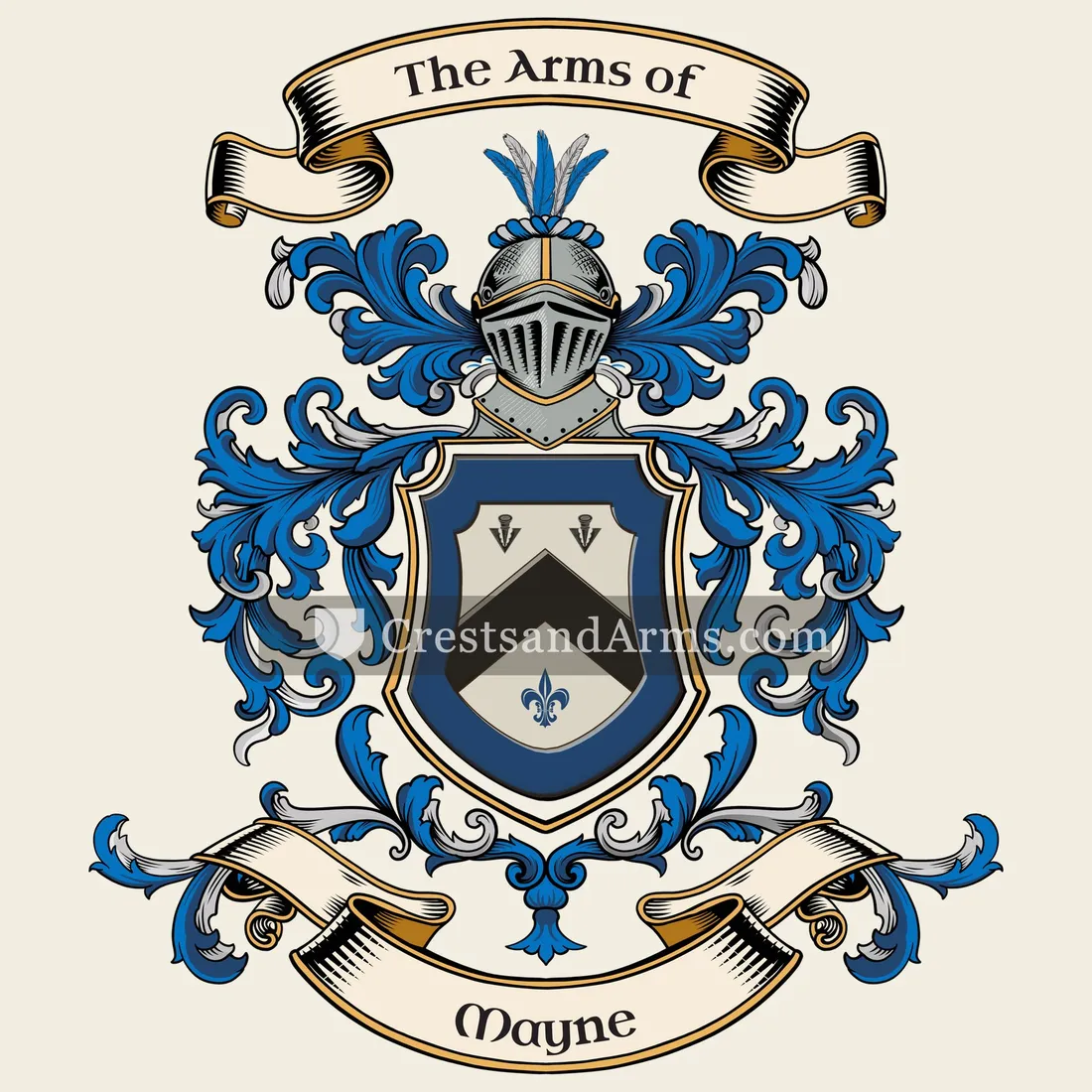
bordureA difference between branches of one family
arms pheon arrowheadReadiness for battle, and the broad arrow of the sovereign
fleur de lisPurity, light, and the sixth son
Colours
Silver (Argent)Means: Peace and sincerity
Black (Sable)Means: Constancy
Blue (Azure)Means: Loyalty and truth
Historical info
Source
Sir Bernard Burke, The General Armory of England, Scotland, Ireland and Wales, London: Harrison & Sons, 1884
Blazon (the actual original written record)
“Ar. two chevronels betw. as many pheons in chief sa. and a fleur-de-lis in base az. within a bordure engr. of the last”
BerksFarley Hill · Berks, c. 1620
Digital archive packCoat of arms PNG, gold border print PDF, vector SVG and the certificate of authenticity. Sent to your email in minutes.
Map of England showing where the Mayne arms are recorded
The Mayne arms were recorded in Berks, c. 1620.
Berkshire sat on the road west from London with the royal castle at Windsor in the middle of it. Court families bought estates within reach, and an estate near the court almost always came with a coat of arms.
This is where the arms were entered in the register. Families often moved to other parts of the country, so the same name can turn up in more than one region.
The body that granted and recorded arms in England in this period.
James VI and I
Sovereign of the period
James VI and I
1603–1625
Reigning in France when the Mayne arms are first recorded.
How Arms Worked in England
English heraldry allowed arms to be shared by all legitimate descendants of the original owner. These symbols were treated as personal property that moved through the generations to all children. While the eldest son kept the original design, other family members could use the same shield without needing to change it or register their own unique versions.
Granting authority
The College of Arms in London has regulated the use of coats of arms throughout England and Wales since 1484.
How they got arms
Families typically obtained their coats of arms through a formal grant from the Crown or by proving their ancient right to them.
Where arms were recorded
All official coats of arms are recorded in the registers kept at the College of Arms, which date back to the fifteenth century.
The family's standing
Recorded among the armigerous families of Berks.
Origin & History of the Mayne Family in England
The surname Mayne has deep roots in the English landscape, evolving from descriptive nicknames that were common during the Middle Ages. The name is often linked to the Old French word "maine," which meant large or great, and it was likely used to describe a person of significant physical stature or a dominant personality. By the time the family was firmly established in the county of Berkshire in 1620, the name had already been present in various parts of England for several centuries. Families bearing this name were often involved in local agriculture and trade, settling into the rhythms of rural life in the southern English shires. As the seventeenth century progressed, these early settlers in Berkshire became part of the growing movement of English families who helped define the social and economic character of the region. Their presence in the historical record during this era reflects a period of stability and transition as the family name became a permanent fixture in local parish registers and land documents.
Meaning of the Mayne family crest colors & symbols
Symbols on this shield
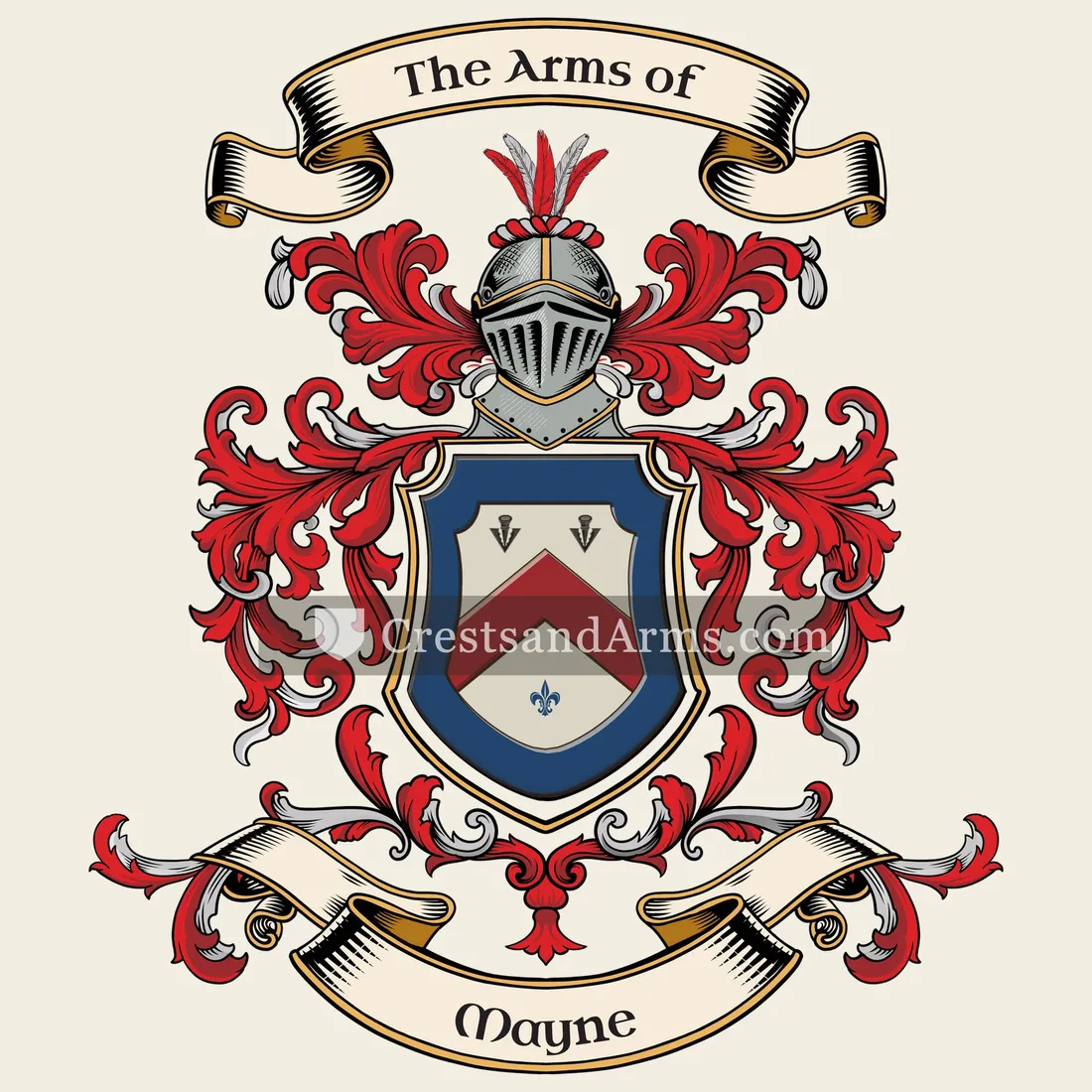
chevronProtection, and faithful service completed
bordureA difference between branches of one family
arms pheon arrowheadReadiness for battle, and the broad arrow of the sovereign
fleur de lisPurity, light, and the sixth son
Colours
Silver (Argent)Means: Peace and sincerity
Red (Gules)Means: Military strength
Blue (Azure)Means: Loyalty and truth
Black (Sable)Means: Constancy
Historical info
Source
Sir Bernard Burke, The General Armory of England, Scotland, Ireland and Wales, London: Harrison & Sons, 1884
Blazon (the actual original written record)
“Ar. a chev. gu. voided of the field betw. two pheons in chief sa. and a fleur-de-lis in base az. a bordure wavy of the last”
ClackmannanPowis · Clackmannan, c. 1748
Digital archive packCoat of arms PNG, gold border print PDF, vector SVG and the certificate of authenticity. Sent to your email in minutes.
Map of Scotland showing where the Mayne arms are recorded
The Mayne arms were recorded in Clackmannan, c. 1748.
Clackmannan is the smallest Scottish county, farming country on the Forth. Its landed families were very few and very long-settled, and long settlement brought arms.
This is where the arms were entered in the register. Families often moved to other parts of the country, so the same name can turn up in more than one region.
The body that granted and recorded arms in Scotland in this period.
George II of Great Britain
Sovereign of the period
George II of Great Britain
1727–1760
Reigning in France when the Mayne arms are first recorded.
How Arms Worked in Scotland
Scottish heraldry is unique because it treats a coat of arms as a piece of personal property protected by law. Only one person can own a specific design at any given time. When a family grows, the head keeps the original shield while other relatives must apply for their own distinct version with slight changes to prove their specific identity.
Granting authority
The Court of the Lord Lyon acts as the official body that regulates and controls all heraldic matters throughout Scotland.
How they got arms
Individuals obtain a legal right to their arms through a formal petition process that confirms their identity and family connection.
Where arms were recorded
All valid coats of arms are officially entered into the Public Register of All Arms and Bearings starting from 1672.
The family's standing
Recorded among the armigerous families of Clackmannan.
Origin & History of the Mayne Family in Scotland
The surname Mayne has deep roots in the Scottish Lowlands, where families bearing the name were well-established long before the eighteenth century. By the year 1748, historical records confirm that members of the Mayne family were living in the county of Clackmannan. During this era, Clackmannan was a hub of agricultural and industrial development, and families like the Maynes were often deeply connected to the local land and the evolving economy of the region. The name itself is thought to have originated from a variety of sources, including descriptive nicknames or references to specific locations, which was common for families settling in the fertile valleys near the River Forth. As these families grew, they became integrated into the fabric of Scottish village life, contributing to the local trades and community governance that defined the period. Their presence in Clackmannan serves as a clear link to a time when families were beginning to leave more permanent marks in parish registers and legal documents.
Mayne Meaning & Related Branches
Root word
Magnus
Latin term meaning great or large.
This name
MayneA locational or descriptive surname referring to a person of great stature or importance.
also spelled
Main
Mayn
Maine
Mane
Related arms
Mainsimilar arms
Maneysimilar arms
Mynesimilar arms
Mainevariant spelling
Documented Sources
J. B. Rietstap, Armorial Général, Gouda: G. B. van Goor Zonen, 1884–87
Archives départementales du Nord, Série G: Clergé séculier
De Smet, Jos, De Vlaamse voornaamgeving in de 17de eeuw, 1954
Pirenne, Henri, Histoire de Belgique, 1900
Digital archive packCoat of arms PNG, gold border print PDF, vector SVG and the certificate of authenticity. Sent to your email in minutes.


 chevronProtection, and faithful service completed
 fleur de lisPurity, light, and the sixth son
 chevronProtection, and faithful service completed
 fleur de lisPurity, light, and the sixth son
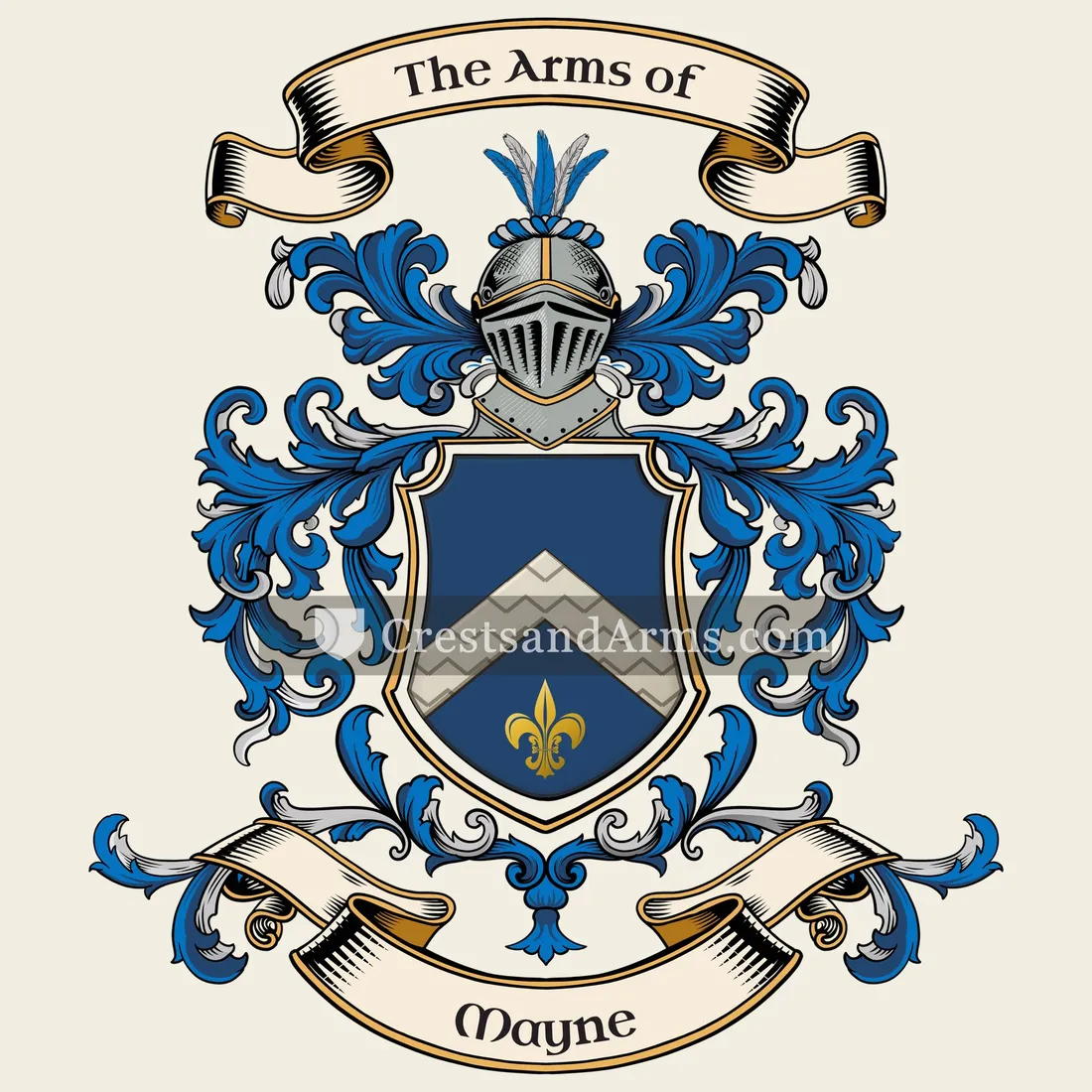


 bordureA difference between branches of one family
 arms pheon arrowheadReadiness for battle, and the broad arrow of the sovereign