A record of documented arms, meaning and origin, researched for the Mayotte family lines. Documented in 3 countries.
Reg. 9445 · Belgian, M–O
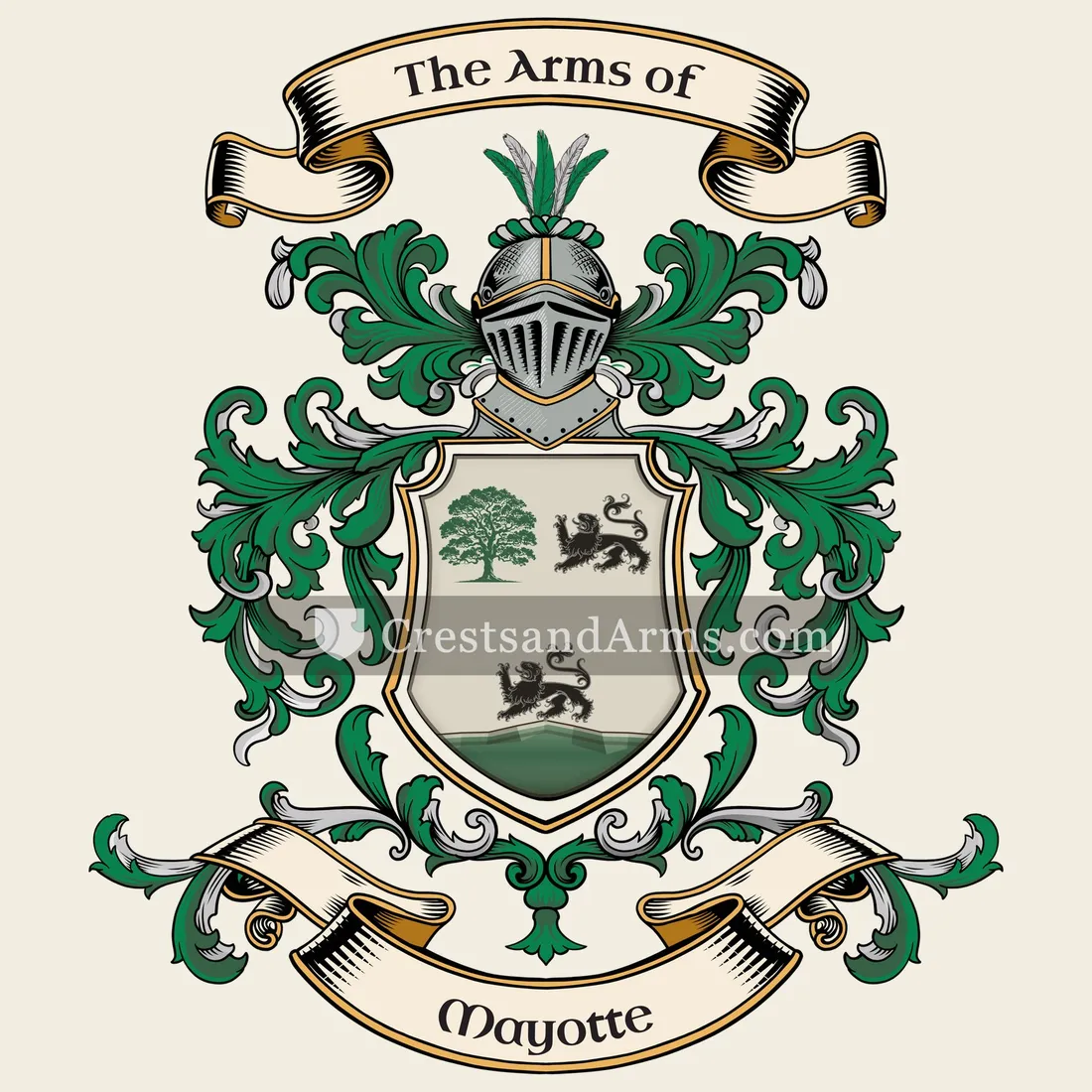
Meaning of the Mayotte family crest colors & symbols
Symbols on this shield
mountThe ground held, and steadfastness upon it
treeLife, endurance and deep roots
lionCourage, strength and royalty
Colours
Silver (Argent)Means: Peace and sincerity
Green (Vert)Means: Hope
Black (Sable)Means: Constancy
Historical info
Source
J. B. Rietstap, Armorial Général, Gouda: G. B. van Goor Zonen, 1884–87
Blazon (the actual original written record)
“D'arg. à un arbre de sin., accosté de deux lions affr. de sa., ramp. contre le fût; le tout soutenu d'une terrasse de sin. C.: un arbre de sin., senestré d'un lion de sa., ramp. contre le fût.”
LiegeLiege, c. 1737
Digital archive packCoat of arms PNG, gold border print PDF, vector SVG and the certificate of authenticity. Sent to your email in minutes.
Map of Belgium showing where the Mayotte arms are recorded
The Mayotte arms were recorded in Liege, c. 1737.
Liege was a prosperous town and its surrounding country, living on metalworking and trade. Merchant families grew rich, bought land outside the walls, and took arms as landowners rather than tradesmen.
This is where the arms were entered in the register. Families often moved to other parts of the country, so the same name can turn up in more than one region.
The body that granted and recorded arms in Belgium in this period.
Charles VI, Holy Roman Emperor
Sovereign of the period
Charles VI, Holy Roman Emperor
1711–1740
Reigning in Belgium when the Mayotte arms are first recorded.
How Arms Worked in Belgium
In Belgium, a coat of arms is considered personal property that is passed down through the male line to legitimate descendants. Families often use the same shield design across generations to show their shared heritage. If a branch of the family wants to change the design, they must apply for an official update to their specific version of the arms.
Granting authority
The Conseil héraldique is the official body that regulates and approves all coats of arms in Belgium.
How they got arms
Families obtain their coats of arms through formal royal grants or by confirming their historical right to use existing designs.
Where arms were recorded
All approved coats of arms are officially recorded in the public registers of the Conseil héraldique since 1844.
The family's standing
Recorded among the armigerous families of Liege.
Origin & History of the Mayotte Family in Belgium
The history of the Mayotte family in Belgium is rooted in the industrial and cultural landscape of the Prince-Bishopric of Liège during the eighteenth century. By 1737, records confirm that members of the family were established within this region, which was then a major center for coal mining, metalwork, and glass production. The name itself likely evolved as a diminutive form of names starting with "Ma," such as Mathieu or Marie, reflecting the common linguistic patterns of the Walloon region. Families living in Liège at this time were often deeply connected to the guild system, which organized the city’s skilled laborers and merchants. As the region underwent significant economic shifts, the Mayotte family would have navigated the complex social structure of a city caught between the influence of the Holy Roman Empire and the rising tides of European trade. Their presence in Liège suggests they were part of a resilient population that helped define the unique identity of the Meuse River valley.
Meaning of the Mayotte family crest colors & symbols
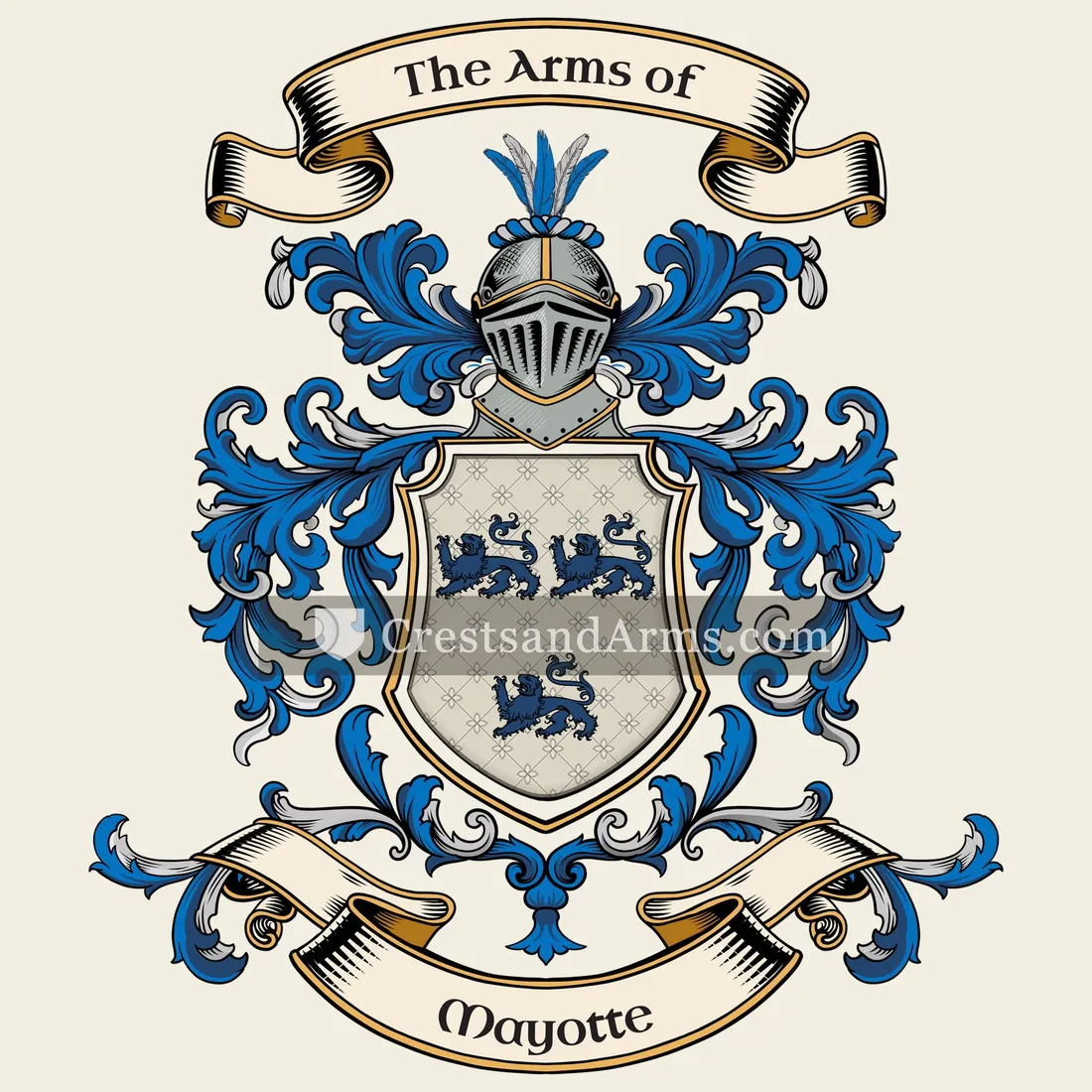
Symbols on this shield
lionCourage, strength and royalty
Colours
Silver (Argent)Means: Peace and sincerity
Blue (Azure)Means: Loyalty and truth
Historical info
Source
J. B. Rietstap, Armorial Général, Gouda: G. B. van Goor Zonen, 1884–87
Blazon (the actual original written record)
“D'arg. à trois lions d'azur. Cri: CAMBRESIS!”
BoulonnaisBoulonnais, c. 1663
Digital archive packCoat of arms PNG, gold border print PDF, vector SVG and the certificate of authenticity. Sent to your email in minutes.
Map of France showing where the Mayotte arms are recorded
The Mayotte arms were recorded in Boulonnais, c. 1663.
Boulonnais was small coastal country facing England across the Channel. Its families held land in return for keeping the coast defended, and a defending household carried a shield.
This is where the arms were entered in the register. Families often moved to other parts of the country, so the same name can turn up in more than one region.
The body that granted and recorded arms in France in this period.
Louis XIV of France
Sovereign of the period
Louis XIV of France
1643–1715
Reigning in Belgium when the Mayotte arms are first recorded.
How Arms Worked in France
In France, a coat of arms was a mark of honor that passed down through the male line to all legitimate descendants. Families often used the same shield without changes to show their shared heritage. If a branch wanted to stand out, they could add a small mark to their shield to show their specific place in the family tree.
Granting authority
The Juge d'armes de France acted as the official authority that regulated and verified coats of arms across the country.
How they got arms
Families typically inherited their arms from ancestors, though they could also receive them through royal grants or by proving their noble status.
Where arms were recorded
Coats of arms were officially recorded in the Armorial Général de France, which began its main collection in the year 1696.
The family's standing
Recorded among the armigerous families of Boulonnais.
Origin & History of the Mayotte Family in France
The surname Mayotte finds its historical roots in the northern region of France known as the Boulonnais. By the year 1663, records confirm that families bearing this name were well-established within this coastal area near the English Channel. The name likely evolved as a diminutive form of the name Mahieu, which was a common regional variation of Matthew. During the seventeenth century, the people of the Boulonnais lived in a landscape defined by small rural parishes and a strong connection to the land. Families like the Mayottes were often part of the local agrarian society, contributing to the development of the region through farming and trade. As the name spread from these early settlements, it became a distinct identifier for families who maintained deep ties to their ancestral home in northern France before some eventually sought new opportunities across the Atlantic.
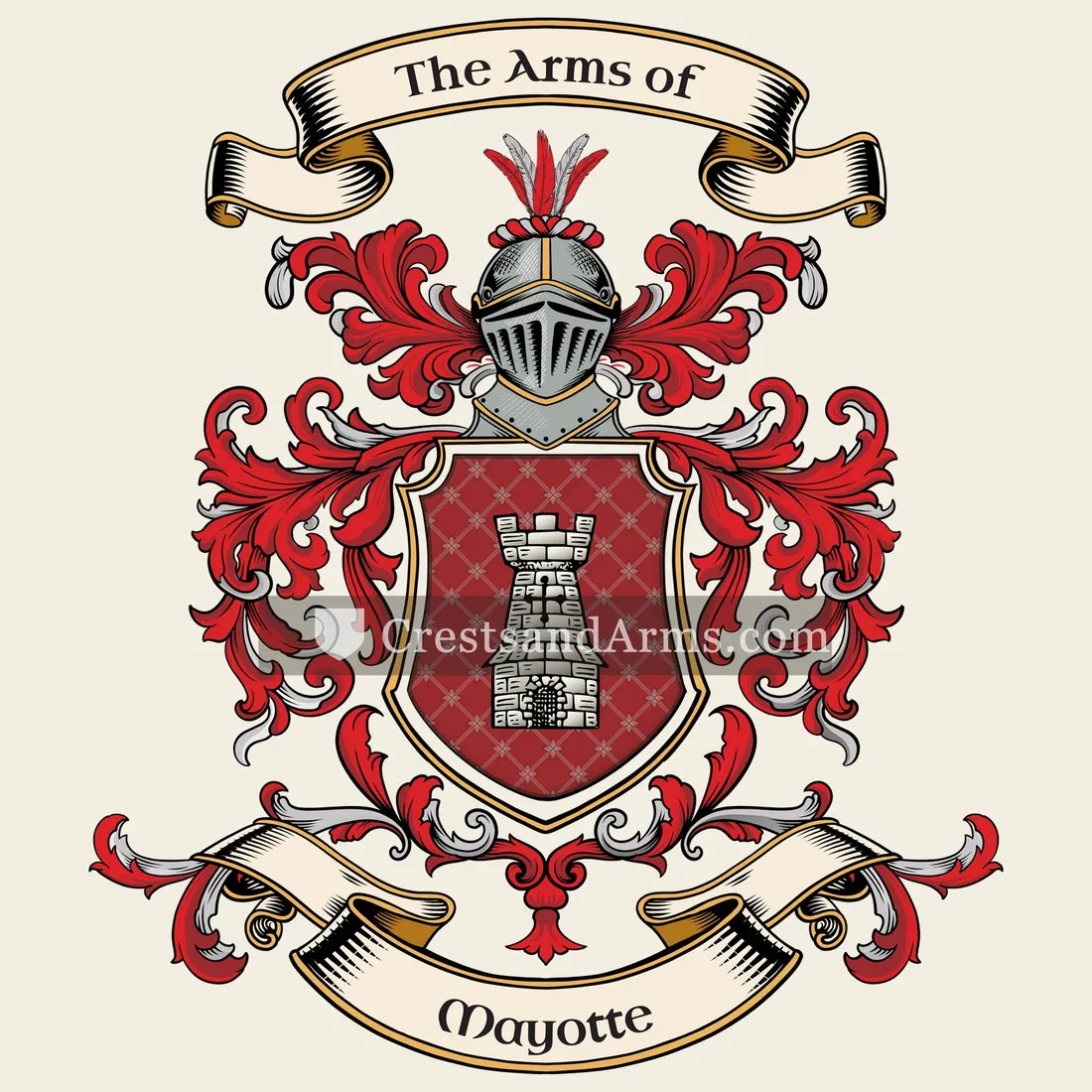
Meaning of the Mayotte family crest colors & symbols
Symbols on this shield
towerGrandeur and solidity, and a stronghold defended
Colours
Red (Gules)Means: Military strength
Silver (Argent)Means: Peace and sincerity
Historical info
Source
J. B. Rietstap, Armorial Général, Gouda: G. B. van Goor Zonen, 1884–87
Blazon (the actual original written record)
“De gu. à une tour d'arg., ouv. du champ.”
Germanyc. 1765
Digital archive packCoat of arms PNG, gold border print PDF, vector SVG and the certificate of authenticity. Sent to your email in minutes.
Map of Germany showing where the Mayotte arms are recorded
The Mayotte arms were recorded in Germany, c. 1765.
Arms such as these were typically recorded in Bavaria.
Bavaria was a country of old landed families and walled market towns. Estates passed down the same line for centuries, and both the landowners and the leading townsmen kept arms, which is why so many Bavarian names sit in the registers.
This is where the arms were entered in the register. Families often moved to other parts of the country, so the same name can turn up in more than one region.
The body that granted and recorded arms in Germany in this period.
Francis I, Holy Roman Emperor
Sovereign of the period
Francis I, Holy Roman Emperor
1745–1765
Reigning in Belgium when the Mayotte arms are first recorded.
How Arms Worked in Germany
In the Holy Roman Empire, coats of arms were often granted to individuals by the Emperor or his representatives. These arms were then passed down through the generations to all legitimate descendants of the original holder. Younger branches of a family usually kept the same shield design without needing to change it, as the arms belonged to the entire lineage.
Granting authority
The Holy Roman Emperor held the sole power to grant new coats of arms throughout his vast imperial territories.
How they got arms
Families typically obtained their coats of arms through a formal imperial grant or by proving their noble status to the authorities.
Where arms were recorded
These grants were officially recorded in the Imperial Chancery registers, which began keeping formal records of such honors during the Middle Ages.
The family's standing
Recorded among the armigerous families of Germany.
Origin & History of the Mayotte Family in Germany
The family name Mayotte carries a distinct history rooted in the cultural landscape of eighteenth-century Bavaria. By 1765, records confirm that members of the family were already established within this region, which was then a prominent part of the Holy Roman Empire. During this period, Bavaria was undergoing significant social and agricultural changes, and families like the Mayottes were often tied to the land or specific local trades that supported the growing village economies. The name itself reflects the linguistic blending common in border regions, where names often evolved through regional dialects and the movement of people across central Europe. As these early ancestors navigated the strict social hierarchies of the time, they contributed to the local community life that defined the Bavarian countryside. Their presence in the mid-1700s suggests a long-standing integration into the fabric of German society, marking the family as part of the hardworking population that sustained the region during an era of transition.
Mayotte Meaning & Related Branches
Root word
Marie
Derived from the Hebrew name Miryam meaning beloved or bitter.
This name
MayotteA diminutive form of Marie, traditionally used as a pet name or affectionate variation.
also spelled
Mottee
Motteh
Mot
Documented Sources
J. B. Rietstap, Armorial Général, Gouda: G. B. van Goor Zonen, 1884–87
Archives de l'État à Liège, Registres paroissiaux de la ville de Liège
Archives de l'État à Liège, Fonds de la Cour féodale de Liège
Génard, Pierre, Histoire des rues, places et passages de Liège, 1868
Kupper, Jean-Louis, Liège et l'Église impériale, 1981
Digital archive packCoat of arms PNG, gold border print PDF, vector SVG and the certificate of authenticity. Sent to your email in minutes.


 mountThe ground held, and steadfastness upon it
 treeLife, endurance and deep roots
 lionCourage, strength and royalty
 mountThe ground held, and steadfastness upon it
 treeLife, endurance and deep roots
 lionCourage, strength and royalty




 towerGrandeur and solidity, and a stronghold defended