Map of Spain showing where the Mcadoo arms are recorded
The Mcadoo arms were recorded in Flandre, c. 1722.
Flandre grew rich on cloth, and its towns were among the busiest in Europe. Merchant families bought land with their profits and took arms to go with it, so trade put as many names in the registers here as land did.
This is where the arms were entered in the register. Families often moved to other parts of the country, so the same name can turn up in more than one region.
The body that granted and recorded arms in Spain in this period.
Philip V of Spain
Sovereign of the period
Philip V of Spain
1714–1724
Reigning in Spain when the Mcadoo arms are first recorded.
How Arms Worked in Spain
In Spain, a coat of arms was considered a form of property that belonged to the entire family line. These arms were passed down from a father to all his children equally. Younger branches of the family usually kept the original design without needing to add any special marks to distinguish their specific line.
Granting authority
The Cronista Rey de Armas was the official body that regulated and granted coats of arms throughout Spain.
How they got arms
Families often obtained their arms through royal grants or by proving their noble status to the official heraldic authority.
Where arms were recorded
Coats of arms were officially recorded in the registers of the Cronista Rey de Armas starting in 1496.
The family's standing
Recorded among the armigerous families of Flandre.
Origin & History of the Mcadoo Family in Spain
The history of the McAdoo name in Spain is deeply connected to the movement of soldiers and political exiles across Europe during the eighteenth century. While the name is of Gaelic origin, members of the family established a presence in the Spanish Netherlands, known as Flandre, by 1722. During this period, the Spanish Crown maintained a significant military and administrative footprint in the region, which attracted many families from the British Isles seeking service or refuge. These individuals often integrated into the local Spanish military structures, serving as officers or administrators far from their ancestral homes. As these family members moved through the territories controlled by Spain, they adapted their names to fit local linguistic patterns while maintaining their distinct identity. This transition highlights how the McAdoo family navigated the complex political landscape of Europe by aligning themselves with the Spanish monarchy during a time of constant territorial change.
Meaning of the Mcadoo family crest colors & symbols
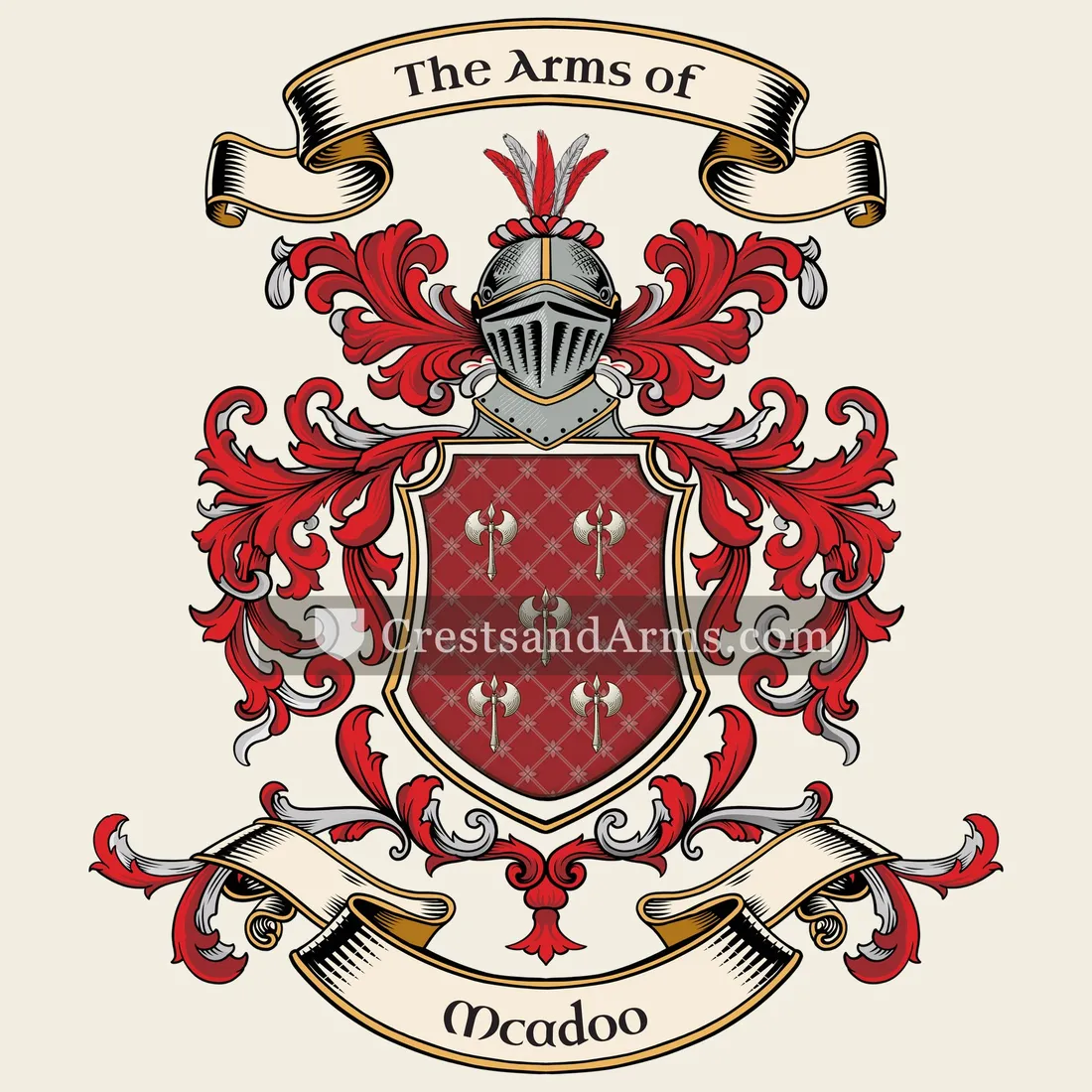
Symbols on this shield
axeThe execution of military duty
Colours
Red (Gules)Means: Military strength
Silver (Argent)Means: Peace and sincerity
Historical info
Source
Sir Bernard Burke, The General Armory of England, Scotland, Ireland and Wales, London: Harrison & Sons, 1884
Blazon (the actual original written record)
“Gu. five battle axes, two, one and two”
ScotlandClarenceux King, c. 1516
Digital archive packCoat of arms PNG, gold border print PDF, vector SVG and the certificate of authenticity. Sent to your email in minutes.
Map of Scotland showing where the Mcadoo arms are recorded
The Mcadoo arms were recorded in Clarenceux King, c. 1516.
Arms such as these were typically recorded in Edinburgh.
Edinburgh was the seat of Scotland's government, its courts and its heralds. Families with business there settled nearby, and being close to where arms were recorded is exactly why so many of them appear.
This is where the arms were entered in the register. Families often moved to other parts of the country, so the same name can turn up in more than one region.
The body that granted and recorded arms in Scotland in this period.
James V of Scotland
Sovereign of the period
James V of Scotland
1513–1542
Reigning in Spain when the Mcadoo arms are first recorded.
How Arms Worked in Scotland
Scottish heraldry is unique because it treats a coat of arms as a piece of personal property protected by law. Only one person can own a specific design at any given time. When a family grows, the head keeps the original shield while other relatives must apply for their own distinct version with slight changes to prove their specific identity.
Granting authority
The Court of the Lord Lyon acts as the official body that regulates and controls all heraldic matters throughout Scotland.
How they got arms
Individuals obtain a legal right to their arms through a formal petition process that confirms their identity and family connection.
Where arms were recorded
All valid coats of arms are officially entered into the Public Register of All Arms and Bearings starting from 1672.
The family's standing
Recorded among the armigerous families of Scotland.
Origin & History of the Mcadoo Family in Scotland
The family name McAdoo traces its roots to the Gaelic language, where it is derived from the phrase *Mac Dubhshithe*, meaning son of the dark one of peace. While many families with similar names have strong ties to the western Highlands and islands, the McAdoo line established a notable presence in the bustling city of Edinburgh by the early sixteenth century. Records confirm that members of the family were living in the Scottish capital as early as 1516, a time when Edinburgh was rapidly growing as a center of trade and royal administration. Living in such a central urban environment suggests that these early ancestors were likely involved in the skilled crafts or merchant networks that defined the city during the Renaissance. As the family navigated the social and political shifts of the era, they became part of the fabric of Scottish urban life, moving away from traditional clan structures to participate in the developing economy of the Lowlands.
Mcadoo Meaning & Related Branches
Root word
Mac Dubhshithe
Gaelic patronymic meaning son of the dark one of peace.
This name
McadooDerived from Irish origins signifying a descendant of a dark-complexioned man of peace.
also spelled
Mashado
Machadoh
Machad
Documented Sources
J. B. Rietstap, Armorial Général, Gouda: G. B. van Goor Zonen, 1884–87
O'Connell, Maurice R., Irish Politics and Social Conflict in the Age of the American Revolution, 1965
Archivo General de Simancas, Secretaría de Guerra, Legajos de extranjeros al servicio de España
Digital archive packCoat of arms PNG, gold border print PDF, vector SVG and the certificate of authenticity. Sent to your email in minutes.


 axeThe execution of military duty
 axeThe execution of military duty