Map of Scotland showing where the Mcbrien arms are recorded
The Mcbrien arms were recorded in Angus, c. 1748.
This is where the arms were entered in the register. Families often moved to other parts of the country, so the same name can turn up in more than one region.
The body that granted and recorded arms in Scotland in this period.
George II of Great Britain
Sovereign of the period
George II of Great Britain
1727–1760
Reigning in Scotland when the Mcbrien arms are first recorded.
How Arms Worked in Scotland
Scottish heraldry is unique because it treats a coat of arms as a piece of personal property protected by law. Only one person can own a specific design at any given time. When a family grows, the head keeps the original shield while other relatives must apply for their own distinct version with slight changes to prove their specific identity.
Granting authority
The Court of the Lord Lyon acts as the official body that regulates and controls all heraldic matters throughout Scotland.
How they got arms
Individuals obtain a legal right to their arms through a formal petition process that confirms their identity and family connection.
Where arms were recorded
All valid coats of arms are officially entered into the Public Register of All Arms and Bearings starting from 1672.
The family's standing
Recorded among the armigerous families of Angus.
Origin & History of the Mcbrien Family in Scotland
The family name McBrien is a variation of the Gaelic name Mac Briain, which translates to son of Brian. While the name has deep roots in Ireland, branches of the family established a presence in Scotland by the mid-eighteenth century. Official records confirm that members of the McBrien family were living in the county of Angus by 1748. During this period, Angus was a region defined by its agricultural landscape and growing textile industry. Families like the McBriens often moved between Scotland and Ireland due to the close proximity of the two nations and the frequent movement of laborers and tradespeople across the Irish Sea. Settling in Angus suggests that these early family members were likely part of the skilled workforce that helped sustain the local economy in eastern Scotland during the mid-1700s.
Meaning of the Mcbrien family crest colors & symbols
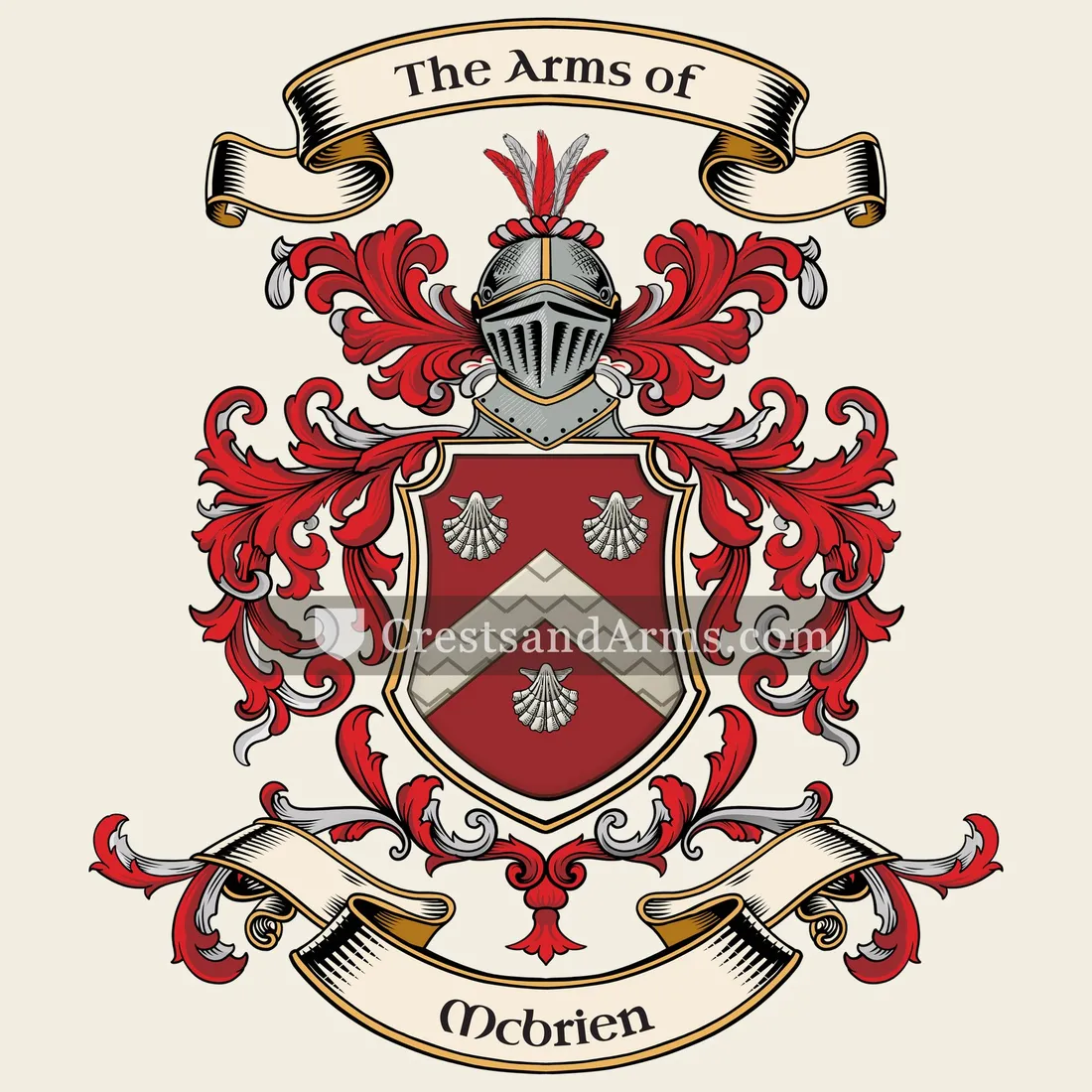
Symbols on this shield
escallopThe pilgrim's shell, and a long journey made
Colours
Red (Gules)Means: Military strength
Silver (Argent)Means: Peace and sincerity
Historical info
Source
Sir Bernard Burke, The General Armory of England, Scotland, Ireland and Wales, London: Harrison & Sons, 1884
Blazon (the actual original written record)
“Gu. three chevronels betw. as many escallops ar”
Englandc. 1620
Digital archive packCoat of arms PNG, gold border print PDF, vector SVG and the certificate of authenticity. Sent to your email in minutes.
Map of England showing where the Mcbrien arms are recorded
The Mcbrien arms were recorded in England, c. 1620.
Arms such as these were typically recorded in York.
Yorkshire is the largest of the English counties, and it held more gentry families than any other. Land there was split among a great many households rather than a few, so a great many of them carried arms.
This is where the arms were entered in the register. Families often moved to other parts of the country, so the same name can turn up in more than one region.
The body that granted and recorded arms in England in this period.
James VI and I
Sovereign of the period
James VI and I
1603–1625
Reigning in Scotland when the Mcbrien arms are first recorded.
How Arms Worked in England
English heraldry allowed arms to be shared by all legitimate descendants of the original owner. These symbols were treated as personal property that moved through the generations to all children. While the eldest son kept the original design, other family members could use the same shield without needing to change it or register their own unique versions.
Granting authority
The College of Arms in London has regulated the use of coats of arms throughout England and Wales since 1484.
How they got arms
Families typically obtained their coats of arms through a formal grant from the Crown or by proving their ancient right to them.
Where arms were recorded
All official coats of arms are recorded in the registers kept at the College of Arms, which date back to the fifteenth century.
The family's standing
Recorded among the armigerous families of England.
Origin & History of the Mcbrien Family in England
The history of the McBrien name in England is deeply rooted in the movement of people across the Irish Sea during the early seventeenth century. While the name is of Gaelic origin, records confirm that members of the family were established in the city of York by 1620. During this period, York served as a major administrative and commercial hub in Northern England, attracting families who were seeking new economic opportunities or fleeing political instability in Ireland. These early settlers often integrated into the local trades and parish life of the city, transitioning from their traditional Gaelic roots into the English social structure of the Stuart era. Their presence in York suggests that the family was part of a broader pattern of migration that reshaped the demographics of English urban centers during the early modern period.
Mcbrien Meaning & Related Branches
Root word
Mac Briain
Son of Brian, derived from the Celtic word for high or noble.
This name
McbrienA patronymic surname indicating descent from a person named Brian, meaning noble or strong.
also spelled
McBride
Macbryde
Documented Sources
Sir Bernard Burke, The General Armory of England, Scotland, Ireland and Wales, London: Harrison & Sons, 1884
National Records of Scotland, OPR Births and Baptisms, Angus, 1748
Black, George F., The Surnames of Scotland: Their Origin, Meaning, and History, 1946
Digital archive packCoat of arms PNG, gold border print PDF, vector SVG and the certificate of authenticity. Sent to your email in minutes.


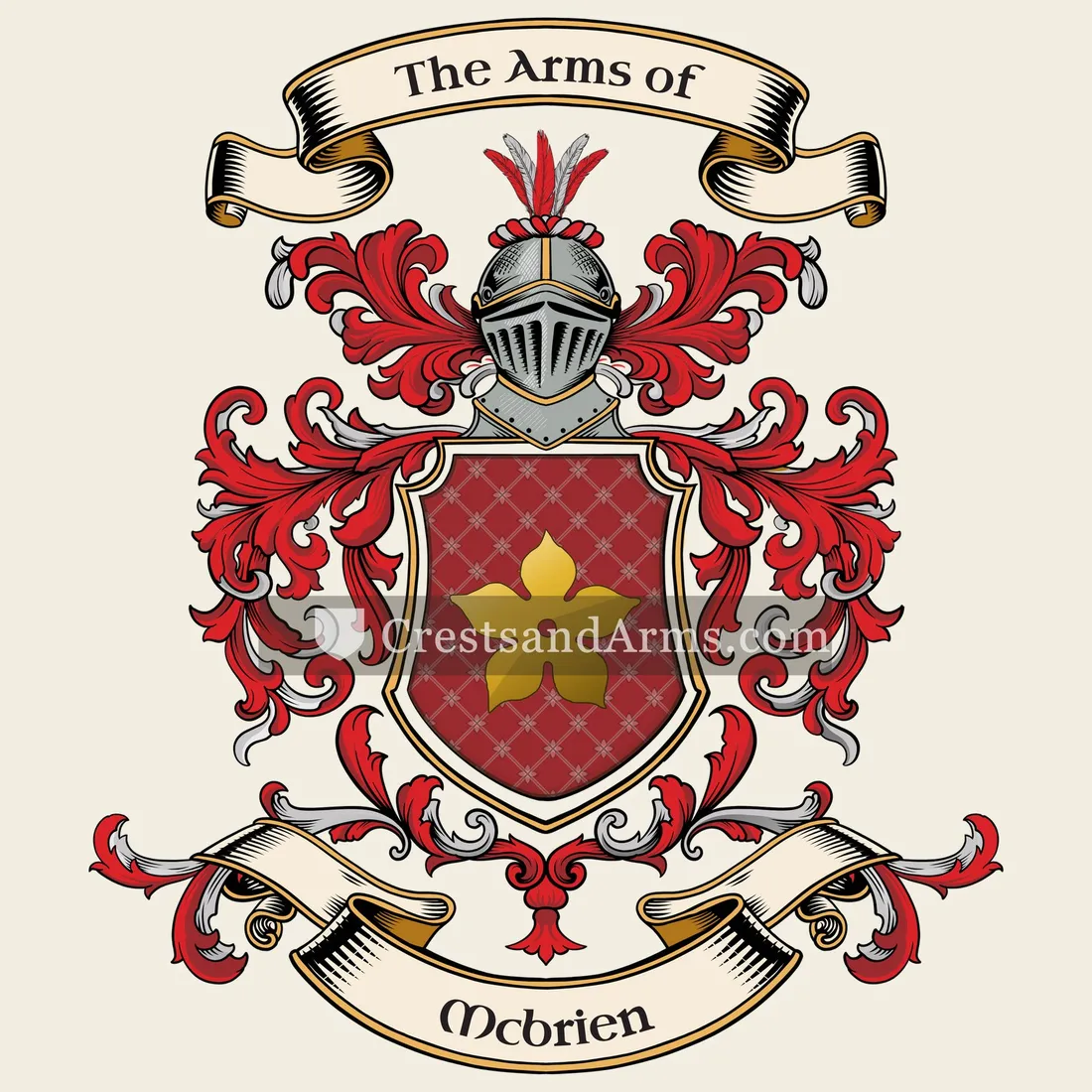
 cinquefoilHope and joy
 cinquefoilHope and joy


 escallopThe pilgrim's shell, and a long journey made