Map of Scotland showing where the Mccrae arms are recorded
The Mccrae arms were recorded in Scotland, c. 1748.
Arms such as these were typically recorded in Edinburgh.
Edinburgh was the seat of Scotland's government, its courts and its heralds. Families with business there settled nearby, and being close to where arms were recorded is exactly why so many of them appear.
This is where the arms were entered in the register. Families often moved to other parts of the country, so the same name can turn up in more than one region.
The body that granted and recorded arms in Scotland in this period.
George II of Great Britain
Sovereign of the period
George II of Great Britain
1727–1760
Reigning in Scotland when the Mccrae arms are first recorded.
How Arms Worked in Scotland
Scottish heraldry is unique because it treats a coat of arms as a piece of personal property protected by law. Only one person can own a specific design at any given time. When a family grows, the head keeps the original shield while other relatives must apply for their own distinct version with slight changes to prove their specific identity.
Granting authority
The Court of the Lord Lyon acts as the official body that regulates and controls all heraldic matters throughout Scotland.
How they got arms
Individuals obtain a legal right to their arms through a formal petition process that confirms their identity and family connection.
Where arms were recorded
All valid coats of arms are officially entered into the Public Register of All Arms and Bearings starting from 1672.
The family's standing
Recorded among the armigerous families of Scotland.
Origin & History of the Mccrae Family in Scotland
The name McCrae, often spelled MacRae, originates from the Gaelic phrase *Mac Rath*, which translates to "son of grace" or "son of prosperity." While the family is most famously associated with the rugged lands of Kintail in the Scottish Highlands, their influence eventually spread into the urban centers of the Lowlands. By the mid-eighteenth century, members of the family were firmly established in Edinburgh. Records from 1748 confirm their presence in the capital city during a time of significant social and political transition in Scotland. As the family moved from the rural Highlands into the bustling streets of Edinburgh, they integrated into the professional and civic life of the city. This shift reflects the broader movement of Scottish families who sought new opportunities in trade, law, and education during the Enlightenment period. Their presence in the capital highlights how a name rooted in ancient Gaelic tradition adapted to the changing landscape of eighteenth-century Scotland.
Meaning of the Mccrae family crest colors & symbols
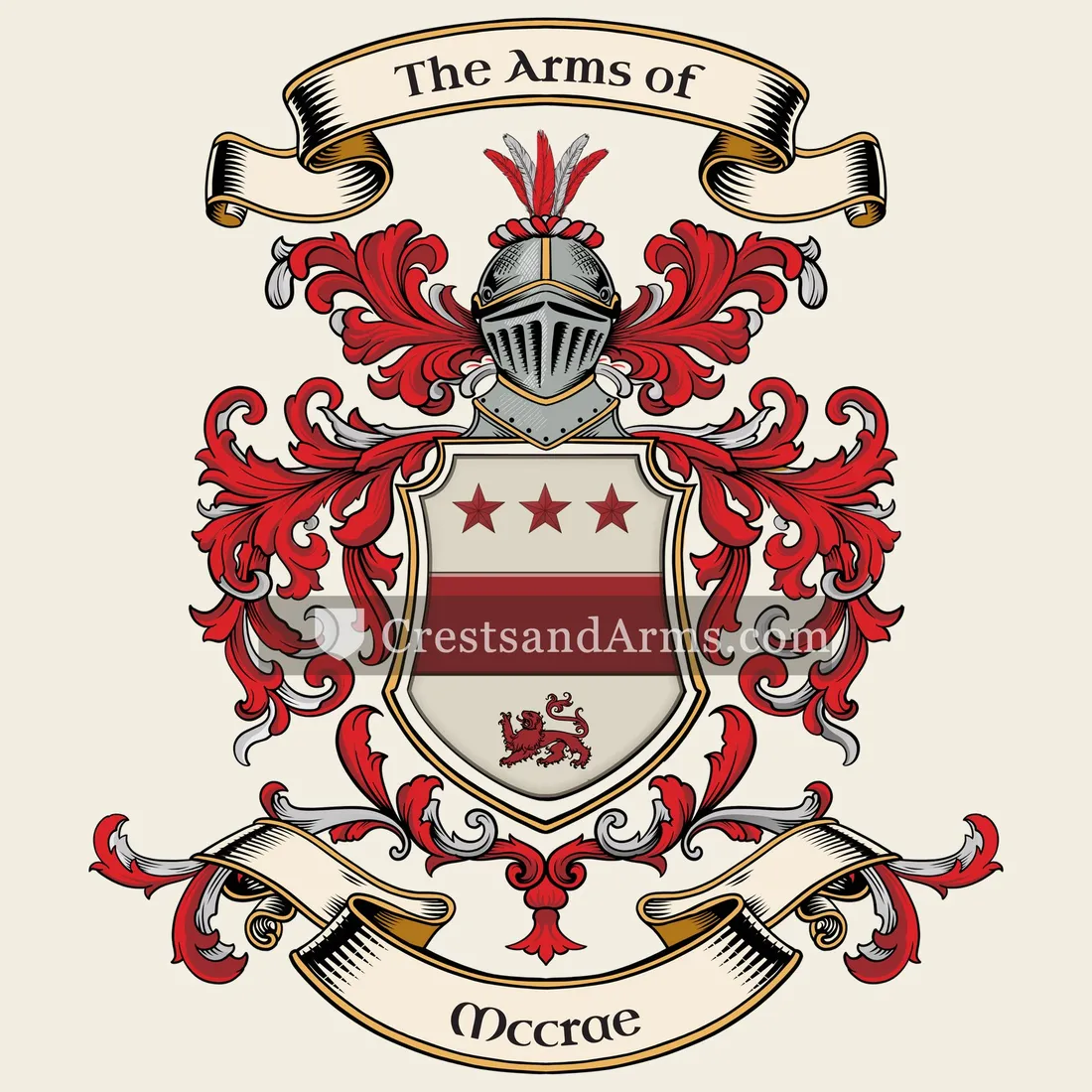
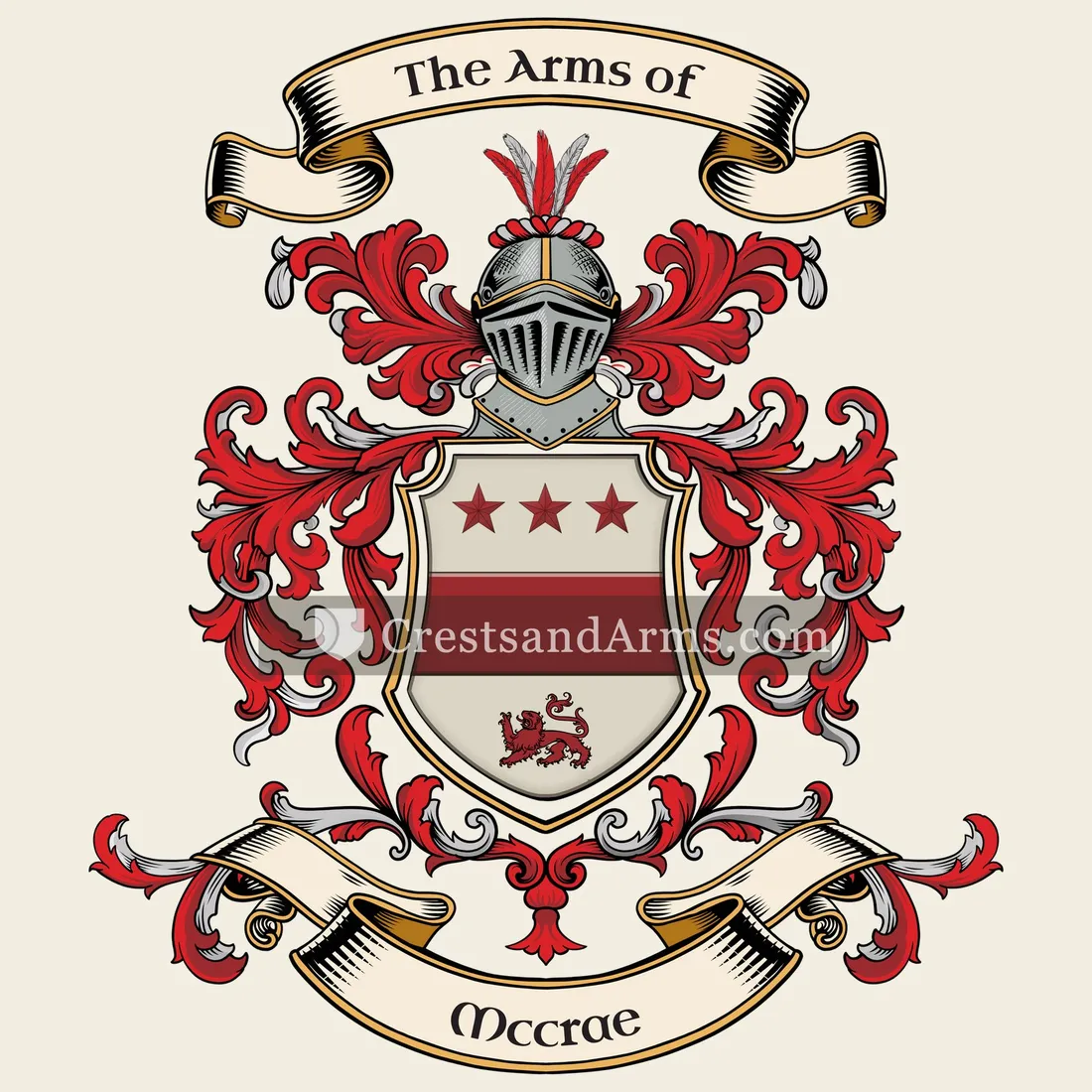
Symbols on this shield
fessThe military belt, and readiness to serve
mulletThe third son, and a divine quality from above
lionCourage, strength and royalty
Colours
Silver (Argent)Means: Peace and sincerity
Red (Gules)Means: Military strength
Historical info
Source
Sir Bernard Burke, The General Armory of England, Scotland, Ireland and Wales, London: Harrison & Sons, 1884
Blazon (the actual original written record)
“Ar. a fess betw. three mullets in chief and a lion ramp. in base gu”
IrelandOrangefield, c. 1736
Digital archive packCoat of arms PNG, gold border print PDF, vector SVG and the certificate of authenticity. Sent to your email in minutes.
Map of Ireland showing where the Mccrae arms are recorded
The Mccrae arms were recorded in Orangefield, c. 1736.
Arms such as these were typically recorded in Dublin.
Dublin was the seat of government in Ireland and the place where grants were sought and recorded. Families with business at the castle or the courts settled nearby, and settling there put their arms on record.
This is where the arms were entered in the register. Families often moved to other parts of the country, so the same name can turn up in more than one region.
The body that granted and recorded arms in Ireland in this period.
George II of Great Britain
Sovereign of the period
George II of Great Britain
1727–1760
Reigning in Scotland when the Mccrae arms are first recorded.
How Arms Worked in Ireland
The Ulster King of Arms granted coats of arms to individuals who proved their social standing and good character. These symbols were typically inherited by all legitimate descendants of the original holder. If a family branch wanted a unique look, they could apply for a specific change to their design through the office to ensure their identity remained distinct.
Granting authority
The Ulster King of Arms acted as the official body that regulated and issued all coats of arms throughout Ireland.
How they got arms
Families obtained their arms through formal grants issued by the office after proving their eligibility and paying the required fees.
Where arms were recorded
All official grants were recorded in the registers held by the Ulster King of Arms starting from the year 1552.
The family's standing
Recorded among the armigerous families of Ireland.
Origin & History of the Mccrae Family in Ireland
The name McCrae is a variation of the Gaelic surname Mac Raith, which translates to son of grace or son of prosperity. While the name has deep roots in the Gaelic traditions of Scotland and Ireland, historical records confirm that members of the family were firmly established in Dublin by 1736. During the eighteenth century, Dublin served as a bustling center for trade and administration, attracting families from across the countryside who sought new opportunities in the urban economy. The presence of the McCrae family in the city during this period suggests they were likely part of the growing professional or merchant classes who helped shape the social fabric of the capital. As the family integrated into Dublin life, they navigated the complex political and religious landscape of the era, leaving behind a legacy that reflects the broader movement of people into Ireland’s largest city during the Georgian period.
Mccrae Meaning & Related Branches
Root word
Mac Rath
Son of the prosperous or fortunate one.
This name
MccraeDerived from Gaelic, signifying a descendant of someone blessed with good fortune or prosperity.
also spelled
McRae
MacRay
Documented Sources
Sir Bernard Burke, The General Armory of England, Scotland, Ireland and Wales, London: Harrison & Sons, 1884
Black, George Fraser. The Surnames of Scotland: Their Origin, Meaning, and History. 1946
National Records of Scotland. Edinburgh Burgess and Guild Brethren Roll, 1406–1846
Digital archive packCoat of arms PNG, gold border print PDF, vector SVG and the certificate of authenticity. Sent to your email in minutes.


 fessThe military belt, and readiness to serve
 mulletThe third son, and a divine quality from above
 lionCourage, strength and royalty
 fessThe military belt, and readiness to serve
 mulletThe third son, and a divine quality from above
 lionCourage, strength and royalty