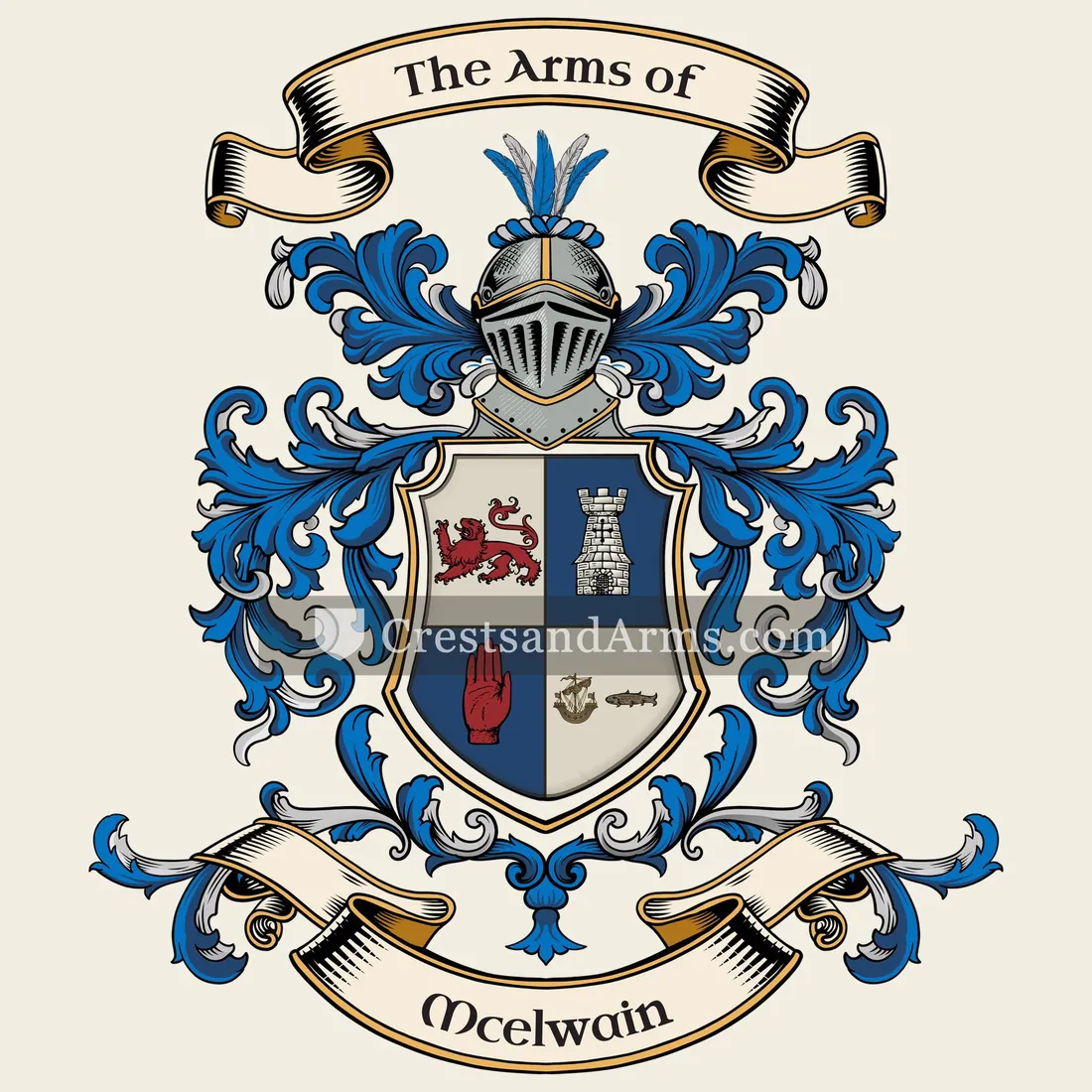
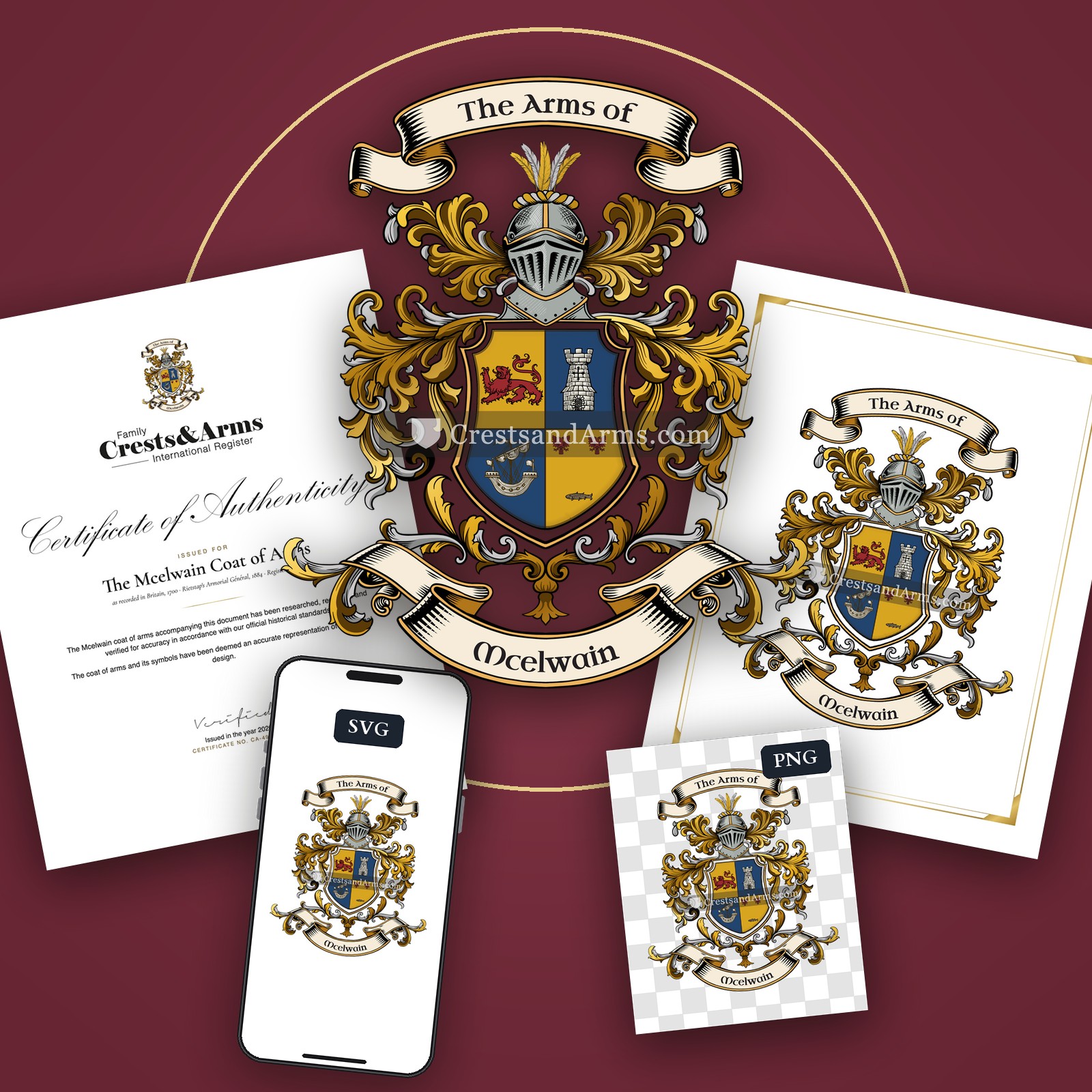
A record of documented arms, meaning and origin, researched for the Mcelwain family lines. Documented in 2 countries.
Reg. 4972 · Britain, M–O
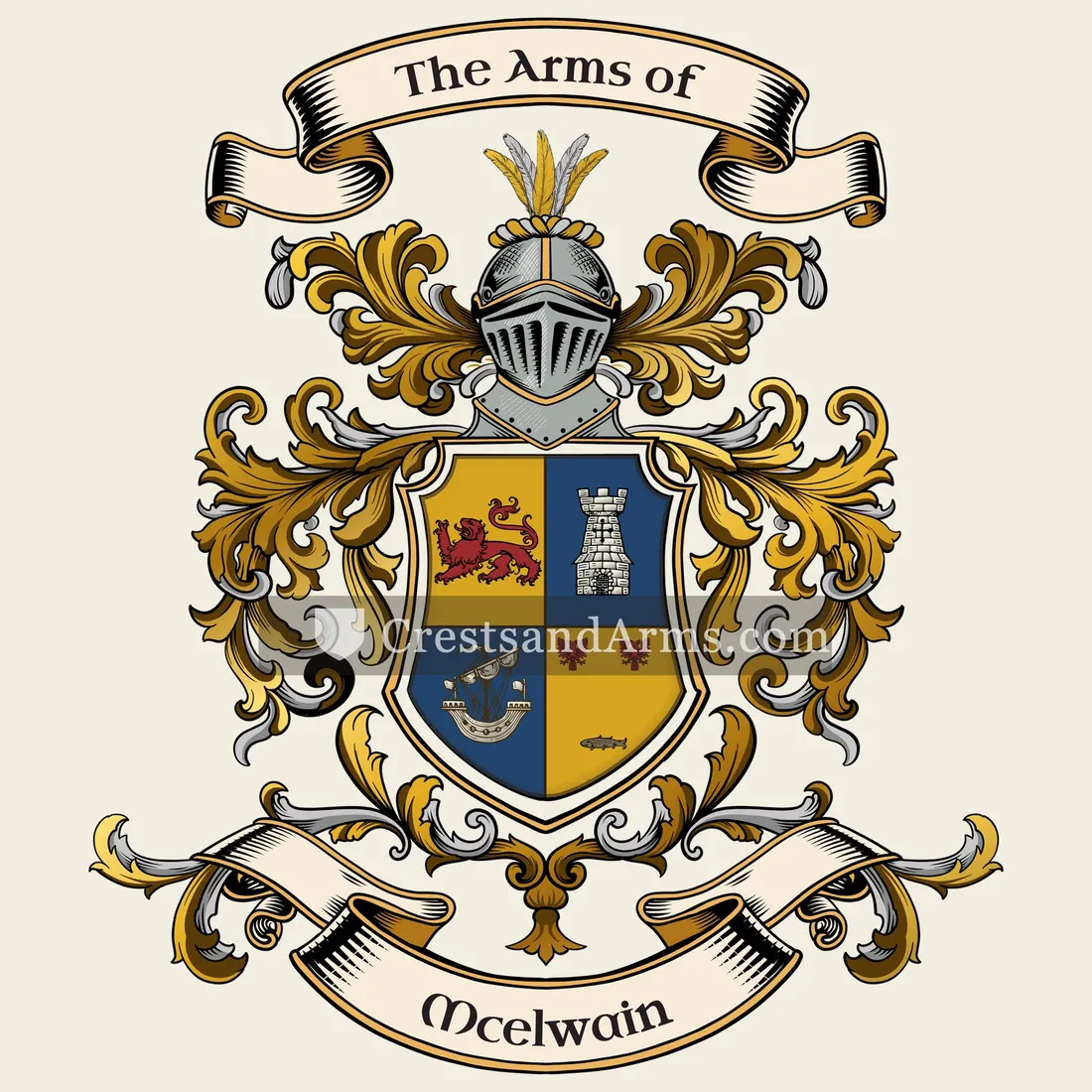
Meaning of the Mcelwain family crest colors & symbols
Symbols on this shield
lionCourage, strength and royalty
towerGrandeur and solidity, and a stronghold defended
shipEnterprise, and a great voyage undertaken
eagleNobility, strength and a keen mind
fishA true and generous mind, and Christian faith
Colours
Gold (Or)Means: Generosity
Blue (Azure)Means: Loyalty and truth
Red (Gules)Means: Military strength
Silver (Argent)Means: Peace and sincerity
Historical info
Source
J. B. Rietstap, Armorial Général, Gouda: G. B. van Goor Zonen, 1884–87
Blazon (the actual original written record)
“Ec.: au 1 d'or au lion de gu.; au 2 d'azur à une tour d'arg., sommée de trois tourelles de sa., maçonnée du même, portillé de gu., aj. de quatre pièces du même, deux fenêtres accostant la porte et les deux autres la surmontant; au 3 d'arg. à une galère au nat., les voiles ferlées; au 4 d'arg. à deux têtes d'aigle affr. de gu. en chef et un saumon nageant au nat. en p.”
Britainc. 1700
Digital archive packCoat of arms PNG, gold border print PDF, vector SVG and the certificate of authenticity. Sent to your email in minutes.
Map of Britain showing where the Mcelwain arms are recorded
The Mcelwain arms were recorded in Britain, c. 1700.
Arms such as these were typically recorded in Kent.
Kent sits between London and the short crossing to Europe, and the trade passing through made it wealthy. Merchant families bought land with that money, and it was landowners who took coats of arms.
This is where the arms were entered in the register. Families often moved to other parts of the country, so the same name can turn up in more than one region.
The body that granted and recorded arms in Britain in this period.
William III of England
Sovereign of the period
William III of England
1694–1702
Reigning in Britain when the Mcelwain arms are first recorded.
How Arms Worked in Britain
English heraldry allowed arms to be shared by all legitimate descendants of the original owner. These symbols were treated as personal property that moved through the generations to all children. While the eldest son kept the original design, other family members could use the same shield without needing to change it or register their own unique versions.
Granting authority
The College of Arms in London has regulated the use of coats of arms throughout England and Wales since 1484.
How they got arms
Families typically obtained their coats of arms through a formal grant from the Crown or by proving their ancient right to them.
Where arms were recorded
All official coats of arms are recorded in the registers kept at the College of Arms, which date back to the fifteenth century.
The family's standing
Recorded among the armigerous families of Britain.
Origin & History of the Mcelwain Family in Britain
The surname McElwain is a variation of names rooted in the Gaelic tradition, specifically linked to the phrase "son of the servant of Saint John." While the name has strong historical ties to Ireland and Scotland, records confirm that members of the family were established in the English county of Kent by the year 1700. During this period, Kent served as a vital hub for trade and movement between London and the European continent. Families moving into this region often integrated into local agricultural or merchant communities, adapting their surnames to fit the phonetic patterns of the English language. This migration was part of a larger trend of families moving across the British Isles to seek new economic opportunities in growing towns. By settling in Kent, these early ancestors became part of a diverse social landscape that defined the region during the turn of the eighteenth century.
Meaning of the Mcelwain family crest colors & symbols
Symbols on this shield
lionCourage, strength and royalty
towerGrandeur and solidity, and a stronghold defended
handFaith, sincerity and justice
shipEnterprise, and a great voyage undertaken
fishA true and generous mind, and Christian faith
Colours
Silver (Argent)Means: Peace and sincerity
Blue (Azure)Means: Loyalty and truth
Red (Gules)Means: Military strength
Historical info
Source
Sir Bernard Burke, The General Armory of England, Scotland, Ireland and Wales, London: Harrison & Sons, 1884
Blazon (the actual original written record)
“Quarterly, 1st, ar. a lion ramp. gu.; 2nd, az. a tower ar.; 3rd, or, a dexter hand couped in fesse gu. holding a cross crosslet fitchée az.; 4th, ar. a lymphad ppr. her sails furled, in base a salmon naiant ppr”
GloucesterKington House · Gloucester, c. 1620
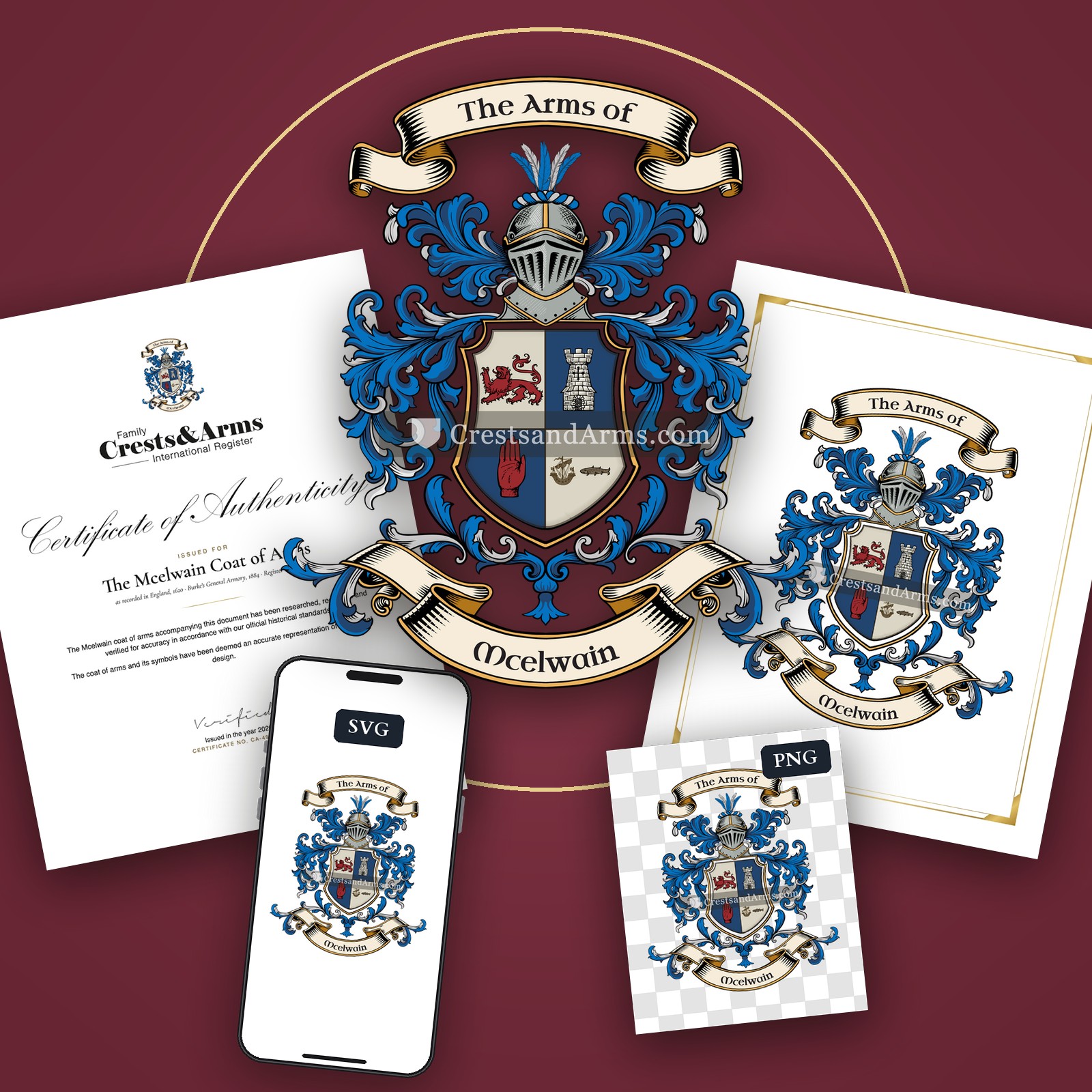
Digital archive packCoat of arms PNG, gold border print PDF, vector SVG and the certificate of authenticity. Sent to your email in minutes.
Map of England showing where the Mcelwain arms are recorded
The Mcelwain arms were recorded in Gloucester, c. 1620.
Gloucestershire had good farmland, a cloth trade in its valleys and a river carrying goods to Bristol. All three made money, and money bought the estates that brought arms with them.
This is where the arms were entered in the register. Families often moved to other parts of the country, so the same name can turn up in more than one region.
The body that granted and recorded arms in England in this period.
James VI and I
Sovereign of the period
James VI and I
1603–1625
Reigning in Britain when the Mcelwain arms are first recorded.
How Arms Worked in England
English heraldry allowed arms to be shared by all legitimate descendants of the original owner. These symbols were treated as personal property that moved through the generations to all children. While the eldest son kept the original design, other family members could use the same shield without needing to change it or register their own unique versions.
Granting authority
The College of Arms in London has regulated the use of coats of arms throughout England and Wales since 1484.
How they got arms
Families typically obtained their coats of arms through a formal grant from the Crown or by proving their ancient right to them.
Where arms were recorded
All official coats of arms are recorded in the registers kept at the College of Arms, which date back to the fifteenth century.
The family's standing
Recorded among the armigerous families of Gloucester.
Origin & History of the Mcelwain Family in England
The surname McElwain is primarily associated with Scottish and Irish roots, but its early presence in England provides a fascinating glimpse into the lives of families during the seventeenth century. By 1620, records indicate that members of the family were established in the city of Gloucester. At that time, Gloucester was a bustling center of trade and religious activity, situated along the River Severn. Families living in this region were often involved in the local cloth industry or maritime commerce, which were the primary economic drivers of the area. The migration of the McElwain name into English urban centers reflects the broader movement of people across the British Isles during a period of significant social and economic change. Settling in a city like Gloucester suggests that these early ancestors were likely integrated into the professional or artisan classes, helping to shape the local community as they navigated the challenges of life in early modern England.
Mcelwain Meaning & Related Branches
Root word
Mac Giolla Fhaoláin
Son of the servant of Saint Faolán
This name
McelwainDerived from Gaelic, signifying a descendant of a devotee of the wolf-like saint.
also spelled
Maclane
McLaine
MacLean
Documented Sources
J. B. Rietstap, Armorial Général, Gouda: G. B. van Goor Zonen, 1884–87
Black, George Fraser. The Surnames of Scotland: Their Origin, Meaning, and History. 1946
Reaney, Percy Hide. A Dictionary of British Surnames. 1958
Kent Archives and Local History Service, Parish Registers of Kent
Digital archive packCoat of arms PNG, gold border print PDF, vector SVG and the certificate of authenticity. Sent to your email in minutes.


 lionCourage, strength and royalty
 towerGrandeur and solidity, and a stronghold defended
 shipEnterprise, and a great voyage undertaken
 eagleNobility, strength and a keen mind
 fishA true and generous mind, and Christian faith
 lionCourage, strength and royalty
 towerGrandeur and solidity, and a stronghold defended
 shipEnterprise, and a great voyage undertaken
 eagleNobility, strength and a keen mind
 fishA true and generous mind, and Christian faith


 handFaith, sincerity and justice