Map of Ireland showing where the Mcgaugh arms are recorded
The Mcgaugh arms were recorded in Armagh, c. 1824.
Armagh was the church capital of Ireland with good farmland around it. Church office and landholding both brought standing, and standing was marked with arms.
This is where the arms were entered in the register. Families often moved to other parts of the country, so the same name can turn up in more than one region.
The body that granted and recorded arms in Ireland in this period.
George IV of the United Kingdom
Sovereign of the period
George IV of the United Kingdom
1820–1830
Reigning in Ireland when the Mcgaugh arms are first recorded.
How Arms Worked in Ireland
The Ulster King of Arms granted coats of arms to individuals who proved their social standing and good character. These symbols were typically inherited by all legitimate descendants of the original holder. If a family branch wanted a unique look, they could apply for a specific change to their design through the office to ensure their identity remained distinct.
Granting authority
The Ulster King of Arms acted as the official body that regulated and issued all coats of arms throughout Ireland.
How they got arms
Families obtained their arms through formal grants issued by the office after proving their eligibility and paying the required fees.
Where arms were recorded
All official grants were recorded in the registers held by the Ulster King of Arms starting from the year 1552.
The family's standing
Recorded among the armigerous families of Armagh.
Origin & History of the Mcgaugh Family in Ireland
The surname McGaugh is a variation of the Gaelic name Mag Eochadha, which translates to the son of Eochaidh. This name has deep roots in the Irish province of Ulster, where families often lived in close-knit communities connected by shared ancestry. By the early 19th century, records confirm that members of the McGaugh family were well-established in County Armagh. During this period, the region was a center for linen production and agriculture, and families like the McGaughs were typically involved in the local farming economy. Life in Armagh at this time was defined by strong ties to the land and the local parish, which served as the primary hub for recording births, marriages, and deaths. As the 1800s progressed, many families from this area faced significant economic changes, leading some to move toward urban centers or eventually seek new opportunities abroad.
Related Branches & Arms
Root word
Mag Eachaidh
Son of the horseman or rider
This name
McgaughDerived from a Gaelic patronymic indicating descent from a person named Eachaidh.
also spelled
McGeogh
McGeoghe
Documented Sources
Sir Bernard Burke, The General Armory of England, Scotland, Ireland and Wales, London: Harrison & Sons, 1884
Bell, Robert, The Book of Ulster Surnames, 1988
MacLysaght, Edward, The Surnames of Ireland, 1985
Public Record Office of Northern Ireland, Tithe Applotment Books, 1824–1838
Digital archive packCoat of arms PNG, gold border print PDF, vector SVG and the certificate of authenticity. Sent to your email in minutes.


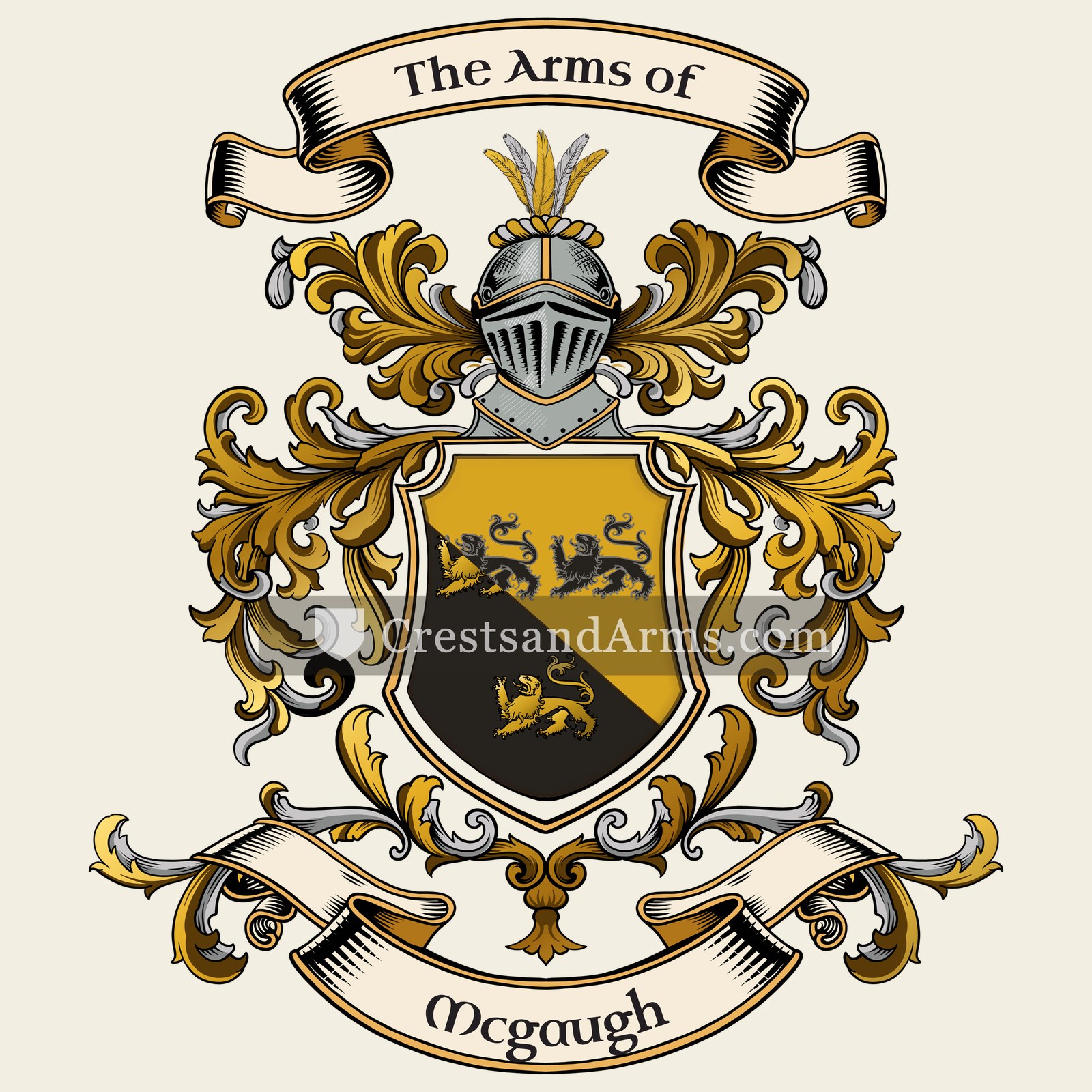
 lionCourage, strength and royalty
 lionCourage, strength and royalty