Map of Germany showing where the Mckey arms are recorded
The Mckey arms were recorded in Silesia, c. 1806.
Silesia was farming country in the east of the German lands, held in large estates by families who stayed put for generations. Owning land was what entitled a family to arms, so the region fills a good deal of the register.
This is where the arms were entered in the register. Families often moved to other parts of the country, so the same name can turn up in more than one region.
The body that granted and recorded arms in Germany in this period.
Frederick William III of Prussia
Sovereign of the period
Frederick William III of Prussia
1797–1840
Reigning in Germany when the Mckey arms are first recorded.
How Arms Worked in Germany
Prussian heraldry was strictly tied to social rank and noble status rather than being a free choice for every citizen. These symbols were treated as permanent family property that moved through the generations to all legitimate heirs. If a family branch wanted to change their design to stand out, they had to apply for official permission to alter their specific version of the shield.
Granting authority
The Prussian Heroldsamt acted as the central state office that managed and strictly controlled all noble titles and coats of arms.
How they got arms
Families usually obtained their arms through formal royal grants or by proving their long-standing noble status to the state authorities.
Where arms were recorded
All official coats of arms were kept in the rolls of the Prussian Heroldsamt, which functioned from 1706 until 1918.
The family's standing
Recorded among the armigerous families of Silesia.
Origin & History of the Mckey Family in Germany
The family name McKey has roots that trace back to the complex cultural landscape of Central Europe, specifically within the historical region of Silesia. By 1806, members of the family were established in this area, which was then a significant crossroads for trade and migration between Germanic and Slavic populations. During this period, Silesia was undergoing major political shifts as the Napoleonic Wars reshaped the borders of the Prussian state. Families living in the region at this time often navigated a blend of local traditions and evolving administrative systems. The name itself likely evolved as a phonetic adaptation of regional surnames, reflecting the way families adjusted their identities to fit into the changing social structures of the nineteenth century. As the family moved through these shifting territories, they became part of the broader history of a region defined by its resilience and its role as a bridge between different European cultures.
Mckey Meaning & Related Branches
Root word
Mac Aodha
Gaelic patronymic meaning son of the fire god.
This name
MckeyAn anglicized Irish surname denoting descent from a person named Aodh.
also spelled
Muecke
Muecken
Mooka
Documented Sources
J. B. Rietstap, Armorial Général, Gouda: G. B. van Goor Zonen, 1884–87
Davies, Norman, God's Playground: A History of Poland, 1981
Tymieniecki, Kazimierz, Historia Polski, 1971
Archiwum Państwowe we Wrocławiu (State Archive in Wrocław), Akta stanu cywilnego (Civil Registry Records), 1806
Digital archive packCoat of arms PNG, gold border print PDF, vector SVG and the certificate of authenticity. Sent to your email in minutes.


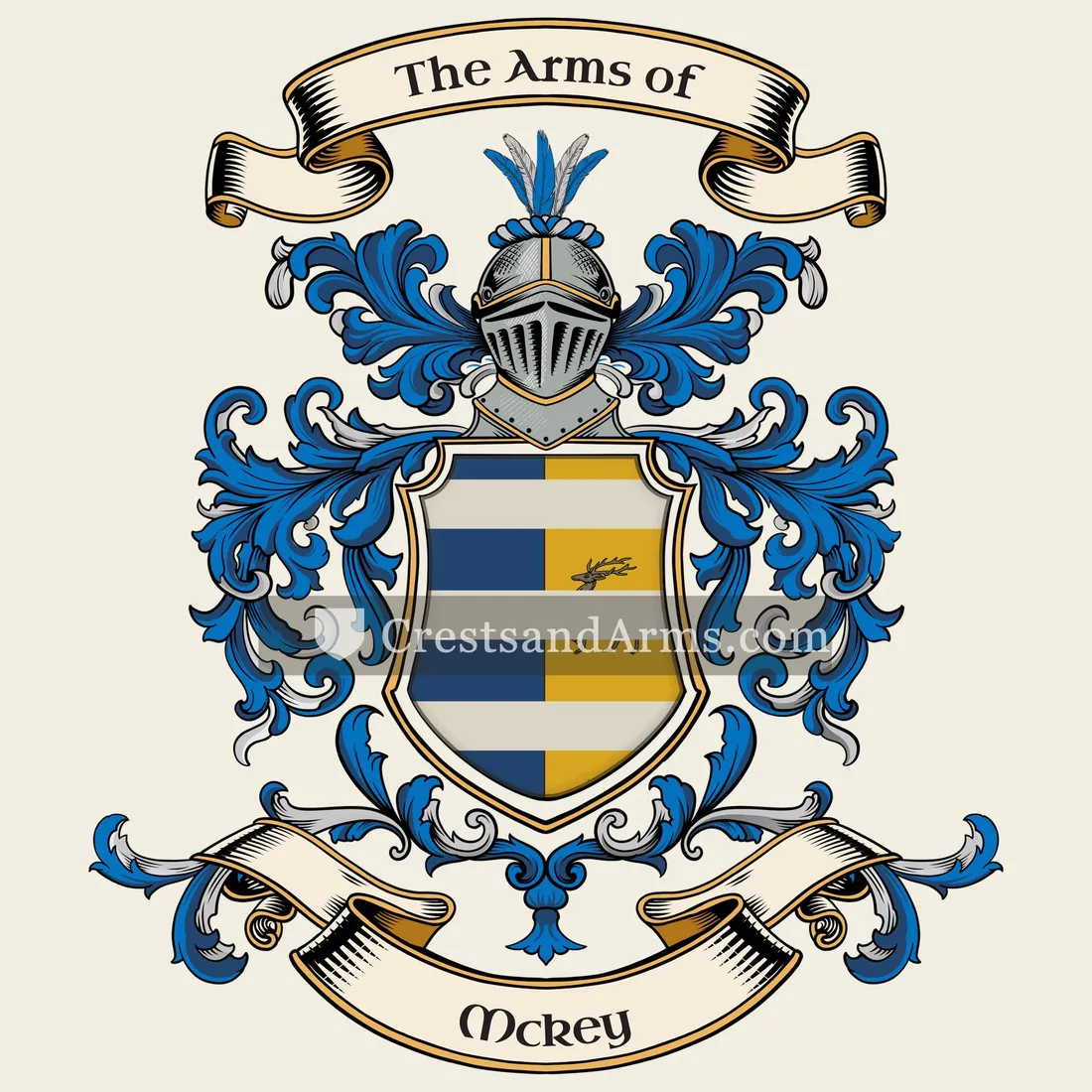
 stagPeace and harmony, and one who will not fight unprovoked
 stagPeace and harmony, and one who will not fight unprovoked