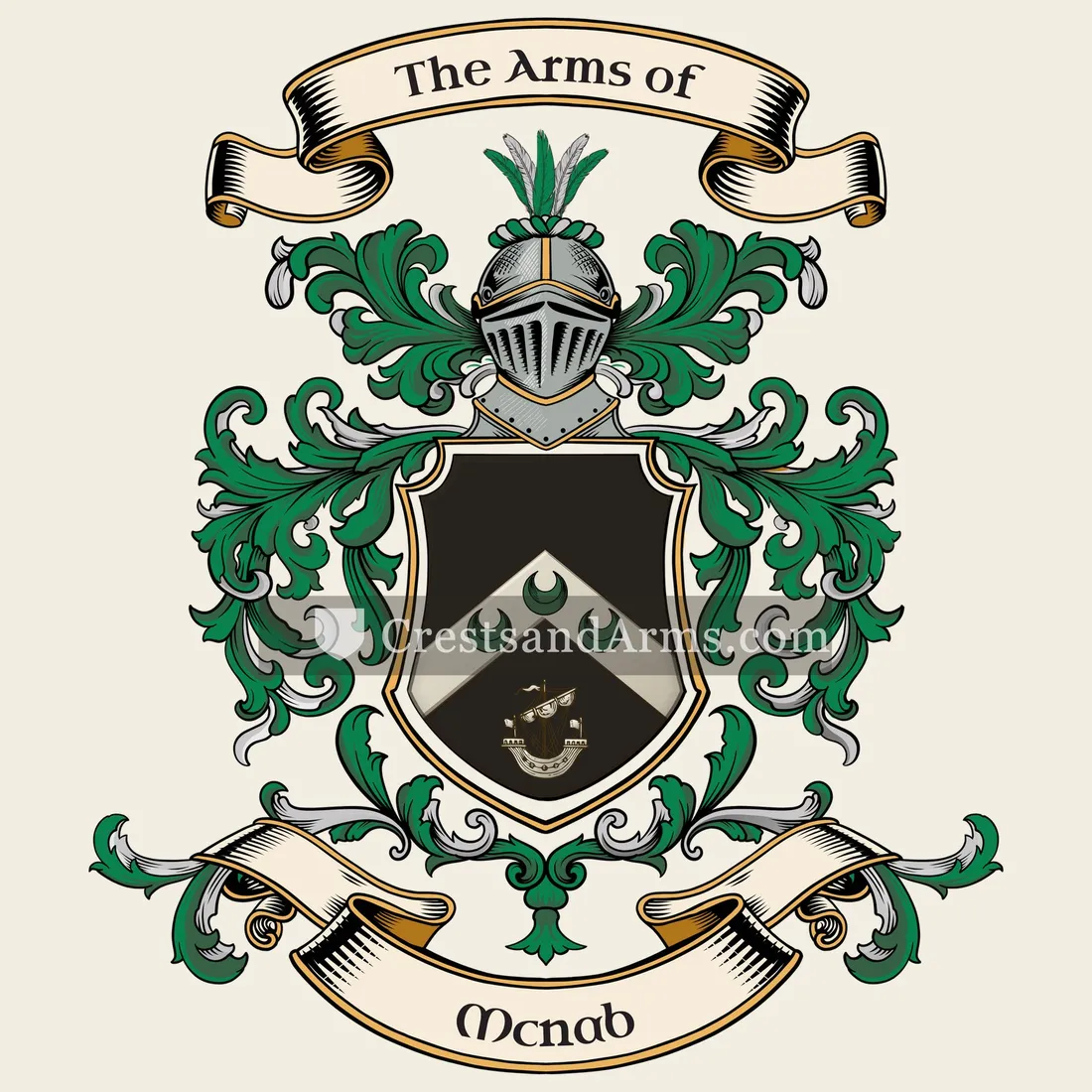
A record of documented arms, meaning and origin, researched for the Mcnab family of Britain.
Reg. 6238 · Britain, M–O
Meaning of the Mcnab family crest colors & symbols
Symbols on this shield
chevronProtection, and faithful service completed
shipEnterprise, and a great voyage undertaken
crescentHonour by the sovereign, and the second son
Colours
Black (Sable)Means: Constancy
Silver (Argent)Means: Peace and sincerity
Green (Vert)Means: Hope
Historical info
Source
J. B. Rietstap, Armorial Général, Gouda: G. B. van Goor Zonen, 1884–87
Blazon (the actual original written record)
“De sa. au chev. d'arg., ch. de trois croiss. de sin. et acc. d'un canot avec ses avirons, voguant sur une mer en p., le tout au nat. C.: une tête de sauvage de carn. D.: TIMOR OMNIS ABESTO.”
BritainCanada, c. 1856
Digital archive packCoat of arms PNG, gold border print PDF, vector SVG and the certificate of authenticity. Sent to your email in minutes.
Map of Britain showing where the Mcnab arms are recorded
The Mcnab arms were recorded in Canada, c. 1856.
Arms such as these were typically recorded in Kent.
Kent sits between London and the short crossing to Europe, and the trade passing through made it wealthy. Merchant families bought land with that money, and it was landowners who took coats of arms.
This is where the arms were entered in the register. Families often moved to other parts of the country, so the same name can turn up in more than one region.
The body that granted and recorded arms in Britain in this period.
Victoria
Sovereign of the period
Victoria
1837–1901
Reigning in Britain when the Mcnab arms are first recorded.
How Arms Worked in Britain
English heraldry allowed arms to be shared by all legitimate descendants of the original owner. These symbols were treated as personal property that moved through the generations to all children. While the eldest son kept the original design, other family members could use the same shield without needing to change it or register their own unique versions.
Granting authority
The College of Arms in London has regulated the use of coats of arms throughout England and Wales since 1484.
How they got arms
Families typically obtained their coats of arms through a formal grant from the Crown or by proving their ancient right to them.
Where arms were recorded
All official coats of arms are recorded in the registers kept at the College of Arms, which date back to the fifteenth century.
The family's standing
Recorded among the armigerous families of Britain.
Origin & History of the Mcnab Family in Britain
The surname McNab is rooted in the Gaelic language, originating from the phrase "Mac an Aba," which translates to "son of the abbot." This indicates that the family line likely began with the descendants of a high-ranking religious official in early medieval Scotland. While the name is traditionally associated with the rugged Highlands near Loch Tay, the family history expanded significantly as members moved across the British Isles for work and opportunity. By the mid-19th century, records confirm that McNab families were well-established in the county of Kent. These individuals were part of a broader movement of people who brought their Scottish heritage into the heart of southern England during the Victorian era. Their presence in Kent by 1856 highlights how the family adapted to new environments while maintaining a name that reflects a deep connection to ancient ecclesiastical traditions.
Mcnab Meaning & Related Branches
Root word
Mac an Aba
Gaelic for son of the abbot.
This name
McnabA Scottish patronymic surname indicating descent from a religious leader or head of a monastery.
Documented Sources
J. B. Rietstap, Armorial Général, Gouda: G. B. van Goor Zonen, 1884–87
Black, George Fraser. The Surnames of Scotland: Their Origin, Meaning, and History. 1946
The National Archives (UK). General Register Office: 1851 Census Returns. Series HO 107
Digital archive packCoat of arms PNG, gold border print PDF, vector SVG and the certificate of authenticity. Sent to your email in minutes.


 chevronProtection, and faithful service completed
 shipEnterprise, and a great voyage undertaken
 crescentHonour by the sovereign, and the second son
 chevronProtection, and faithful service completed
 shipEnterprise, and a great voyage undertaken
 crescentHonour by the sovereign, and the second son