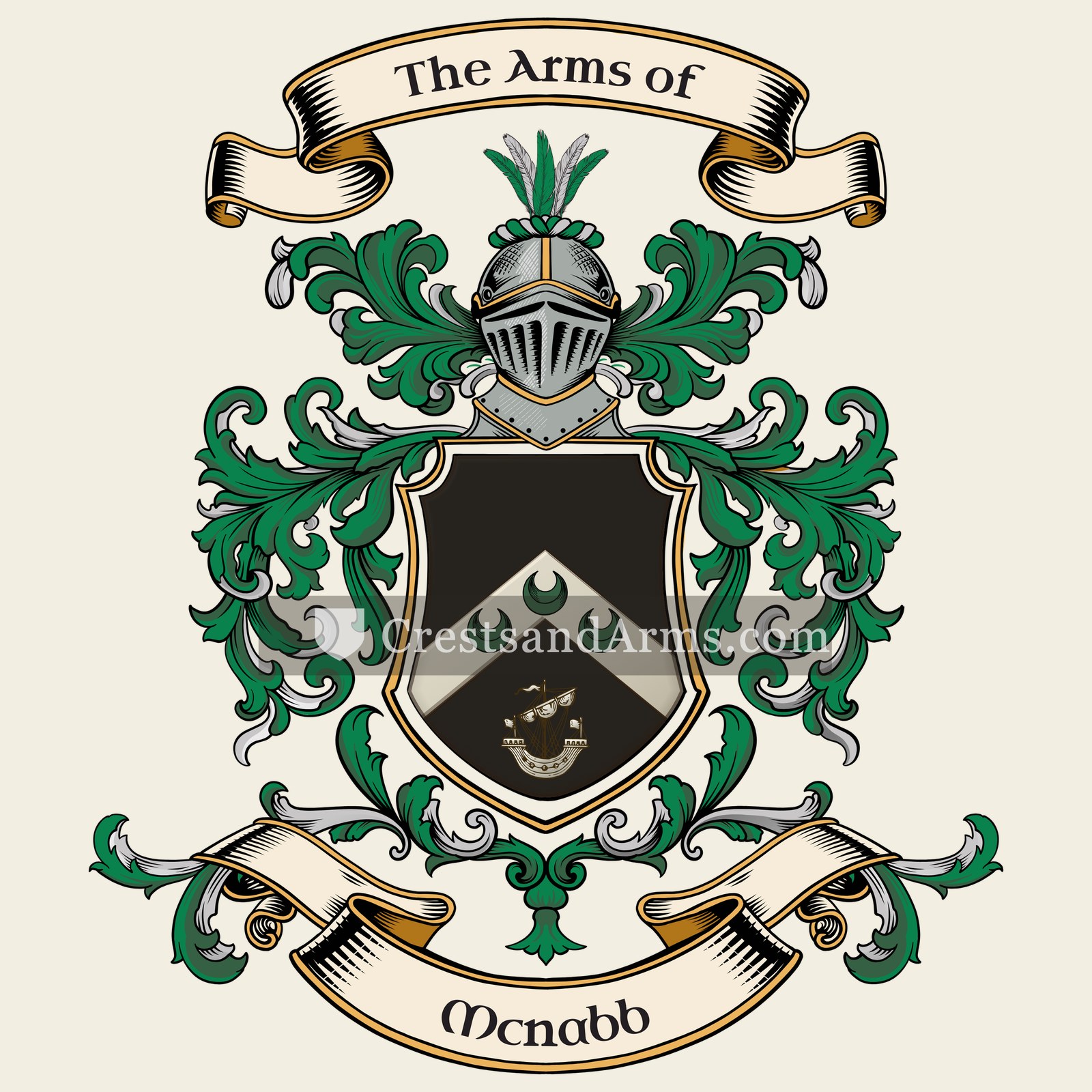
A record of documented arms, meaning and origin, researched for the Mcnabb family of Britain.
Reg. 2858 · Britain, M–O
Coat of Arms & Family Crest Details
Symbols on this shield
chevronProtection, and faithful service completed
shipEnterprise, and a great voyage undertaken
crescentHonour by the sovereign, and the second son
Colours
Black (Sable)Means: Constancy
Silver (Argent)Means: Peace and sincerity
Green (Vert)Means: Hope
Historical info
Source
J. B. Rietstap, Armorial Général, Gouda: G. B. van Goor Zonen, 1884–87
Blazon (the actual original written record)
“De sa. au chev. d'arg., ch. de trois croiss. de sin. et acc. d'un canot avec ses avirons, voguant sur une mer en p., le tout au nat. C.: une tête de sauvage de carn. D.: TIMOR OMNIS ABESTO.”
BritainCanada, c. 1856
Digital archive packCoat of arms PNG, gold border print PDF, vector SVG and the certificate of authenticity. Sent to your email in minutes.
Map of Britain showing where the Mcnabb arms are recorded
The Mcnabb arms were recorded in Canada, c. 1856.
Arms such as these were typically recorded in Kent.
Kent sits between London and the short crossing to Europe, and the trade passing through made it wealthy. Merchant families bought land with that money, and it was landowners who took coats of arms.
This is where the arms were entered in the register. Families often moved to other parts of the country, so the same name can turn up in more than one region.
The body that granted and recorded arms in Britain in this period.
Victoria
Sovereign of the period
Victoria
1837–1901
Reigning in Britain when the Mcnabb arms are first recorded.
How Arms Worked in Britain
English heraldry allowed arms to be shared by all legitimate descendants of the original owner. These symbols were treated as personal property that moved through the generations to all children. While the eldest son kept the original design, other family members could use the same shield without needing to change it or register their own unique versions.
Granting authority
The College of Arms in London has regulated the use of coats of arms throughout England and Wales since 1484.
How they got arms
Families typically obtained their coats of arms through a formal grant from the Crown or by proving their ancient right to them.
Where arms were recorded
All official coats of arms are recorded in the registers kept at the College of Arms, which date back to the fifteenth century.
The family's standing
Recorded among the armigerous families of Britain.
Origin & History of the Mcnabb Family in Britain
The surname McNabb is an Anglicized version of the Gaelic name Mac an Aba, which translates to "son of the abbot." This indicates that the family line likely originated from a descendant of a medieval church leader, as celibacy was not always strictly enforced among the clergy in early Gaelic society. While the name is most famously associated with the Scottish Highlands, particularly the lands surrounding Loch Tay, families often migrated for work or opportunity during the nineteenth century. By 1856, records confirm that members of the McNabb family had established a presence in Kent, England. This movement was part of a larger trend of internal migration within the British Isles during the Industrial Revolution, as families moved to follow new economic prospects in growing urban and agricultural centers.
Related Branches & Arms
Root word
Mac an Aba
Gaelic phrase meaning son of the abbot.
This name
McnabbA patronymic surname indicating descent from a religious leader or monastic head.
Documented Sources
J. B. Rietstap, Armorial Général, Gouda: G. B. van Goor Zonen, 1884–87
Black, George Fraser. The Surnames of Scotland: Their Origin, Meaning, and History, 1946
National Records of Scotland. Records of the Clan Macnab, GD112
The National Archives (UK). Census Returns of England and Wales, 1851 and 1861, HO 107 and RG 9
Digital archive packCoat of arms PNG, gold border print PDF, vector SVG and the certificate of authenticity. Sent to your email in minutes.


 chevronProtection, and faithful service completed
 shipEnterprise, and a great voyage undertaken
 crescentHonour by the sovereign, and the second son
 chevronProtection, and faithful service completed
 shipEnterprise, and a great voyage undertaken
 crescentHonour by the sovereign, and the second son