A record of documented arms, meaning and origin, researched for the Mcreynolds family lines. Documented in 3 countries.
Reg. 9586 · Britain, M–O
Coat of Arms & Family Crest Details
Symbols on this shield
chevronProtection, and faithful service completed
cross symbolChristian faith and service
Colours
Silver (Argent)Means: Peace and sincerity
Gold (Or)Means: Generosity
Blue (Azure)Means: Loyalty and truth
Red (Gules)Means: Military strength
Historical info
Source
J. B. Rietstap, Armorial Général, Gouda: G. B. van Goor Zonen, 1884–87
Blazon (the actual original written record)
“D'arg. au chev. losangé d'or et d'azur, acc. de trois croix recr. de gu. Cq. timbré d'une couronne murale d'or. C.: un dogue iss. d'arg., coll. et enchaîné d'or [Armes du célèbre peintre, Josua R.]”
BritainLondres, c. 1700
Digital archive packCoat of arms PNG, gold border print PDF, vector SVG and the certificate of authenticity. Sent to your email in minutes.
Map of Britain showing where the Mcreynolds arms are recorded
The Mcreynolds arms were recorded in Londres, c. 1700.
Arms such as these were typically recorded in Kent.
Kent sits between London and the short crossing to Europe, and the trade passing through made it wealthy. Merchant families bought land with that money, and it was landowners who took coats of arms.
This is where the arms were entered in the register. Families often moved to other parts of the country, so the same name can turn up in more than one region.
The body that granted and recorded arms in Britain in this period.
William III of England
Sovereign of the period
William III of England
1694–1702
Reigning in Britain when the Mcreynolds arms are first recorded.
How Arms Worked in Britain
English heraldry allowed arms to be shared by all legitimate descendants of the original owner. These symbols were treated as personal property that moved through the generations to all children. While the eldest son kept the original design, other family members could use the same shield without needing to change it or register their own unique versions.
Granting authority
The College of Arms in London has regulated the use of coats of arms throughout England and Wales since 1484.
How they got arms
Families typically obtained their coats of arms through a formal grant from the Crown or by proving their ancient right to them.
Where arms were recorded
All official coats of arms are recorded in the registers kept at the College of Arms, which date back to the fifteenth century.
The family's standing
Recorded among the armigerous families of Britain.
Origin & History of the Mcreynolds Family in Britain
The family name McReynolds finds its linguistic roots in the Gaelic tradition, specifically originating from the patronymic "Mac Raghnaill," which translates to "son of Reginald." While the name is deeply tied to Scottish and Irish ancestry, historical records confirm that members of the family had established a presence in the English county of Kent by the year 1700. During this period, Kent served as a vital hub for trade and migration, often acting as a gateway for families moving between the British Isles and the continent. The arrival of the McReynolds family in this region suggests they were part of a broader movement of people seeking new opportunities in the growing urban centers of southern England. By settling in Kent, these early family members integrated into a society defined by agricultural development and coastal commerce, marking a significant transition from their northern origins to the landscapes of southeastern Britain.
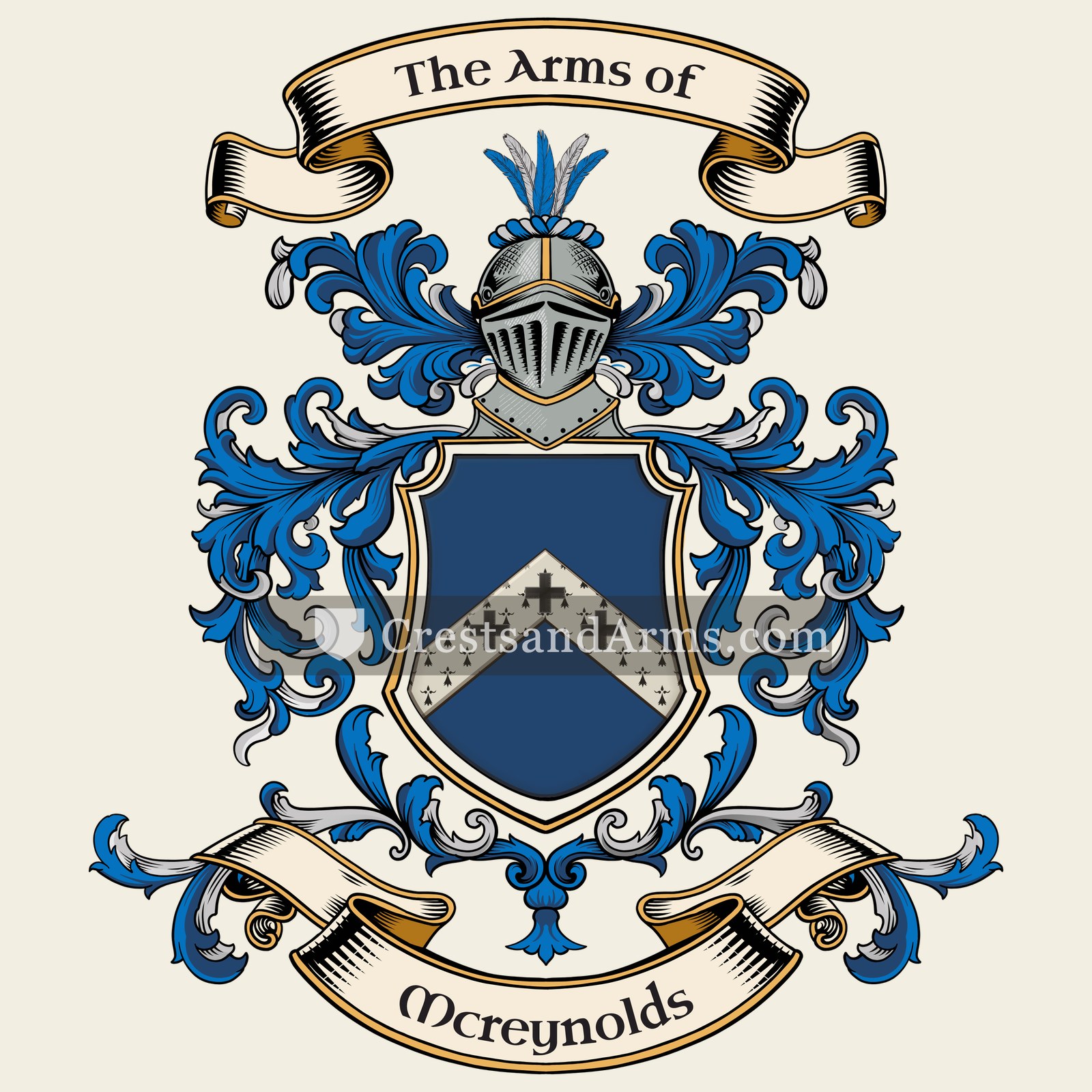
Coat of Arms & Family Crest Details
Symbols on this shield
chevronProtection, and faithful service completed
cross symbolChristian faith and service
Colours
Blue (Azure)Means: Loyalty and truth
ErmineMeans: Dignity
Black (Sable)Means: Constancy
Historical info
Source
Sir Bernard Burke, The General Armory of England, Scotland, Ireland and Wales, London: Harrison & Sons, 1884
Blazon (the actual original written record)
“Az. on a chev. erm. three crosses crosslet fitchée sa”
LeicesterBraunston · Leicester, c. 1614
Digital archive packCoat of arms PNG, gold border print PDF, vector SVG and the certificate of authenticity. Sent to your email in minutes.
Map of England showing where the Mcreynolds arms are recorded
The Mcreynolds arms were recorded in Leicester, c. 1614.
Leicestershire was grazing country, and wool and cattle made steady money rather than spectacular fortunes. Steady money bought manors, and manors are what brought families into the registers.
This is where the arms were entered in the register. Families often moved to other parts of the country, so the same name can turn up in more than one region.
The body that granted and recorded arms in England in this period.
James VI and I
Sovereign of the period
James VI and I
1603–1625
Reigning in Britain when the Mcreynolds arms are first recorded.
How Arms Worked in England
English heraldry allowed arms to be shared by all legitimate descendants of the original owner. These symbols were treated as personal property that moved through the generations to all children. While the eldest son kept the original design, other family members could use the same shield without needing to change it or register their own unique versions.
Granting authority
The College of Arms in London has regulated the use of coats of arms throughout England and Wales since 1484.
How they got arms
Families typically obtained their coats of arms through a formal grant from the Crown or by proving their ancient right to them.
Where arms were recorded
All official coats of arms are recorded in the registers kept at the College of Arms, which date back to the fifteenth century.
The family's standing
Recorded among the armigerous families of Leicester.
Origin & History of the Mcreynolds Family in England
The surname McReynolds is primarily associated with Scottish and Irish roots, but historical records confirm that members of the family were established in the English town of Leicester as early as 1614. During the early 17th century, Leicester was a growing market town where families often settled to participate in the thriving wool and textile trades. The presence of the McReynolds name in local parish registers during this period suggests that these individuals were integrated into the social and economic fabric of the Midlands. While the name itself reflects a Gaelic origin meaning "son of Reginald," its appearance in English records highlights the movement of people across the British Isles during a time of significant migration. These early settlers likely worked as craftsmen or merchants, contributing to the local community long before the name became more widely distributed across the globe.
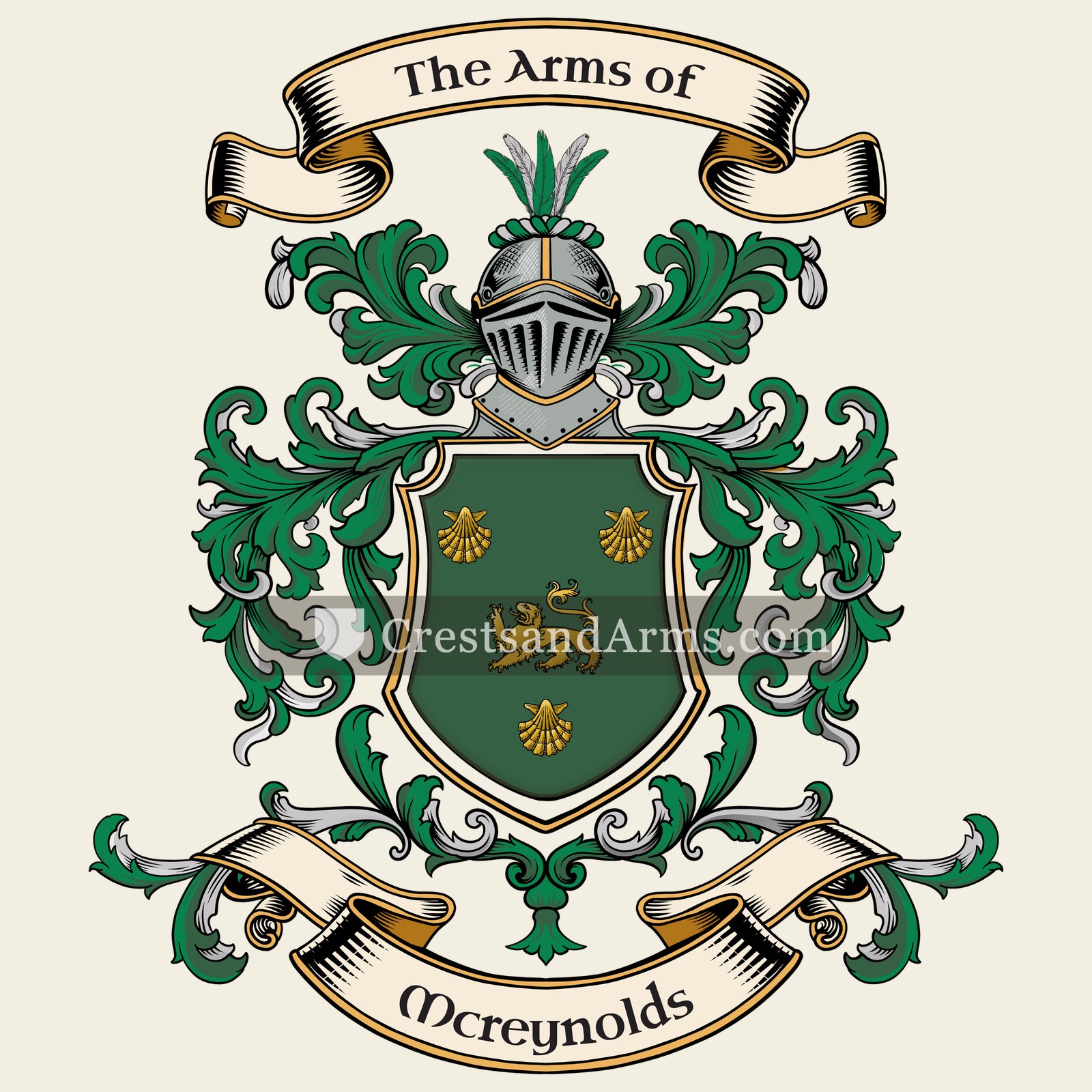
Coat of Arms & Family Crest Details
Symbols on this shield
lionCourage, strength and royalty
escallopThe pilgrim's shell, and a long journey made
Colours
Green (Vert)Means: Hope
Gold (Or)Means: Generosity
Historical info
Source
Sir Bernard Burke, The General Armory of England, Scotland, Ireland and Wales, London: Harrison & Sons, 1884
Blazon (the actual original written record)
“Vert a lion ramp. betw. three escallops or”
CavanTully · Cavan, c. 1645
Digital archive packCoat of arms PNG, gold border print PDF, vector SVG and the certificate of authenticity. Sent to your email in minutes.
Map of Ireland showing where the Mcreynolds arms are recorded
The Mcreynolds arms were recorded in Cavan, c. 1645.
Cavan was drumlin and lake country on the edge of Ulster, planted in the seventeenth century. The new landowners took formal grants, and formal grants were recorded with arms.
This is where the arms were entered in the register. Families often moved to other parts of the country, so the same name can turn up in more than one region.
The body that granted and recorded arms in Ireland in this period.
Charles I of England
Sovereign of the period
Charles I of England
1625–1649
Reigning in Britain when the Mcreynolds arms are first recorded.
How Arms Worked in Ireland
The Ulster King of Arms granted coats of arms to individuals who proved their social standing and good character. These symbols were typically inherited by all legitimate descendants of the original holder. If a family branch wanted a unique look, they could apply for a specific change to their design through the office to ensure their identity remained distinct.
Granting authority
The Ulster King of Arms acted as the official body that regulated and issued all coats of arms throughout Ireland.
How they got arms
Families obtained their arms through formal grants issued by the office after proving their eligibility and paying the required fees.
Where arms were recorded
All official grants were recorded in the registers held by the Ulster King of Arms starting from the year 1552.
The family's standing
Recorded among the armigerous families of Cavan.
Origin & History of the Mcreynolds Family in Ireland
The surname McReynolds is an anglicized version of the Gaelic name Mac Raghnaill, which translates to son of Reginald or son of Ronald. By the mid-seventeenth century, the family was firmly established in County Cavan, a region that served as a significant frontier during the turbulent political shifts of the 1600s. Records from 1645 place the family in this area during a time when the traditional Gaelic social structures were being challenged by land redistributions and new administrative policies. As the family navigated life in Cavan, they were part of a broader movement of clans adapting to changing land ownership laws and the influence of the English crown. The name reflects a deep connection to the Gaelic tradition of patronymics, where the identity of the family was tied directly to the first name of a prominent male ancestor. Over time, the spelling evolved into its current form as the family integrated into the changing linguistic landscape of Ireland.
Related Branches & Arms
Root word
Mac Raghnaill
Son of the ruler or son of the mighty advisor.
This name
McreynoldsA patronymic surname indicating descent from a person named Reginald or Reynold.
also spelled
Reinolds
Reynalds
Renolds
Raynolds
Rainolds
Documented Sources
J. B. Rietstap, Armorial Général, Gouda: G. B. van Goor Zonen, 1884–87
Black, George F., The Surnames of Scotland: Their Origin, Meaning, and History, 1946
Reaney, P.H., A Dictionary of British Surnames, 1958
The National Archives, Kew, Parish Registers of Kent, 1700
Digital archive packCoat of arms PNG, gold border print PDF, vector SVG and the certificate of authenticity. Sent to your email in minutes.


 chevronProtection, and faithful service completed
 cross symbolChristian faith and service
 chevronProtection, and faithful service completed
 cross symbolChristian faith and service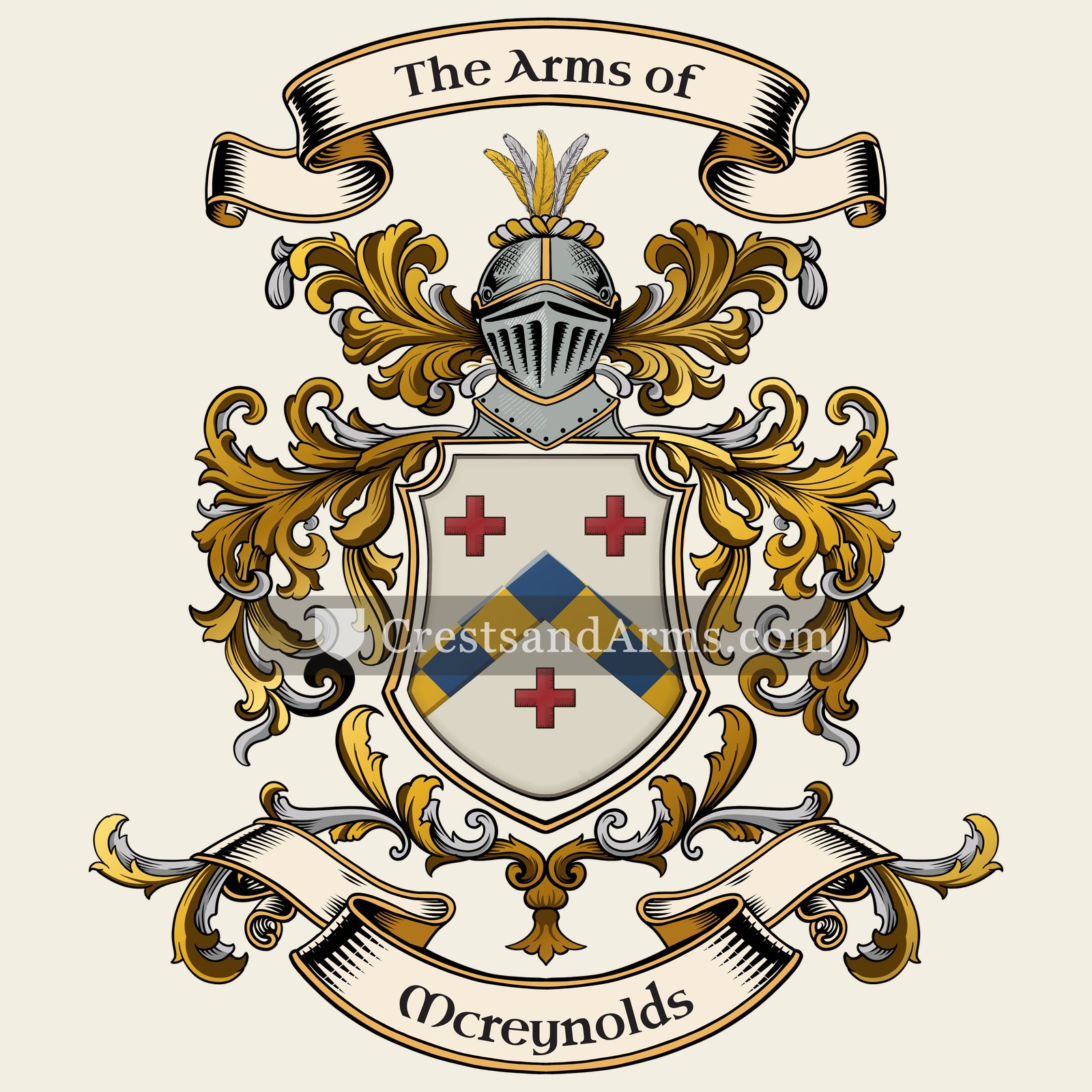



 lionCourage, strength and royalty
 escallopThe pilgrim's shell, and a long journey made