Map of Ireland showing where the Mcweeney arms are recorded
The Mcweeney arms were recorded in Donegal, c. 1267.
Donegal was remote north-western Irish country of mountain and coast. Its land was poor and its families few, but those who held ground held it for a very long time.
This is where the arms were entered in the register. Families often moved to other parts of the country, so the same name can turn up in more than one region.
The body that granted and recorded arms in Ireland in this period.
Henry III of England
Sovereign of the period
Henry III of England
1216–1272
Reigning in Ireland when the Mcweeney arms are first recorded.
How Arms Worked in Ireland
The Ulster King of Arms granted coats of arms to individuals who proved their social standing and good character. These symbols were typically inherited by all legitimate descendants of the original holder. If a family branch wanted a unique look, they could apply for a specific change to their design through the office to ensure their identity remained distinct.
Granting authority
The Ulster King of Arms acted as the official body that regulated and issued all coats of arms throughout Ireland.
How they got arms
Families obtained their arms through formal grants issued by the office after proving their eligibility and paying the required fees.
Where arms were recorded
All official grants were recorded in the registers held by the Ulster King of Arms starting from the year 1552.
The family's standing
Recorded among the armigerous families of Donegal.
Origin & History of the Mcweeney Family in Ireland
The McSweeney family, originally spelled Mac Suibhne, traces its roots to the Scottish Highlands before establishing a powerful presence in County Donegal by 1267. The family name originates from a Norse-Gaelic ancestor named Suibhne, whose descendants became renowned as professional soldiers known as gallowglass. These warriors were highly valued for their skill and loyalty, and they were frequently hired by the powerful O'Donnell clan to serve as elite guards in the north of Ireland. By settling in the rugged landscape of Donegal, the McSweeneys built several stone castles to protect their territory and maintain their influence. Over time, they became deeply integrated into the local Gaelic society and played a major role in the political and military affairs of the region for several centuries.
Related Branches & Arms
Root word
Mac Suibhne
Son of Suibhne, derived from the Gaelic word for pleasant or well-disposed.
This name
McweeneyDescendant of the pleasant one, originating from a prominent gallowglass clan in medieval Ireland.
also spelled
McSweeney
MacSwiney
Documented Sources
Sir Bernard Burke, The General Armory of England, Scotland, Ireland and Wales, London: Harrison & Sons, 1884
O'Donovan, John, Annála Ríoghachta Éireann: Annals of the Kingdom of Ireland by the Four Masters, 1856
Simms, Katharine, Gaelic Warfare in the Middle Ages, 1987
National Library of Ireland, Genealogical Office Manuscripts
Digital archive packCoat of arms PNG, gold border print PDF, vector SVG and the certificate of authenticity. Sent to your email in minutes.


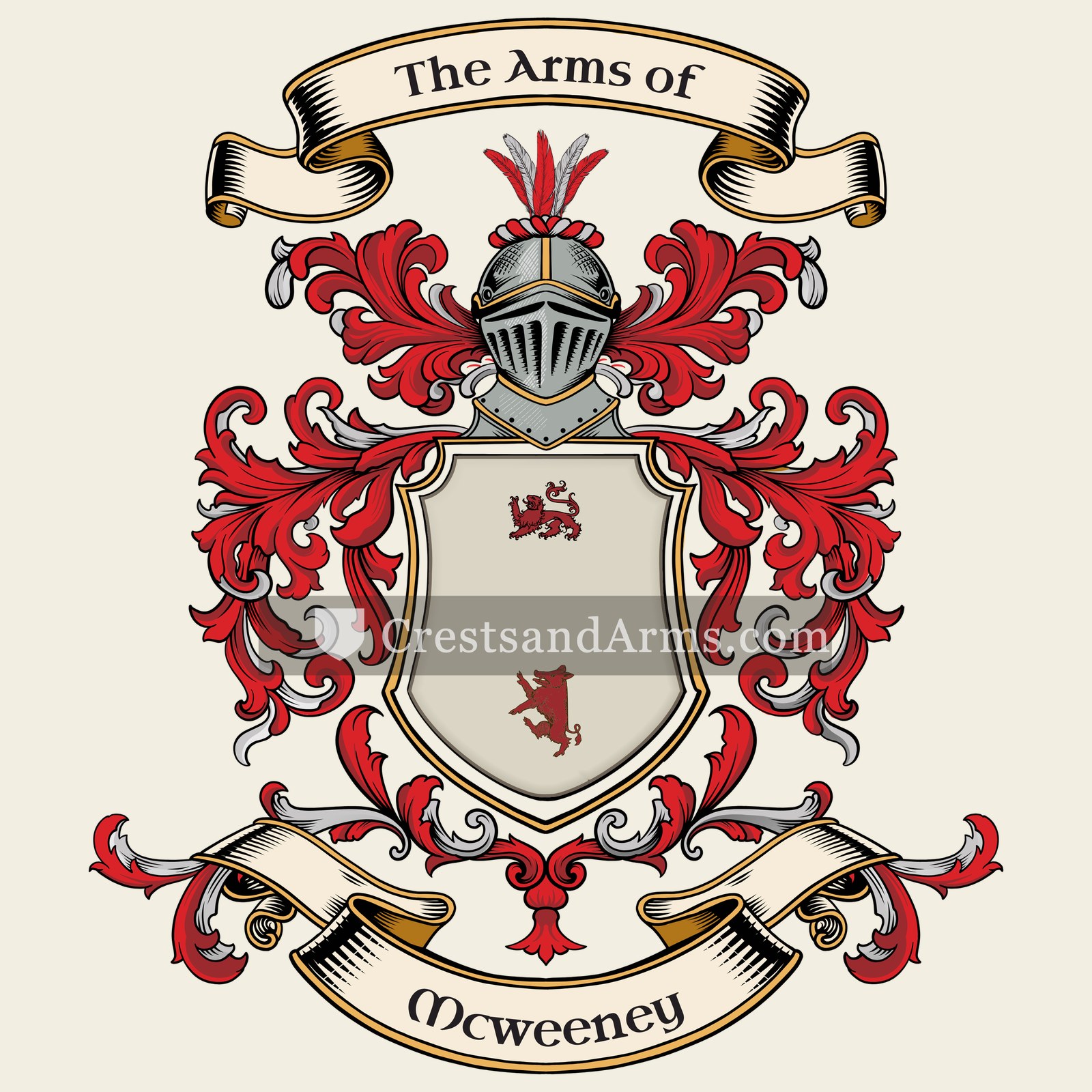
 lionCourage, strength and royalty
 boarA fierce fighter who battles to the end
 lionCourage, strength and royalty
 boarA fierce fighter who battles to the end