Map of England showing where the Mcwilliams arms are recorded
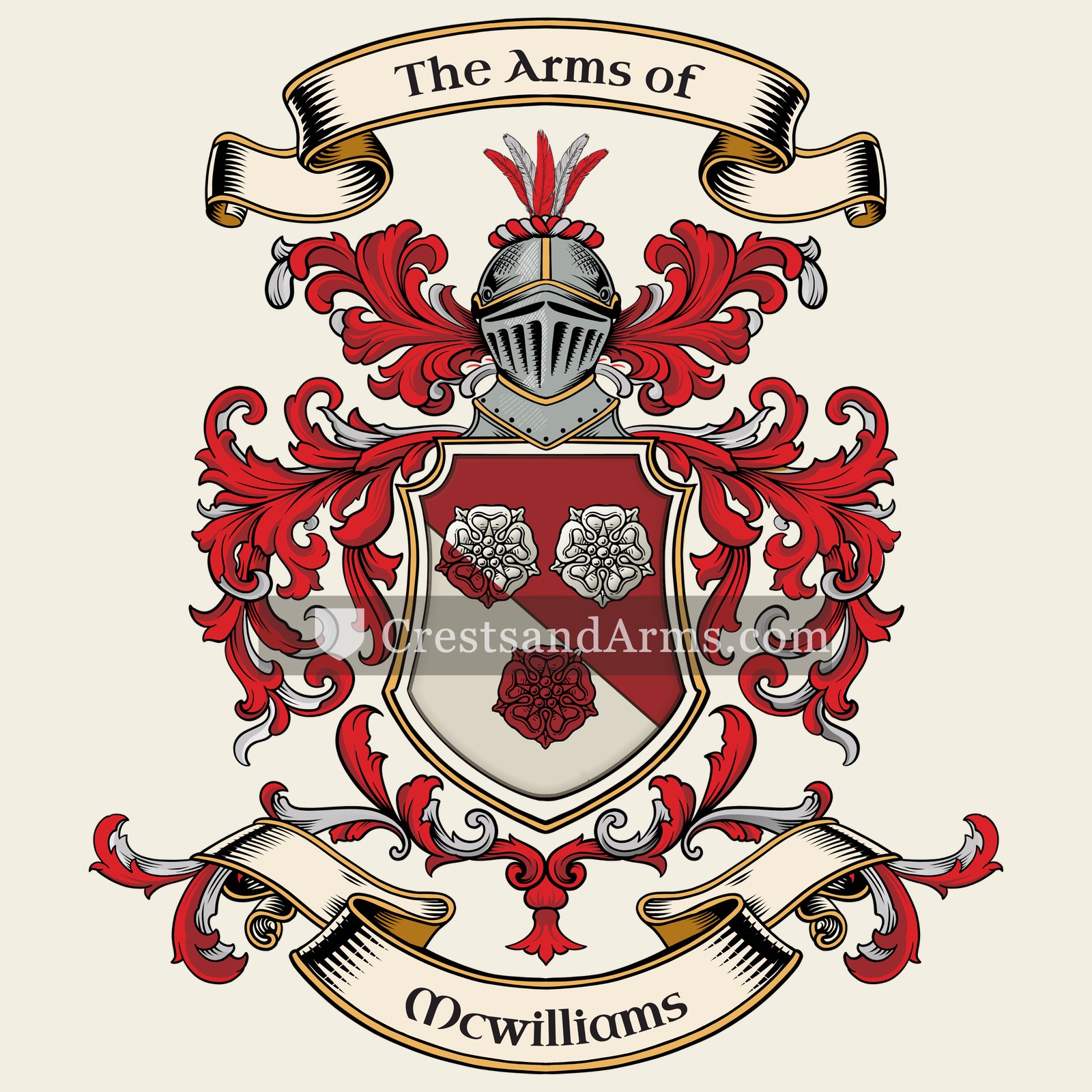
The Mcwilliams arms were recorded in Gloucester, c. 1434.
Gloucestershire had good farmland, a cloth trade in its valleys and a river carrying goods to Bristol. All three made money, and money bought the estates that brought arms with them.
This is where the arms were entered in the register. Families often moved to other parts of the country, so the same name can turn up in more than one region.
The body that granted and recorded arms in England in this period.
Henry VI of England
Sovereign of the period
Henry VI of England
1422–1461
Reigning in England when the Mcwilliams arms are first recorded.
How Arms Worked in England
English heraldry allowed arms to be shared by all legitimate descendants of the original owner. These symbols were treated as personal property that moved through the generations to all children. While the eldest son kept the original design, other family members could use the same shield without needing to change it or register their own unique versions.
Granting authority
The College of Arms in London has regulated the use of coats of arms throughout England and Wales since 1484.
How they got arms
Families typically obtained their coats of arms through a formal grant from the Crown or by proving their ancient right to them.
Where arms were recorded
All official coats of arms are recorded in the registers kept at the College of Arms, which date back to the fifteenth century.
The family's standing
Recorded among the armigerous families of Gloucester.
Origin & History of the Mcwilliams Family in England
The surname McWilliams is a patronymic name, which means it was originally created to identify a person as the son of a man named William. While the name is often associated with Scottish and Irish roots, the presence of the family in Gloucester by 1434 suggests that members of this lineage were well established in England during the late Middle Ages. During this period, families often moved across the British Isles for trade, military service, or agricultural work, which helped spread the name beyond its traditional Gaelic origins. As the family settled into local communities like Gloucester, they likely integrated into the social and economic life of the town as merchants, craftsmen, or landowners. Over time, the spelling evolved from various phonetic interpretations of the name into the modern version used today. This transition reflects the way surnames became fixed as record-keeping became more common in English society.
Mcwilliams Meaning & Related Branches
Root word
William
Derived from Germanic elements meaning resolute protector or strong-willed warrior.
This name
McwilliamsA patronymic surname signifying son of William.
also spelled
McWilliams
Documented Sources
Sir Bernard Burke, The General Armory of England, Scotland, Ireland and Wales, London: Harrison & Sons, 1884
The National Archives, Calendar of the Patent Rolls preserved in the Public Record Office: Henry VI, 1429–1436
Gloucestershire Archives, Records of the Corporation of Gloucester
Reaney, P.H. and Wilson, R.M., A Dictionary of English Surnames, 1991
Black, George F., The Surnames of Scotland: Their Origin, Meaning, and History, 1946
Digital archive packCoat of arms PNG, gold border print PDF, vector SVG and the certificate of authenticity. Sent to your email in minutes.


 roseThe seventh son, and beauty with grace
 roseThe seventh son, and beauty with grace