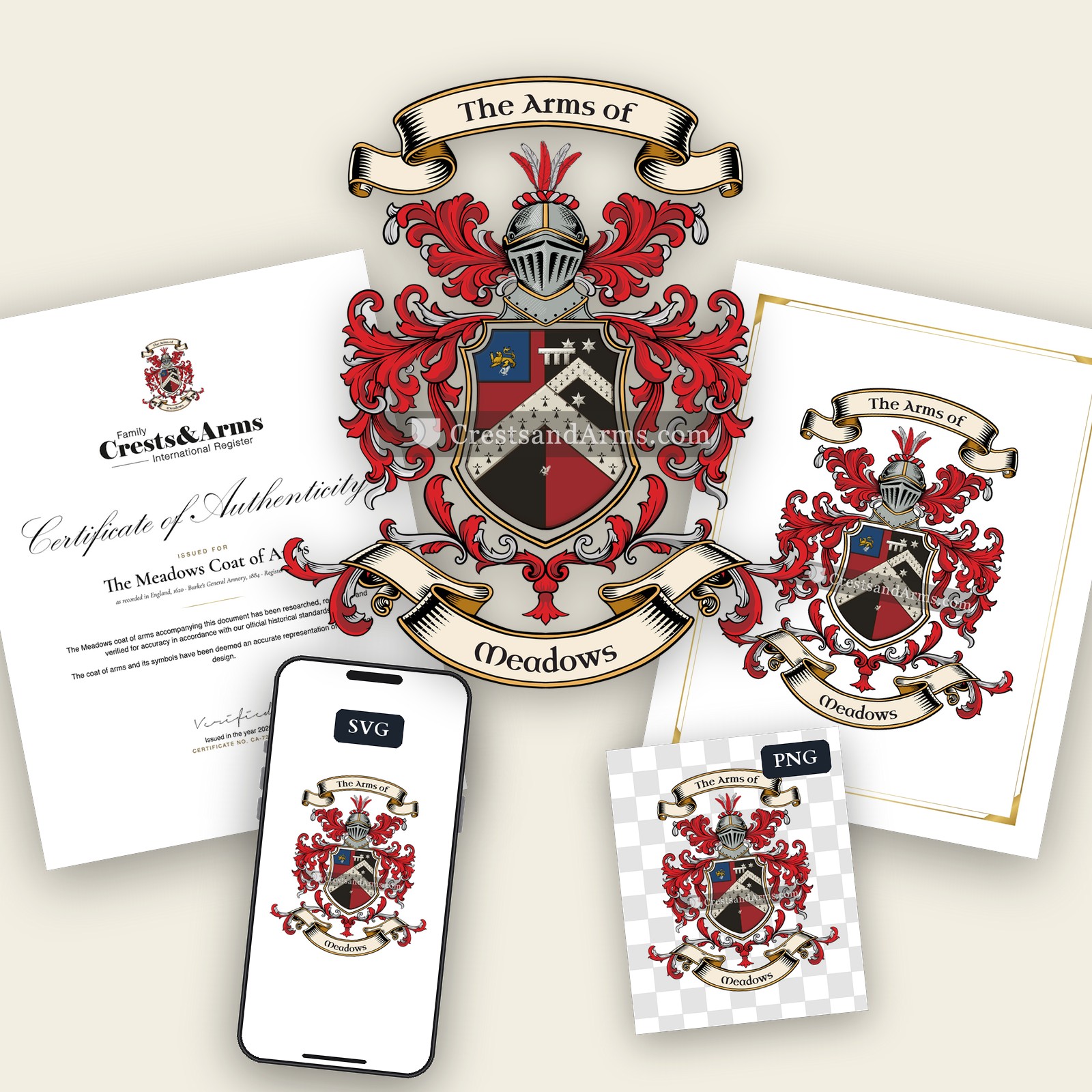
A record of documented arms, meaning and origin, researched for the Meadows family lines. Documented in 2 countries.
Reg. 7201 · English, M–O
Coat of Arms & Family Crest Details
Symbols on this shield
chevronProtection, and faithful service completed
cantonA mark of honour granted by the sovereign
labelThe eldest son, during his father's life
pelicanSelf-sacrifice and devotion to one's children
lionCourage, strength and royalty
starThe celestial goddess, and nobility
Colours
Red (Gules)Means: Military strength
Black (Sable)Means: Constancy
ErmineMeans: Dignity
Blue (Azure)Means: Loyalty and truth
Gold (Or)Means: Generosity
Silver (Argent)Means: Peace and sincerity
Historical info
Source
Sir Bernard Burke, The General Armory of England, Scotland, Ireland and Wales, London: Harrison & Sons, 1884
Blazon (the actual original written record)
“Gu. a chev. erm. betw. three pelicans vulning themselves ppr. (granted as an augmentation) on a canton az. a lion sejant, and in chief a label of three points, quartering BREWSTER, of Wrentham Hall, co. Suffolk, sa. a chev erm. betw. three estoiles ar”
SuffolkWitnesham Hall · Suffolk, c. 1620
Digital archive packCoat of arms PNG, gold border print PDF, vector SVG and the certificate of authenticity. Sent to your email in minutes.
Map of England showing where the Meadows arms are recorded
The Meadows arms were recorded in Suffolk, c. 1620.
Suffolk was wool country, and its cloth towns were among the wealthiest in England. Clothier families bought manors with their profits, and holding a manor was the ordinary route to a coat of arms.
This is where the arms were entered in the register. Families often moved to other parts of the country, so the same name can turn up in more than one region.
The body that granted and recorded arms in England in this period.
James VI and I
Sovereign of the period
James VI and I
1603–1625
Reigning in England when the Meadows arms are first recorded.
How Arms Worked in England
English heraldry allowed arms to be shared by all legitimate descendants of the original owner. These symbols were treated as personal property that moved through the generations to all children. While the eldest son kept the original design, other family members could use the same shield without needing to change it or register their own unique versions.
Granting authority
The College of Arms in London has regulated the use of coats of arms throughout England and Wales since 1484.
How they got arms
Families typically obtained their coats of arms through a formal grant from the Crown or by proving their ancient right to them.
Where arms were recorded
All official coats of arms are recorded in the registers kept at the College of Arms, which date back to the fifteenth century.
The family's standing
Recorded among the armigerous families of Suffolk.
Origin & History of the Meadows Family in England
The surname Meadows is a classic example of a topographic name, which means it was originally given to people based on the landscape where they lived. In medieval England, families often took their last names from the natural features surrounding their homes, such as hills, woods, or, in this case, low-lying grasslands. By the time the name appears in Suffolk records in 1620, it was already well-established as a way to identify individuals who lived near or worked on common meadowlands. These early ancestors were likely farmers or laborers whose daily lives were defined by the rhythmic cycles of the English countryside. Over several generations, the name transitioned from a simple description of a person’s location into a permanent family identifier that was passed down through the centuries. This evolution reflects the broader history of English naming customs, where geography played a vital role in shaping how families were identified within their local communities.
Coat of Arms & Family Crest Details
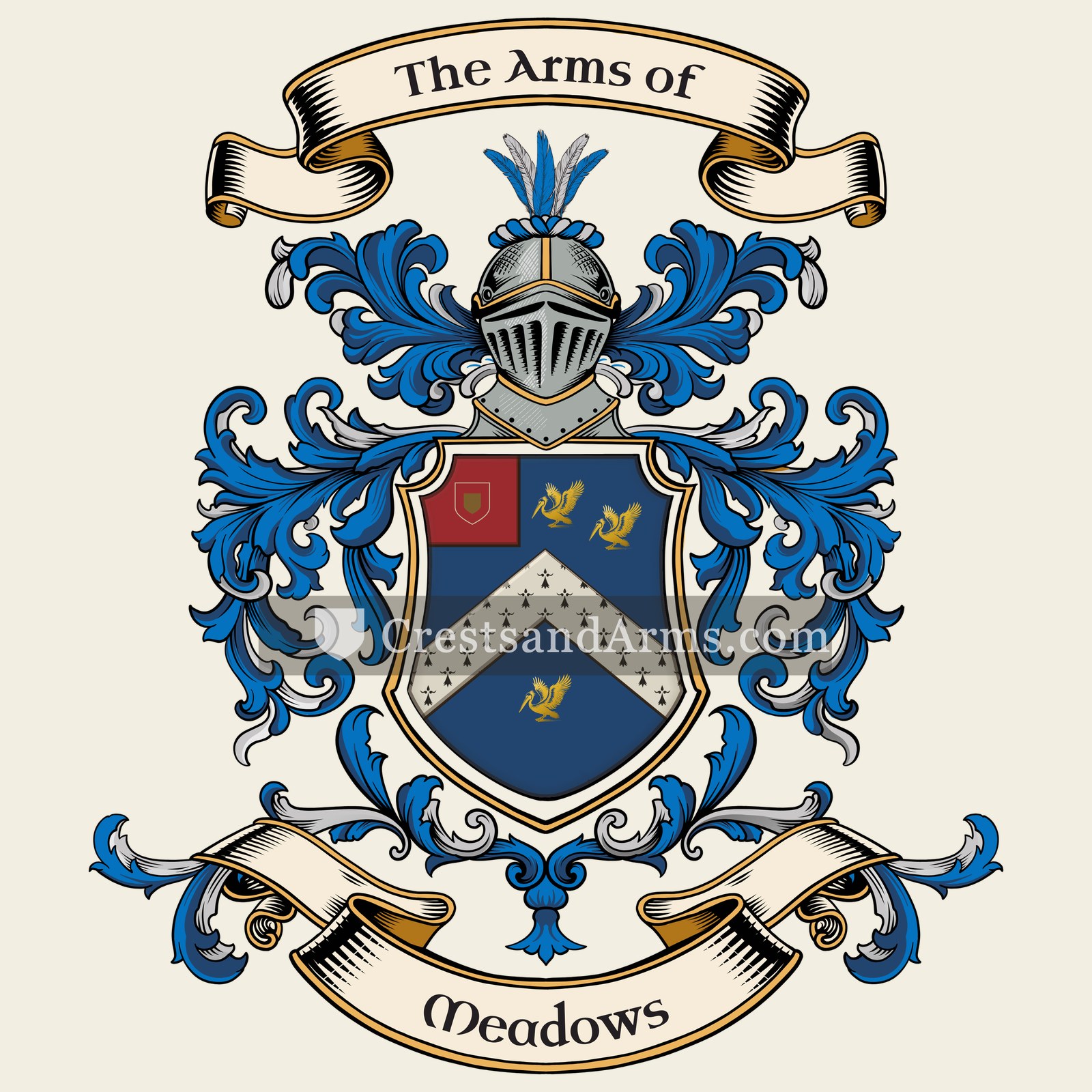
Symbols on this shield
chevronProtection, and faithful service completed
cantonA mark of honour granted by the sovereign
pelicanSelf-sacrifice and devotion to one's children
escutcheonA shield within a shield, and a claim inherited
Colours
Blue (Azure)Means: Loyalty and truth
ErmineMeans: Dignity
Red (Gules)Means: Military strength
Gold (Or)Means: Generosity
Historical info
Source
Sir Bernard Burke, The General Armory of England, Scotland, Ireland and Wales, London: Harrison & Sons, 1884
Blazon (the actual original written record)
“Az. a chev. erm. betw. three pelicans, wings endorsed or, vulned ppr. on a canton of the third an inescutcheon gu. charged with a lion pass. guard. or”
Irelandc. 1645
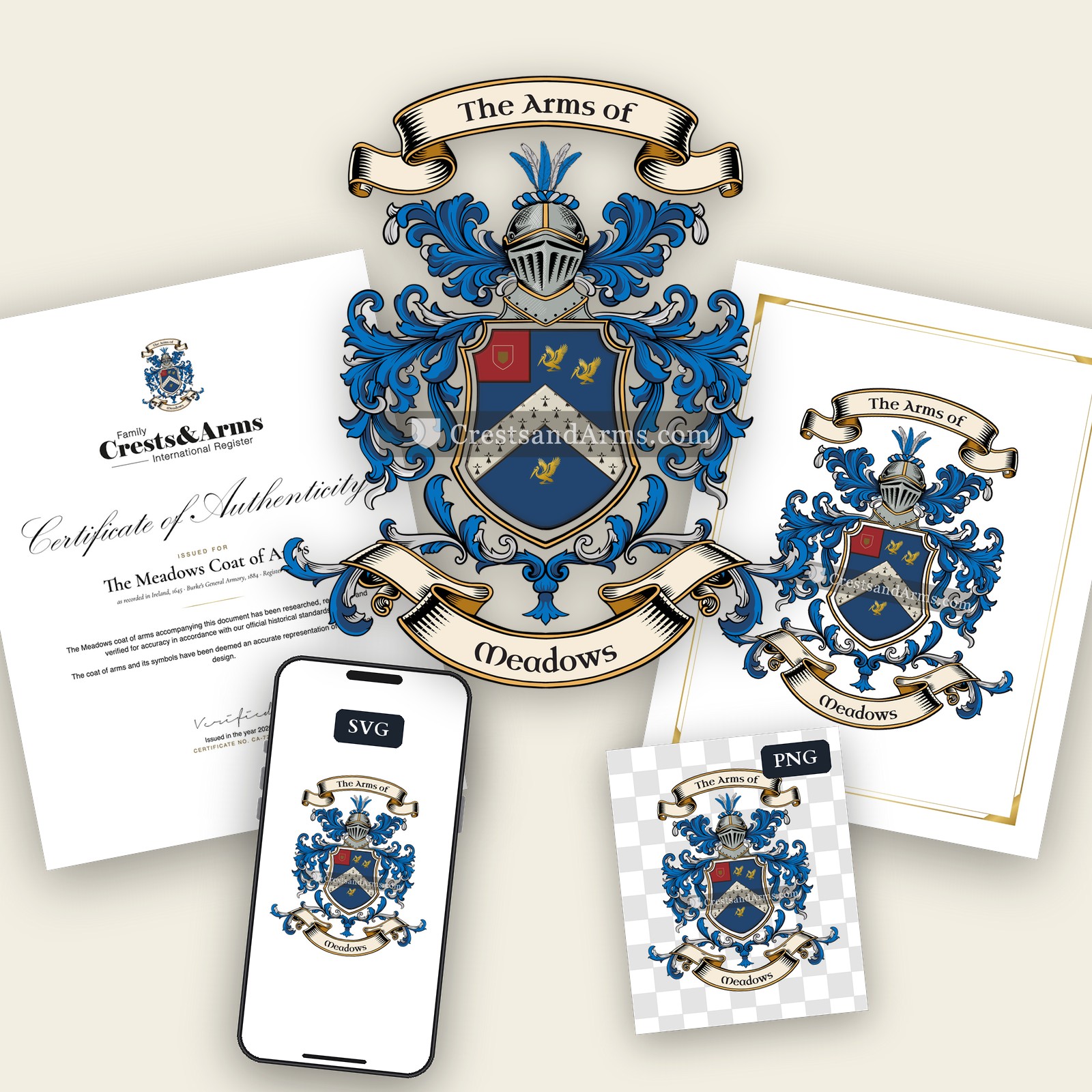
Digital archive packCoat of arms PNG, gold border print PDF, vector SVG and the certificate of authenticity. Sent to your email in minutes.
Map of Ireland showing where the Meadows arms are recorded
The Meadows arms were recorded in Ireland, c. 1645.
Arms such as these were typically recorded in Dublin.
Dublin was the seat of government in Ireland and the place where grants were sought and recorded. Families with business at the castle or the courts settled nearby, and settling there put their arms on record.
This is where the arms were entered in the register. Families often moved to other parts of the country, so the same name can turn up in more than one region.
The body that granted and recorded arms in Ireland in this period.
Charles I of England
Sovereign of the period
Charles I of England
1625–1649
Reigning in England when the Meadows arms are first recorded.
How Arms Worked in Ireland
The Ulster King of Arms granted coats of arms to individuals who proved their social standing and good character. These symbols were typically inherited by all legitimate descendants of the original holder. If a family branch wanted a unique look, they could apply for a specific change to their design through the office to ensure their identity remained distinct.
Granting authority
The Ulster King of Arms acted as the official body that regulated and issued all coats of arms throughout Ireland.
How they got arms
Families obtained their arms through formal grants issued by the office after proving their eligibility and paying the required fees.
Where arms were recorded
All official grants were recorded in the registers held by the Ulster King of Arms starting from the year 1552.
The family's standing
Recorded among the armigerous families of Ireland.
Origin & History of the Meadows Family in Ireland
The surname Meadows is primarily of English origin, but its presence in Ireland dates back to the mid-seventeenth century. Records confirm that members of the family were established in Dublin by 1645, a period defined by significant political and social upheaval in the region. During this time, many families from England migrated to Ireland as part of the broader administrative and military shifts occurring under the influence of the English Parliament. The name itself is topographical, meaning it was originally used to describe people who lived near a meadow or a grassy field. Once in Dublin, these early settlers integrated into the urban landscape of a city that was rapidly changing due to colonial expansion and trade. While the name remained more common in England, the branch of the family that settled in Ireland became part of the growing community of merchants and officials who helped shape the development of the capital city during the seventeenth century.
Meadows Meaning & Related Branches
Root word
mædwe
Old English term for a grassy area or pasture.
This name
MeadowsA topographic surname for someone who lived near a meadow or grassland.
also spelled
Meadowes
Medows
Medowes
Related arms
Stonesimilar arms
Documented Sources
Sir Bernard Burke, The General Armory of England, Scotland, Ireland and Wales, London: Harrison & Sons, 1884
Bardsley, Charles Wareing, A Dictionary of English and Welsh Surnames, 1901
Reaney, P.H., A Dictionary of British Surnames, 1958
Suffolk Archives, Parish Register Transcripts for Suffolk, 1620
Digital archive packCoat of arms PNG, gold border print PDF, vector SVG and the certificate of authenticity. Sent to your email in minutes.


 chevronProtection, and faithful service completed
 cantonA mark of honour granted by the sovereign
 labelThe eldest son, during his father's life
 pelicanSelf-sacrifice and devotion to one's children
 lionCourage, strength and royalty
 starThe celestial goddess, and nobility
 chevronProtection, and faithful service completed
 cantonA mark of honour granted by the sovereign
 labelThe eldest son, during his father's life
 pelicanSelf-sacrifice and devotion to one's children
 lionCourage, strength and royalty
 starThe celestial goddess, and nobility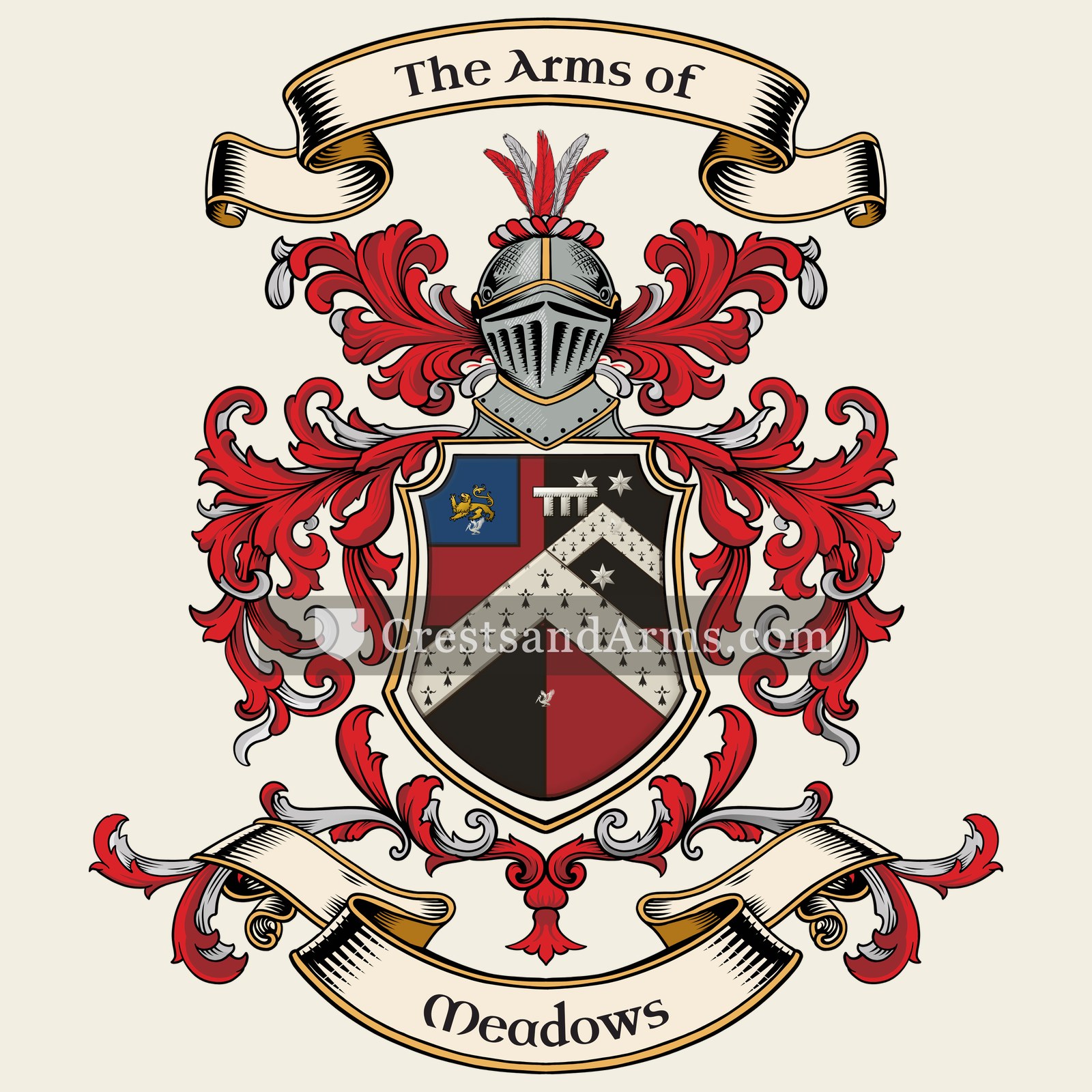


 escutcheonA shield within a shield, and a claim inherited