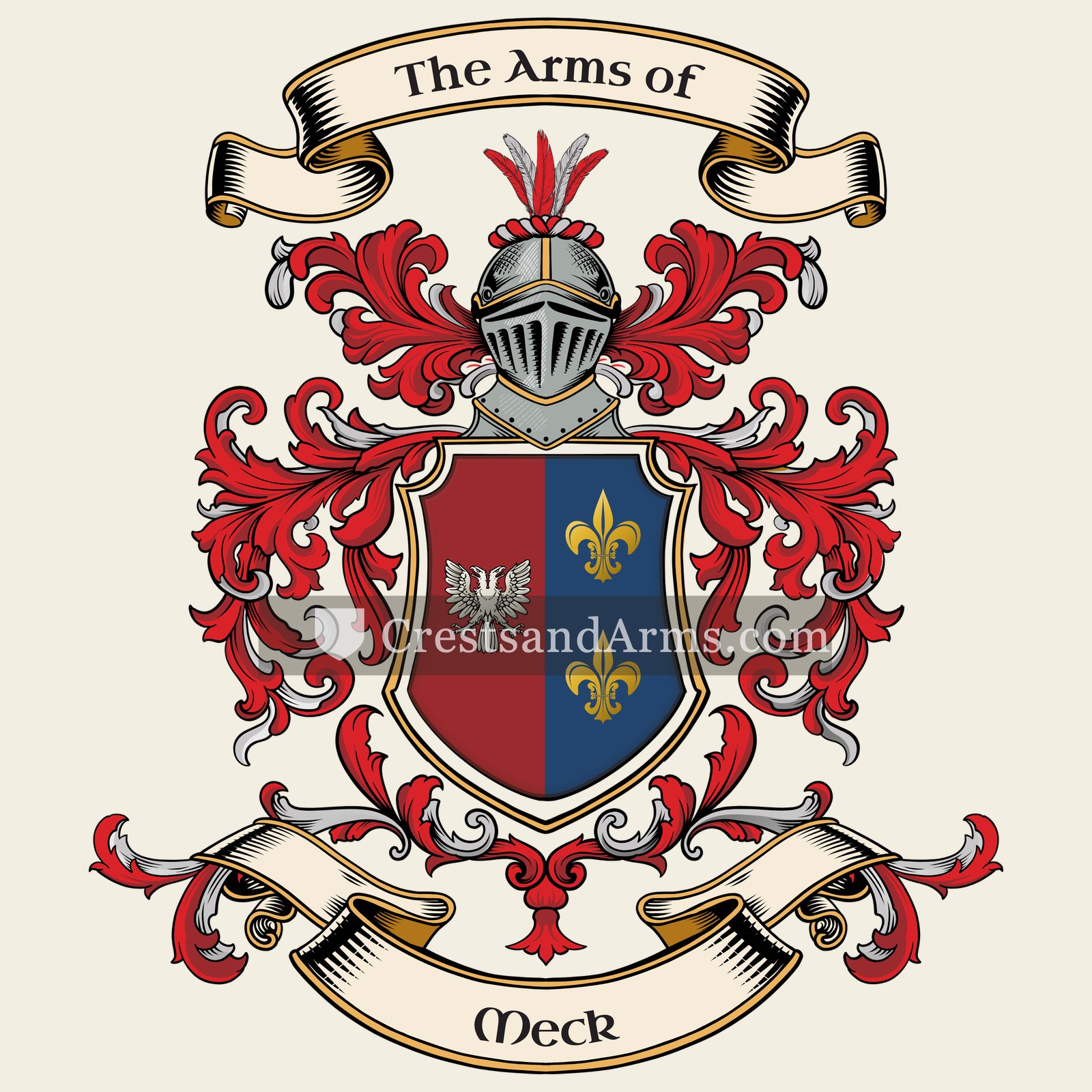
A record of documented arms, meaning and origin, researched for the Meck family lines. Documented in 2 countries.
Reg. 9660 · Swiss, M–O
Coat of Arms & Family Crest Details
Symbols on this shield
knightChivalry and service in arms
Colours
Red (Gules)Means: Military strength
Silver (Argent)Means: Peace and sincerity
Historical info
Source
J. B. Rietstap, Armorial Général, Gouda: G. B. van Goor Zonen, 1884–87
Blazon (the actual original written record)
“De gu. à un homme, hab. d'arg., le haut-de-chausses du même, les souliers de sa., coiffé d'un bonnet d'arg., tenant un bâton d'or. Cq.cour. C.: l'homme, iss. L. d'arg. et de gu.”
SwitzerlandBâle, c. 1745
Digital archive packCoat of arms PNG, gold border print PDF, vector SVG and the certificate of authenticity. Sent to your email in minutes.
Map of Switzerland showing where the Meck arms are recorded
The Meck arms were recorded in Bâle, c. 1745.
This is where the arms were entered in the register. Families often moved to other parts of the country, so the same name can turn up in more than one region.
The body that granted and recorded arms in Switzerland in this period.
How Arms Worked in Switzerland
In Switzerland, coats of arms were not restricted to the nobility and were often adopted by common citizens and families. These symbols were passed down through generations to show family identity. When branches of a family grew, they often changed small details of the design to distinguish their own line from the original group.
Granting authority
Cantonal and civic authorities managed the use of coats of arms within their specific regions and local jurisdictions.
How they got arms
Families typically assumed their own coats of arms based on local custom rather than receiving them from a central monarch.
Where arms were recorded
Arms were recorded in various cantonal and civic registers starting from the fourteenth century throughout the Swiss region.
The family's standing
Recorded among the armigerous families of Switzerland.
Origin & History of the Meck Family in Switzerland
The family name Meck has deep roots in the Swiss city of Basel, where records confirm members of the family were established by 1745. During this period, Basel was a thriving center for trade and craftsmanship, and families like the Mecks were often integrated into the local guild system. The name itself likely originated as a descriptive term or a shortened form of a longer Germanic name, reflecting the common naming patterns of the region during the late Middle Ages and the early modern era. As residents of a city known for its university and its position along the Rhine River, the early Meck family members would have lived in a society that valued literacy, civic participation, and professional specialization. By the mid-18th century, the family was part of the stable urban population that helped define the cultural and economic character of Basel before the major political shifts of the 19th century.
Coat of Arms & Family Crest Details
Symbols on this shield
cross symbolChristian faith and service
eagleNobility, strength and a keen mind
fleur de lisPurity, light, and the sixth son
Colours
Red (Gules)Means: Military strength
Blue (Azure)Means: Loyalty and truth
Silver (Argent)Means: Peace and sincerity
Gold (Or)Means: Generosity
Historical info
Source
J. B. Rietstap, Armorial Général, Gouda: G. B. van Goor Zonen, 1884–87
Blazon (the actual original written record)
“Parti: au 1 de gu. à la demi-aigle d'arg., mouv. du parti; au 2 d'azur à deux fleurs-de-lis d'or, l'une sur l'autre. C.: une couronne royale d'or, la croix du globe sommée d'une fleur-de-lis d'or. L.: à dextre d'arg. et d'or, à sen. d'azur et de gu.”
LivoniaLivonia, c. 1567
Digital archive packCoat of arms PNG, gold border print PDF, vector SVG and the certificate of authenticity. Sent to your email in minutes.
Map of Poland showing where the Meck arms are recorded
The Meck arms were recorded in Livonia, c. 1567.
Livonia was Baltic country held by a small number of landed families who kept their estates for centuries. Land there passed down whole rather than being divided, and long unbroken tenure is what fills a register.
This is where the arms were entered in the register. Families often moved to other parts of the country, so the same name can turn up in more than one region.
Region
Livonia
First recorded
1567
Granting Authority for the Meck Arms
Ennoblement by the Sejm
Author: Olek Remesz · CC BY-SA 3.0
The body that granted and recorded arms in Poland in this period.
Sigismund II Augustus
Sovereign of the period
Sigismund II Augustus
1530–1572
Reigning in Switzerland when the Meck arms are first recorded.
How Arms Worked in Poland
Polish noble families shared a single coat of arms across many different surnames, creating large clans rather than individual designs. These symbols were held collectively by all members of the clan regardless of their specific family name. When a new family joined the nobility, they were adopted into an existing clan and began using that group's established shield.
Granting authority
The Sejm, which was the Polish parliament, held the power to grant noble status and the right to bear arms.
How they got arms
Families typically received their coat of arms through a formal act of ennoblement granted by the Sejm for distinguished service.
Where arms were recorded
These grants were officially recorded in the Crown Metrica, which served as the central archive for state documents starting in the sixteenth century.
The family's standing
Recorded among the armigerous families of Livonia.
Origin & History of the Meck Family in Poland
The history of the Meck family is deeply intertwined with the shifting borders of the Baltic region and the influence of the Polish-Lithuanian Commonwealth. By the year 1567, records confirm that family members were established in Livonia, a territory that was then under the protection of the Polish Crown following the Union of Vilnius. During this era, the region served as a strategic frontier where families of German, Baltic, and Polish heritage often integrated into the local administration and military structures. As the Commonwealth expanded its reach, the Meck family likely navigated the complex political landscape of the 16th century by balancing their regional landholdings with the broader administrative requirements of the Polish state. This period of transition helped define their presence in the area, as they became part of the social fabric that connected the Baltic provinces to the cultural and political life of Poland.
Related Branches & Arms
Root word
Mago
A Latin term referring to a magician, sorcerer, or wise man.
This name
MeckDerived from a nickname for a person perceived as clever, cunning, or possessing magical knowledge.
also spelled
Mek
Mecke
Related arms
Mierzaniecsimilar arms
Röbernsimilar arms
Stophasiussimilar arms
Documented Sources
J. B. Rietstap, Armorial Général, Gouda: G. B. van Goor Zonen, 1884–87
Staatsarchiv Basel-Stadt, Bürgerverzeichnisse und Einwohnerregister der Stadt Basel, 1745
Burckhardt, August, Die Bürger von Basel, 1920
Historisches Lexikon der Schweiz, Basel (Stadt), 2002
Digital archive packCoat of arms PNG, gold border print PDF, vector SVG and the certificate of authenticity. Sent to your email in minutes.


 knightChivalry and service in arms
 knightChivalry and service in arms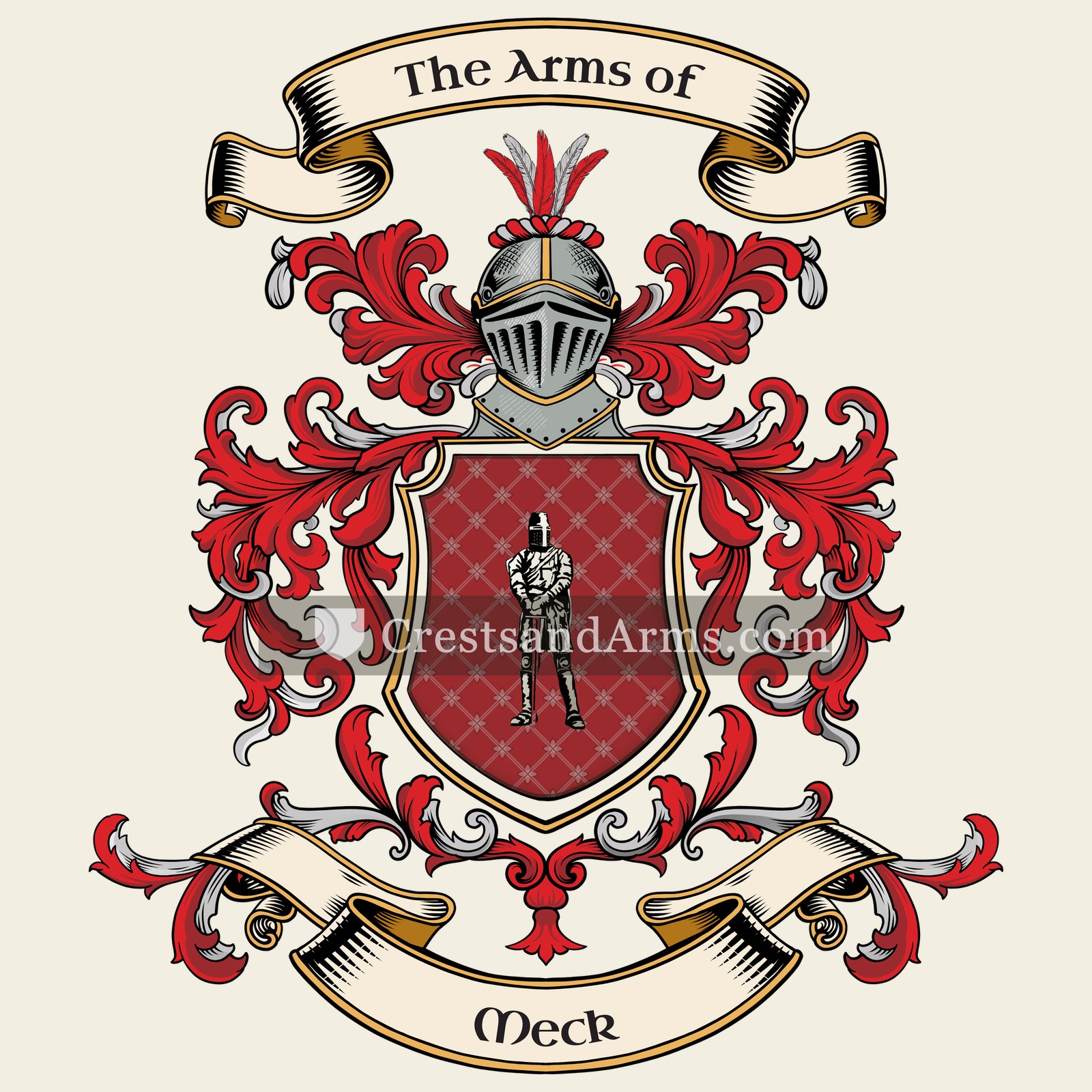

 cross symbolChristian faith and service
 eagleNobility, strength and a keen mind
 fleur de lisPurity, light, and the sixth son