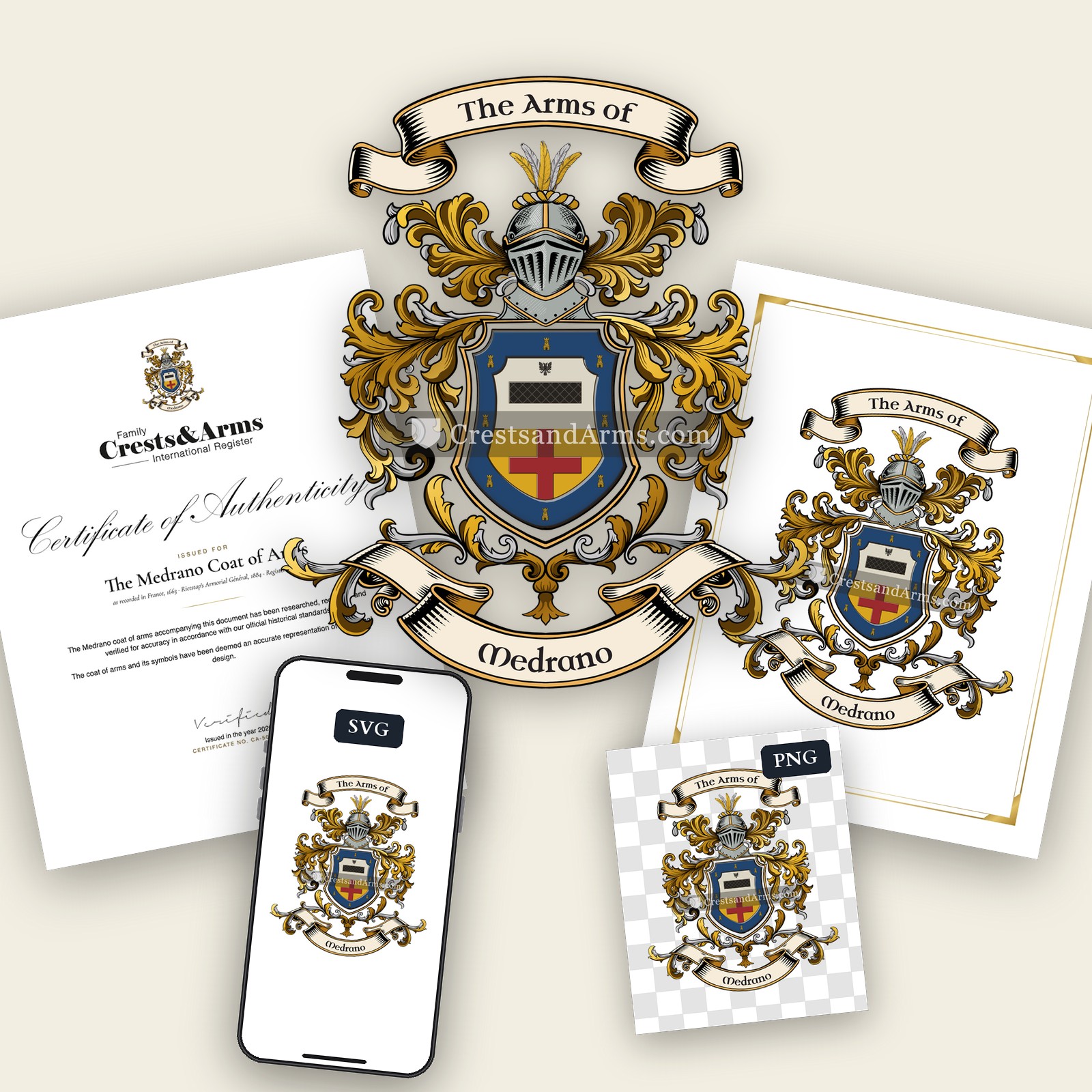
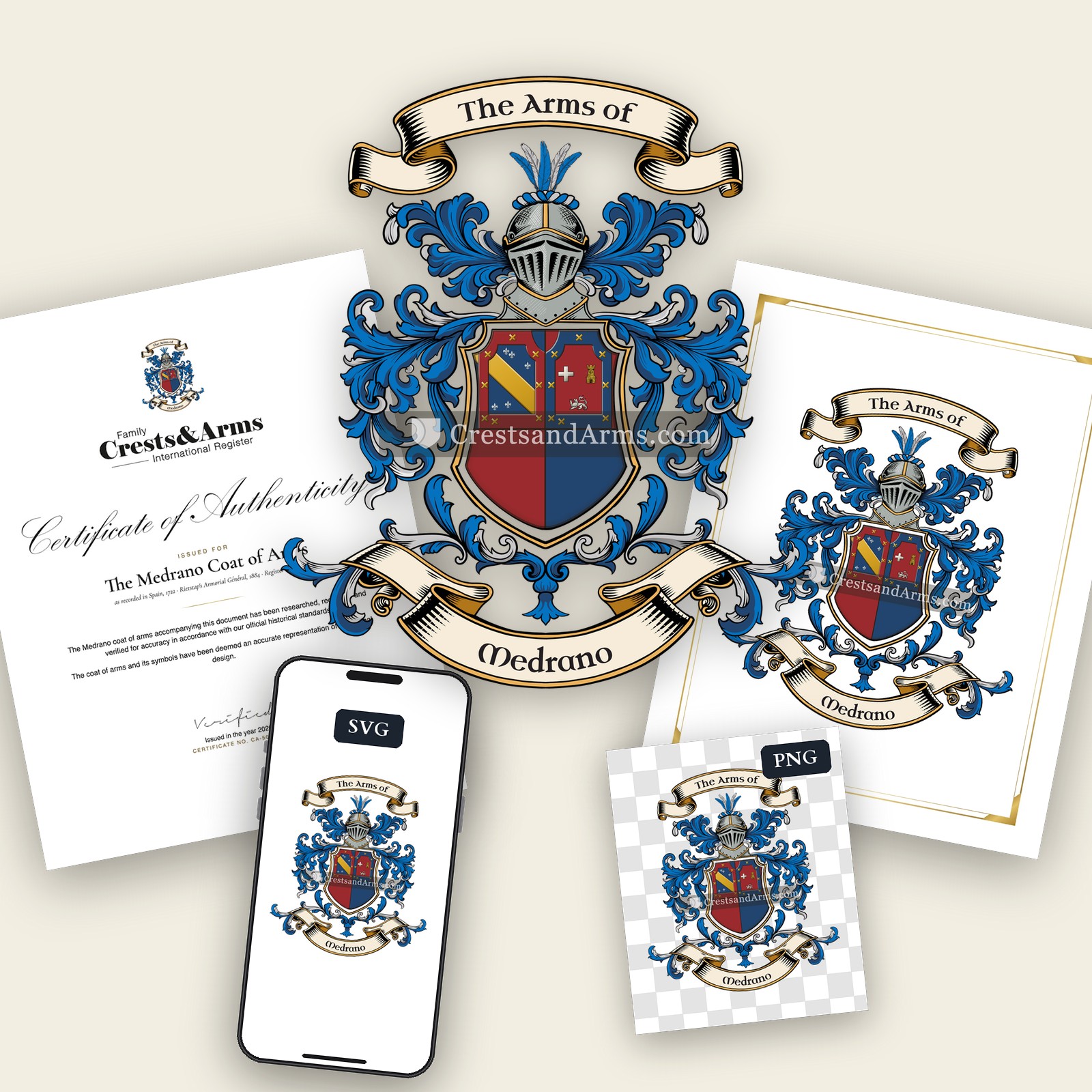
A record of documented arms, meaning and origin, researched for the Medrano family lines. Documented in 2 countries.
Reg. 5078 · French, M–O
Coat of Arms & Family Crest Details
Symbols on this shield
fessThe military belt, and readiness to serve
cross symbolChristian faith and service
towerGrandeur and solidity, and a stronghold defended
eagleNobility, strength and a keen mind
Colours
Silver (Argent)Means: Peace and sincerity
Gold (Or)Means: Generosity
Blue (Azure)Means: Loyalty and truth
Black (Sable)Means: Constancy
Red (Gules)Means: Military strength
Historical info
Source
J. B. Rietstap, Armorial Général, Gouda: G. B. van Goor Zonen, 1884–87
Blazon (the actual original written record)
“Coupé: au 1 d'arg. à la fasce de sa., acc. en chef d'une aigle du même, tenant en son bec un listel d'azur, ch. des mots AVE, ORA d'arg.; au 2 d'or à la croix treflée de gu. L'écu entouré d'une bord. d'azur, ch. de huit tours d'or.”
LanguedocLanguedoc, c. 1663
Digital archive packCoat of arms PNG, gold border print PDF, vector SVG and the certificate of authenticity. Sent to your email in minutes.
Map of France showing where the Medrano arms are recorded
The Medrano arms were recorded in Languedoc, c. 1663.
Languedoc stretched across the south of France, a country of small towns, vineyards and old local families. Its gentry were numerous rather than grand, and a great many of them held arms even where their estates were modest.
This is where the arms were entered in the register. Families often moved to other parts of the country, so the same name can turn up in more than one region.
The body that granted and recorded arms in France in this period.
Louis XIV of France
Sovereign of the period
Louis XIV of France
1643–1715
Reigning in France when the Medrano arms are first recorded.
How Arms Worked in France
In France, a coat of arms was a mark of honor that passed down through the male line to all legitimate descendants. Families often used the same shield without changes to show their shared heritage. If a branch wanted to stand out, they could add a small mark to their shield to show their specific place in the family tree.
Granting authority
The Juge d'armes de France acted as the official authority that regulated and verified coats of arms across the country.
How they got arms
Families typically inherited their arms from ancestors, though they could also receive them through royal grants or by proving their noble status.
Where arms were recorded
Coats of arms were officially recorded in the Armorial Général de France, which began its main collection in the year 1696.
The family's standing
Recorded among the armigerous families of Languedoc.
Origin & History of the Medrano Family in France
The history of the Medrano family in France is deeply connected to the cultural landscape of the Languedoc region during the seventeenth century. By 1663, records confirm that members of the family had established a presence in this southern area, which was known for its distinct linguistic traditions and complex social structure. During this period, families in Languedoc often navigated the shifts between local customs and the growing influence of the centralized French state. The Medrano name likely arrived in this region through historical migration patterns that linked the Iberian Peninsula with southern France. As these individuals settled into the local community, they participated in the agricultural and civic life that defined the province. Their early presence reflects the broader movement of people across the Pyrenees, where families sought new opportunities while maintaining their unique heritage within the French kingdom.
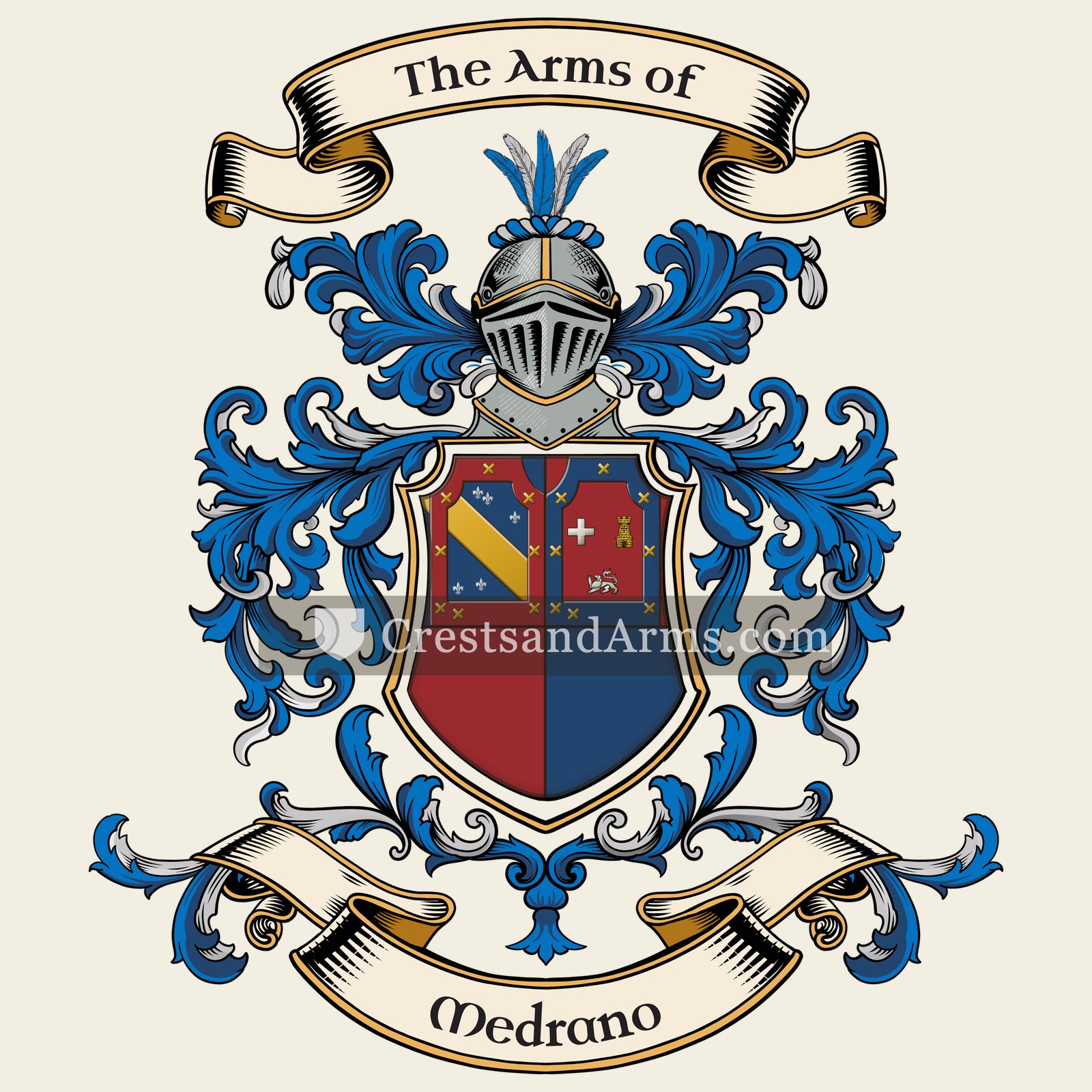
Coat of Arms & Family Crest Details
Symbols on this shield
bendDefence, and the scarf of a commander
cross symbolChristian faith and service
fleur de lisPurity, light, and the sixth son
saltire coupedResolution, and the cross of St Andrew
towerGrandeur and solidity, and a stronghold defended
lionCourage, strength and royalty
Colours
Blue (Azure)Means: Loyalty and truth
Red (Gules)Means: Military strength
Gold (Or)Means: Generosity
Silver (Argent)Means: Peace and sincerity
Historical info
Source
J. B. Rietstap, Armorial Général, Gouda: G. B. van Goor Zonen, 1884–87
Blazon (the actual original written record)
“Parti: au 1 coupé a. d'azur à cinq fleurs-de-lis d'arg., 2, 1 et 2, et un bord. de gu. ch. de huit flanchis d'or; b. de gu. à trois bandes d'or, et une bord. d'azur, ch. de huit flanchis d'or; au 2 tiercé en fasce: a. d'or à la croix florencée de gu.; b. de gu. à un château d'or; c. d'arg. au lion de gu., cour. d'or.”
SpainRequena Castille, c. 1722
Digital archive packCoat of arms PNG, gold border print PDF, vector SVG and the certificate of authenticity. Sent to your email in minutes.
Map of Spain showing where the Medrano arms are recorded
The Medrano arms were recorded in Requena Castille, c. 1722.
This is where the arms were entered in the register. Families often moved to other parts of the country, so the same name can turn up in more than one region.
The body that granted and recorded arms in Spain in this period.
Philip V of Spain
Sovereign of the period
Philip V of Spain
1714–1724
Reigning in France when the Medrano arms are first recorded.
How Arms Worked in Spain
In Spain, a coat of arms was considered a form of property that belonged to the entire family line. These arms were passed down from a father to all his children equally. Younger branches of the family usually kept the original design without needing to add any special marks to distinguish their specific line.
Granting authority
The Cronista Rey de Armas was the official body that regulated and granted coats of arms throughout Spain.
How they got arms
Families often obtained their arms through royal grants or by proving their noble status to the official heraldic authority.
Where arms were recorded
Coats of arms were officially recorded in the registers of the Cronista Rey de Armas starting in 1496.
The family's standing
Recorded among the armigerous families of Spain.
Origin & History of the Medrano Family in Spain
The surname Medrano finds its roots in the rugged landscapes of northern Spain, specifically within the region of La Rioja. The name is topographic in origin, derived from the Basque words "mendi," meaning mountain, and "arano," meaning eagle, which together suggest a family that originated from a place known as the eagle's mountain. Over many centuries, families bearing this name migrated from these northern highlands toward the central and southern parts of the Iberian Peninsula. By the early 18th century, the Medrano family had established a firm presence in the town of Requena. Records from 1722 confirm that members of the family were active participants in the local community of this historic town, which served as a vital crossroads between the kingdoms of Castile and Valencia. This transition from the northern mountains to the agricultural plains of Requena reflects the broader movement of families seeking new opportunities for land and trade during the Spanish Bourbon period.
Medrano Meaning & Related Branches
Root word
Mederanus
Derived from the Latin term for a boundary or a middle marker.
This name
MedranoRefers to a person who lived near a boundary, landmark, or central dividing line.
Related arms
Esparzarecorded with Medrano, same area
Mergelinarecorded with Medrano, same area
Mirandarecorded with Medrano, same area
Documented Sources
J. B. Rietstap, Armorial Général, Gouda: G. B. van Goor Zonen, 1884–87
Archives départementales de l'Hérault, Registres paroissiaux et d'état civil de l'Hérault, 1663
Ladurie, Emmanuel Le Roy, Les Paysans de Languedoc, 1966
Wolff, Philippe, Histoire du Languedoc, 1967
Digital archive packCoat of arms PNG, gold border print PDF, vector SVG and the certificate of authenticity. Sent to your email in minutes.


 fessThe military belt, and readiness to serve
 cross symbolChristian faith and service
 towerGrandeur and solidity, and a stronghold defended
 eagleNobility, strength and a keen mind
 fessThe military belt, and readiness to serve
 cross symbolChristian faith and service
 towerGrandeur and solidity, and a stronghold defended
 eagleNobility, strength and a keen mind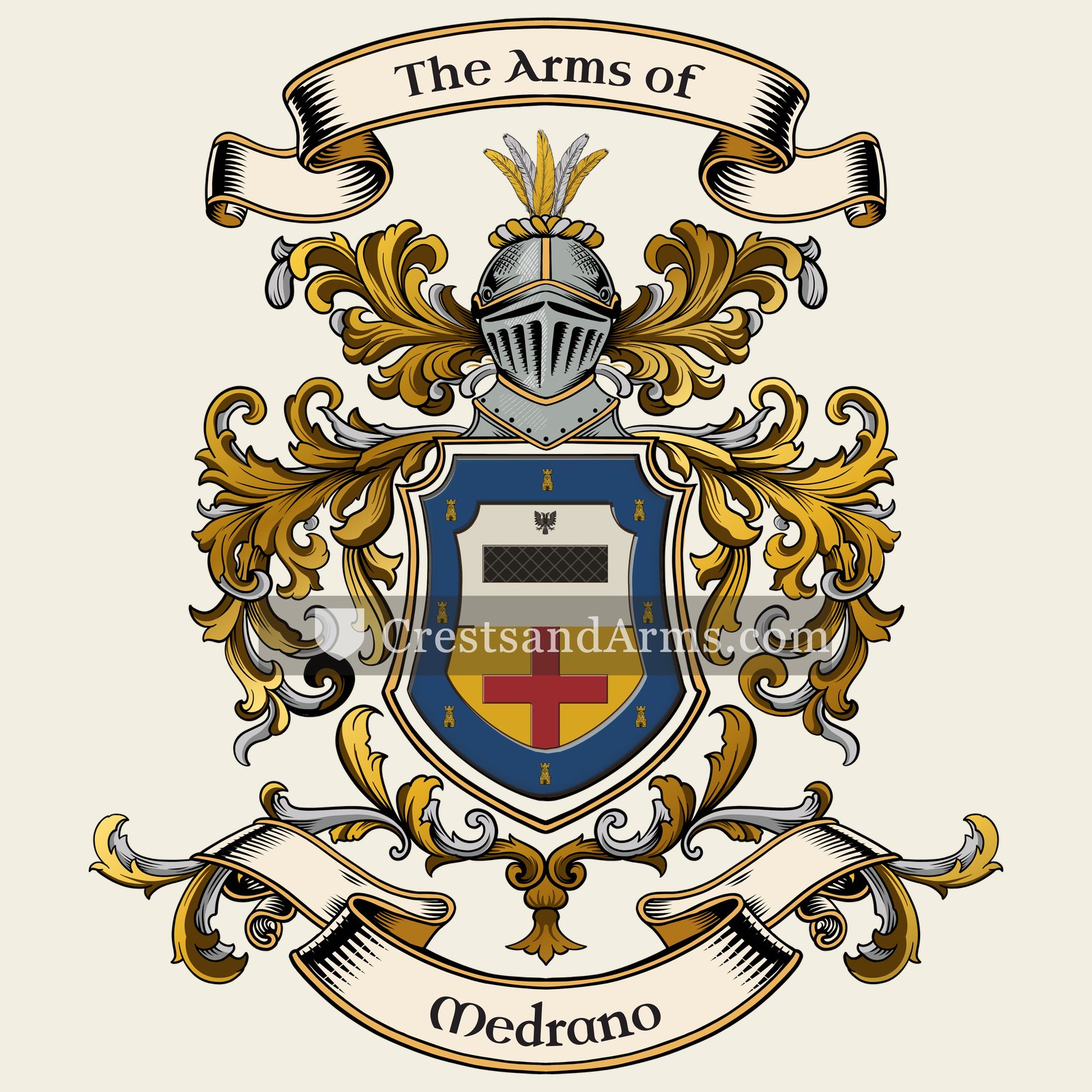


 bendDefence, and the scarf of a commander
 fleur de lisPurity, light, and the sixth son
 saltire coupedResolution, and the cross of St Andrew
 lionCourage, strength and royalty