Map of Germany showing where the Mehalic arms are recorded
The Mehalic arms were recorded in Augsbourg, c. 1765.
This is where the arms were entered in the register. Families often moved to other parts of the country, so the same name can turn up in more than one region.
The body that granted and recorded arms in Germany in this period.
Francis I, Holy Roman Emperor
Sovereign of the period
Francis I, Holy Roman Emperor
1745–1765
Reigning in Germany when the Mehalic arms are first recorded.
How Arms Worked in Germany
In the Holy Roman Empire, coats of arms were often granted to individuals by the Emperor or his representatives. These arms were then passed down through the generations to all legitimate descendants of the original holder. Younger branches of a family usually kept the same shield design without needing to change it, as the arms belonged to the entire lineage.
Granting authority
The Holy Roman Emperor held the sole power to grant new coats of arms throughout his vast imperial territories.
How they got arms
Families typically obtained their coats of arms through a formal imperial grant or by proving their noble status to the authorities.
Where arms were recorded
These grants were officially recorded in the Imperial Chancery registers, which began keeping formal records of such honors during the Middle Ages.
The family's standing
Recorded among the armigerous families of Germany.
Origin & History of the Mehalic Family in Germany
The name Mehalic is rooted in the Slavic linguistic tradition, where it likely evolved as a patronymic surname derived from the given name Mihal or Michael. By the middle of the eighteenth century, members of the family had established a presence in the city of Augsburg, which was then a prominent center for trade and craftsmanship within the Holy Roman Empire. During this period, Augsburg served as a vital crossroads for people moving between Central and Eastern Europe. Families like the Mehalics often migrated to such urban hubs to pursue opportunities in skilled trades or commerce. Their presence in the city records by 1765 suggests that they were integrated into the local social fabric during a time of significant economic transition. This movement reflects the broader historical pattern of families seeking stability and professional growth in the bustling markets of the German-speaking lands.
Mehalic Meaning & Related Branches
Root word
Mihail
Hebrew origin meaning who is like God
This name
MehalicA patronymic surname derived from the given name Michael meaning follower or son of Michael
also spelled
Muhlich
Meelik
Muelik
Documented Sources
J. B. Rietstap, Armorial Général, Gouda: G. B. van Goor Zonen, 1884–87
Bauer, Hermann. Geschichte der Stadt Augsburg. 1984
Kohl, Wilhelm. Die Einwanderung in die deutschen Städte des 18. Jahrhunderts. 1972
Stadtarchiv Augsburg, Bürgeraufnahmen und Zunftprotokolle
Digital archive packCoat of arms PNG, gold border print PDF, vector SVG and the certificate of authenticity. Sent to your email in minutes.


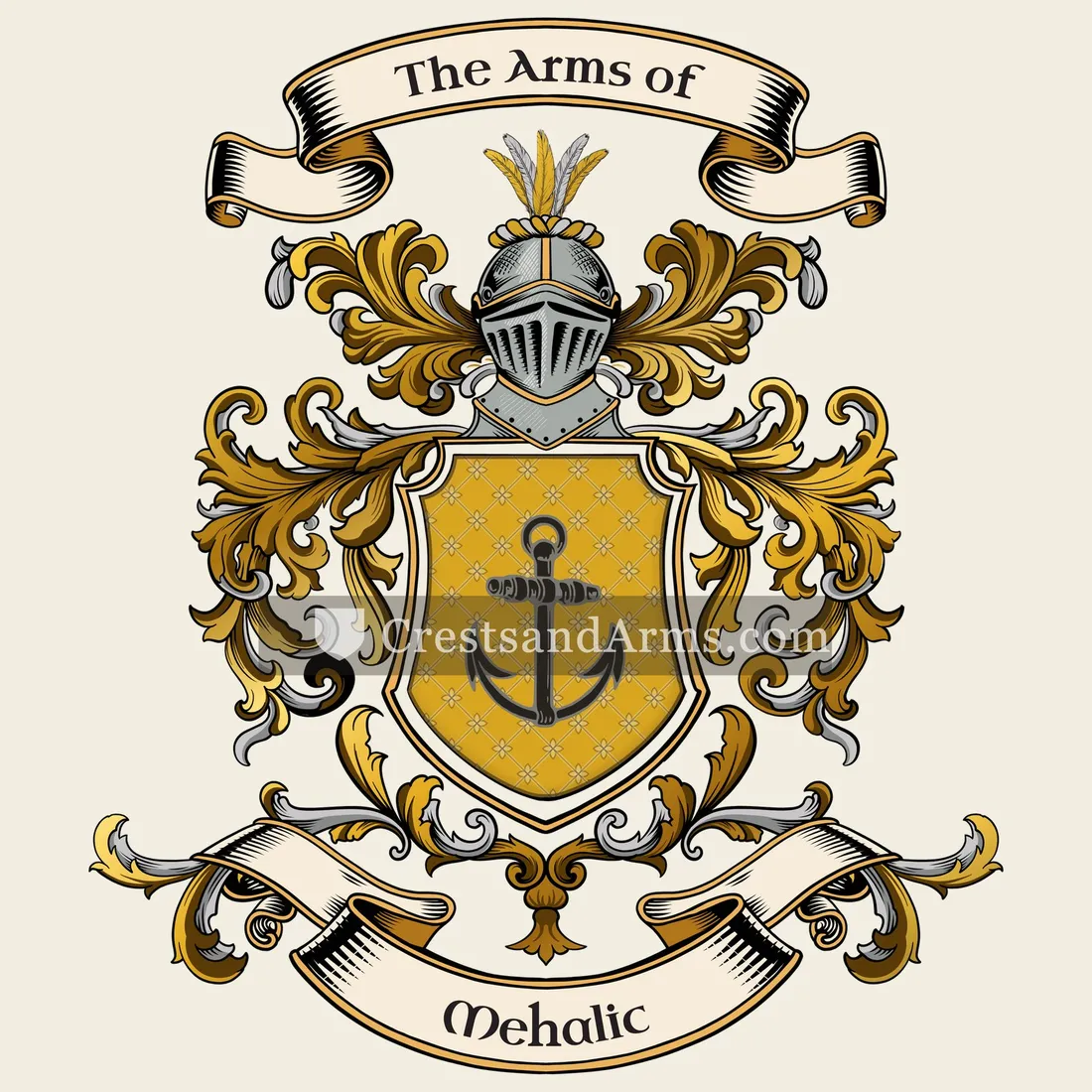
 anchorHope, and steadfastness in trouble
 anchorHope, and steadfastness in trouble