Map of France showing where the Mell arms are recorded
The Mell arms were recorded in Picardie, c. 1663.
Picardie lay on the northern road into France and saw armies pass through it repeatedly. Its landowners were soldiers as often as farmers, and a soldier needed a shield he could be recognised by.
This is where the arms were entered in the register. Families often moved to other parts of the country, so the same name can turn up in more than one region.
The body that granted and recorded arms in France in this period.
Louis XIV of France
Sovereign of the period
Louis XIV of France
1643–1715
Reigning in France when the Mell arms are first recorded.
How Arms Worked in France
In France, a coat of arms was a mark of honor that passed down through the male line to all legitimate descendants. Families often used the same shield without changes to show their shared heritage. If a branch wanted to stand out, they could add a small mark to their shield to show their specific place in the family tree.
Granting authority
The Juge d'armes de France acted as the official authority that regulated and verified coats of arms across the country.
How they got arms
Families typically inherited their arms from ancestors, though they could also receive them through royal grants or by proving their noble status.
Where arms were recorded
Coats of arms were officially recorded in the Armorial Général de France, which began its main collection in the year 1696.
The family's standing
Recorded among the armigerous families of Picardie.
Origin & History of the Mell Family in France
The family name Mell traces its early roots to the historical province of Picardie in northern France. By the year 1663, records confirm that members of the family were well-established within this region. During the seventeenth century, Picardie was a vital area known for its agricultural production and its strategic location near the border of the Spanish Netherlands. Families living in this part of France often worked as skilled laborers or landowners who contributed to the local economy of the rural villages. Life in Picardie during this time was shaped by the influence of the Catholic Church and the evolving administrative policies of the French monarchy. As the Mell family settled into this environment, they became part of the long-standing social fabric of the region, living through a period of significant transition in French history.
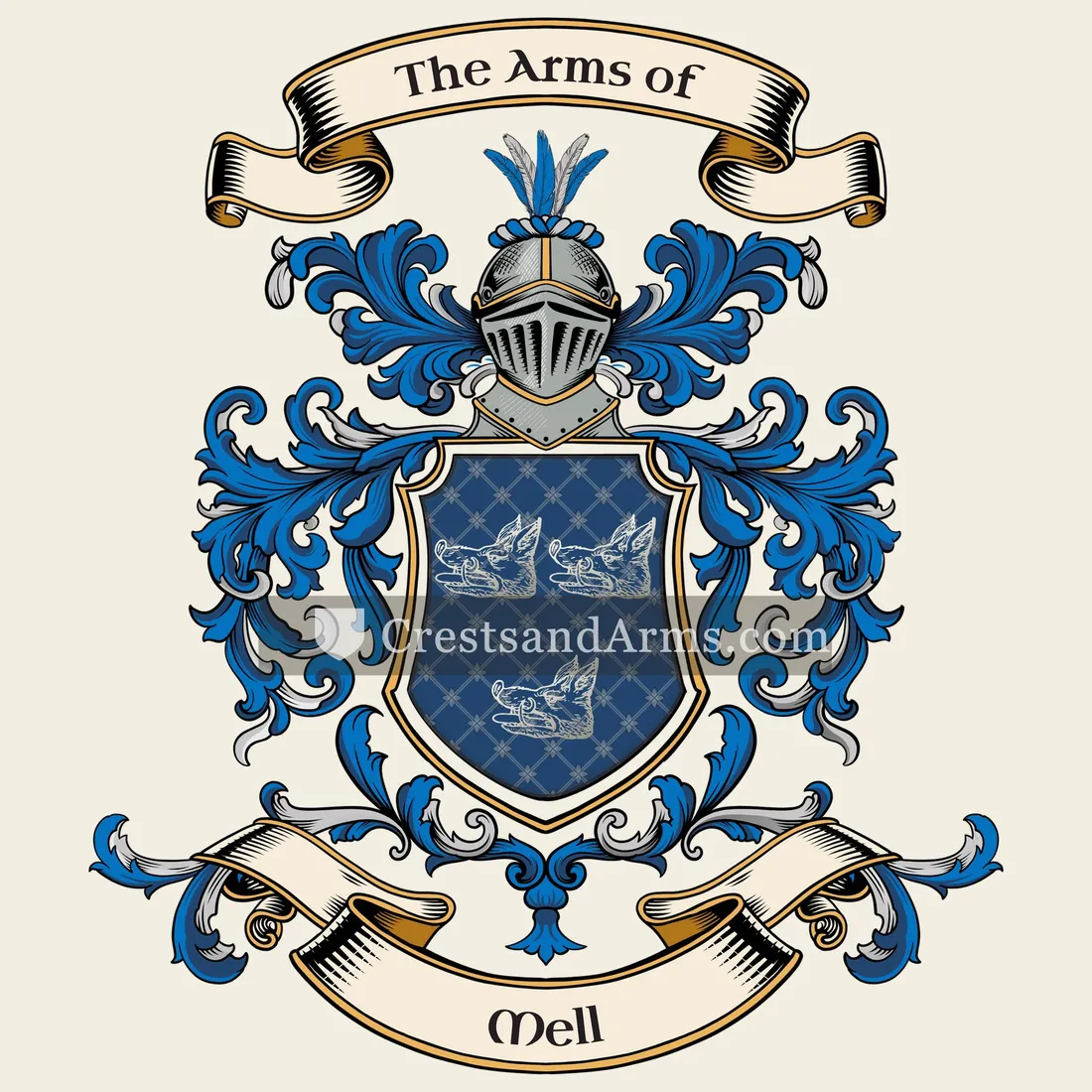
Meaning of the Mell family crest colors & symbols
Symbols on this shield
boars headA fierce fighter who battles to the end
Colours
Blue (Azure)Means: Loyalty and truth
Silver (Argent)Means: Peace and sincerity
Historical info
Source
Sir Bernard Burke, The General Armory of England, Scotland, Ireland and Wales, London: Harrison & Sons, 1884
Blazon (the actual original written record)
“Az. three boars' heads erased in bend ar”
Englandc. 1620
Digital archive packCoat of arms PNG, gold border print PDF, vector SVG and the certificate of authenticity. Sent to your email in minutes.
Map of England showing where the Mell arms are recorded
The Mell arms were recorded in England, c. 1620.
Arms such as these were typically recorded in York.
Yorkshire is the largest of the English counties, and it held more gentry families than any other. Land there was split among a great many households rather than a few, so a great many of them carried arms.
This is where the arms were entered in the register. Families often moved to other parts of the country, so the same name can turn up in more than one region.
The body that granted and recorded arms in England in this period.
James VI and I
Sovereign of the period
James VI and I
1603–1625
Reigning in France when the Mell arms are first recorded.
How Arms Worked in England
English heraldry allowed arms to be shared by all legitimate descendants of the original owner. These symbols were treated as personal property that moved through the generations to all children. While the eldest son kept the original design, other family members could use the same shield without needing to change it or register their own unique versions.
Granting authority
The College of Arms in London has regulated the use of coats of arms throughout England and Wales since 1484.
How they got arms
Families typically obtained their coats of arms through a formal grant from the Crown or by proving their ancient right to them.
Where arms were recorded
All official coats of arms are recorded in the registers kept at the College of Arms, which date back to the fifteenth century.
The family's standing
Recorded among the armigerous families of England.
Origin & History of the Mell Family in England
The surname Mell has deep roots in the northern regions of England, particularly within the historic city of York. By the year 1620, records confirm that members of the family were already established residents of this area. During the seventeenth century, York was a bustling center of trade and religious life, and families like the Mells often played a role in the local economy. The name itself is thought to have originated as a descriptive nickname or a locational reference, possibly derived from the Middle English word for a mill or a specific geographic feature near a stream. As the family grew, they became part of the social fabric of Yorkshire, living through a time of significant political and cultural change in England. Their presence in the city during this era suggests they were likely involved in the common trades and civic duties that defined life in a major provincial hub.
Mell Meaning & Related Branches
Root word
Mel
Derived from the Latin word for honey.
This name
MellA topographic name for someone living near a honey-producing area or a sweet-natured person.
also spelled
Melo
Mellow
Mellou
Documented Sources
J. B. Rietstap, Armorial Général, Gouda: G. B. van Goor Zonen, 1884–87
Archives départementales de la Somme, Registres paroissiaux et d'état civil
Boulanger, Jacques, La vie en Picardie au XVIIe siècle, 1928
Lottin, Alain, Histoire de la Picardie, 1974
Digital archive packCoat of arms PNG, gold border print PDF, vector SVG and the certificate of authenticity. Sent to your email in minutes.


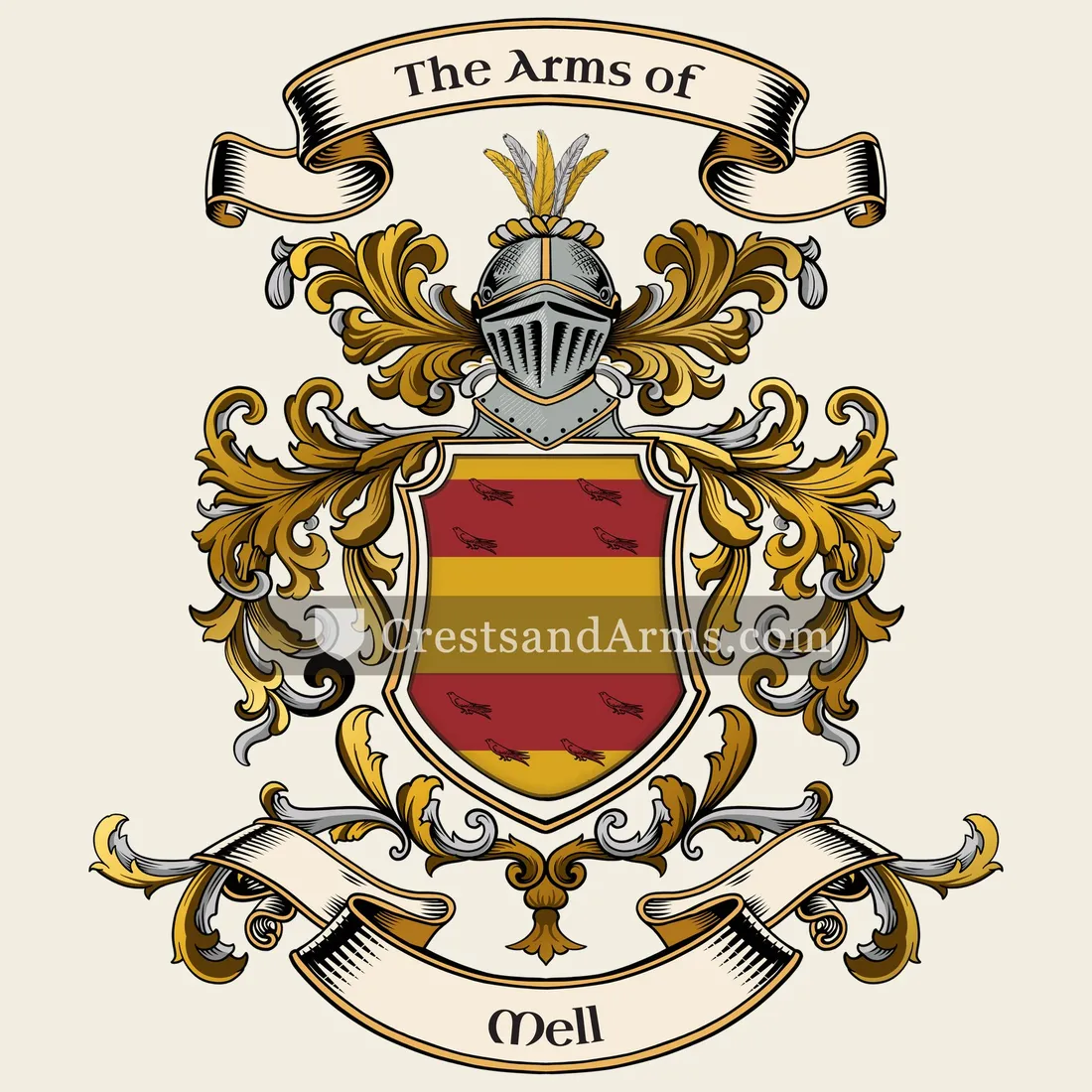
 fessThe military belt, and readiness to serve
 martletA younger son, who must win his own land
 fessThe military belt, and readiness to serve
 martletA younger son, who must win his own land


 boars headA fierce fighter who battles to the end